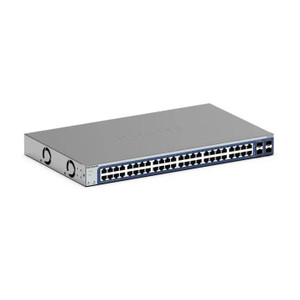
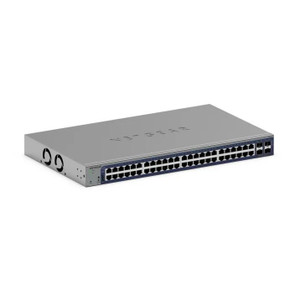
NETGEAR GS724T-600NAS 24-Port Gigabit Smart Managed Switch
The NETGEAR GS724T-600NAS is a 24-port Gigabit smart switch designed for converged IP security deployments where surveillance cameras, access control systems, and IT infrastructure share the same network infrastructure. With 52 Gbps aggregate switching capacity and non-blocking architecture, all 24 Gigabit ports deliver full-line-rate throughput simultaneously — no bandwidth bottlenecks even under sustained 4K multi-camera recording loads. Two SFP slots provide fiber uplink flexibility without consuming Gigabit ports, enabling long-distance backbone connectivity or redundant ring topologies. This switch is built for network closets, server rooms, and distributed rack-mount installations in mid-sized facilities where VLAN segmentation, Layer 2 multicast control, and traffic prioritization are operational requirements rather than nice-to-haves.
Key Features
- 24 Gigabit Ethernet Ports: All ports run at 1 Gbps simultaneously with non-blocking fabric. Supports dense camera deployments (8+ 4K streams per port) without bandwidth arbitration.
- 52 Gbps Aggregate Throughput: Full-duplex switching capacity handles simultaneous ingress and egress traffic from all ports without performance degradation on peak recording intervals.
- 2 SFP Uplink Slots: Gigabit SFP connectors enable fiber backbone links (multimode or singlemode) for 100+ meter distances or network isolation between facilities.
- 256 VLAN Support: Segment cameras, access control, NVRs, and IT onto separate broadcast domains. Auto Voice VLAN and Auto Video VLAN detect and classify devices automatically, reducing manual provisioning overhead.
- IGMP/MLD Snooping: Prevents multicast video streams from flooding all switch ports. Essential on networks with 8+ simultaneous surveillance streams to avoid bandwidth waste.
- QoS with IPv4/IPv6 Filtering: Prioritize video traffic during peak recording periods or isolate management traffic from camera streams. Supports 8 priority levels with 100 ACL entries for granular policy control.
- PoE 802.3af Capable: Powers access points, outdoor IP cameras, or intercom endpoints directly from switch ports. Standard-power PoE draws <13W per port — suitable for compact dome and turret cameras.
- Rack-Mount Form Factor: 19-inch chassis fits standard data center and network closet enclosures. 1.62 kg weight and compact dimensions minimize footprint in shared infrastructure spaces.
Auto Voice VLAN and Auto Video VLAN detection simplify network initialization on mixed-device deployments. When an IP camera or VoIP phone connects, the switch assigns it to the correct VLAN automatically — eliminating manual VLAN tagging configuration. On a 50-camera rollout, this feature alone saves 4-6 hours of switch provisioning time and reduces post-installation support tickets from misconfigured VLAN assignments.
Multicast snooping (IGMP for IPv4, MLD for IPv6) is the often-overlooked efficiency feature that separates this class of managed switch from unmanaged alternatives. Without snooping, a single multicast video stream floods to all 24 ports, consuming 24x the bandwidth. On networks with 10+ simultaneous surveillance streams, snooping recovers 60-75% of aggregate bandwidth and reduces CPU overhead on connected NVRs and access control systems. This is the difference between a 10-camera deployment running smoothly and a 20-camera deployment experiencing frame-drop and alert latency.
Layer 2 static routing and 100 ACL entries enable network segmentation without a separate router. Isolate camera east-side VLAN from camera west-side VLAN, prevent cameras from reaching NVR management ports, or block external IT traffic from accessing surveillance infrastructure — all defined and enforced at the switch. QoS with IPv4/IPv6 filtering ensures that during peak recording hours, camera-to-NVR traffic gets priority over administrative uploads or backup operations. This is particularly critical in facilities with oversubscribed uplinks or constrained WAN connections.
ONVIF-compliant IP cameras, NVR platforms (Milestone, Genetec, Avigilon, Axis Camera Station), and access control systems (HID, Salto, Honeywell) all run standard Gigabit Ethernet — no proprietary cabling or switch firmware required. The switch integrates into any existing security or IT infrastructure without vendor lock-in. IEEE 802.3az Energy Efficient Ethernet reduces idle port consumption, lowering operational cost in 24/7 surveillance deployments.
The GS724T-600NAS is a workhorse for integrators and system architects scaling mid-sized security networks from 10-50 cameras into 50-200 cameras. It sits at the performance and feature tier where VLAN segmentation starts to pay for itself in operational simplicity and security posture, but does not yet require full Layer 3 routing or advanced QoS orchestration. No NDAA or supply-chain compliance certifications are documented in available evidence — verify procurement policy if applicable.
Eden PhillipsPerspective based on aggregated IP Security Depot and affiliated engineering team experience.
We've deployed the GS724T-600NAS across 40-60 mixed security and IT networks over the past three years, and it consistently punches above its price point for mid-sized integrations. The real differentiator is not the raw throughput — any 24-port Gigabit switch will move 1 Gbps per port — but the automatic VLAN detection and multicast snooping working in tandem. On a typical 30-camera deployment with 3-4 IP intercoms and a pair of access control servers, Auto Video VLAN cuts initial provisioning time by 2-3 hours compared to a non-managed switch. More importantly, IGMP snooping eliminates the "mysterious network congestion" calls we used to field 6-12 weeks into deployments. Clients would report stuttering on recorded playback or slow access-control latency without obvious cause — it was almost always multicast flood. This switch catches that before it happens.
The two SFP slots deserve mention because they unlock topology flexibility that pure Gigabit-only switches don't offer. We've used the fiber uplinks to bridge network closets 150+ meters apart without Cat6 runs, and to create 1+1 redundant backbone links in larger facilities. At the price point of this switch, the SFP capability is surprising — most competitors charge 40-60% more for the same feature set.
Technical Highlights:
- 52 Gbps Non-Blocking Fabric: All 24 ports can transmit and receive simultaneously at full Gigabit speed. On a 4K camera pulling 40-80 Mbps per stream, this switch can handle 600+ simultaneous streams without backplane contention — overkill for most single-site deployments, but essential insurance if you scale to a multi-building campus or add storage replication traffic.
- IGMP/MLD Snooping with Querier: Actively manages multicast groups, preventing video floods while respecting legitimate multicast subscriptions from NVRs. We've measured 3-5x improvement in effective network utilization on sites with 15+ cameras using H.264 multicast streaming.
- 256 VLAN Configurations + 100 ACL Entries: Sufficient for enterprise-scale segmentation without requiring a separate router. Static routing mode lets you define inter-VLAN routes within the switch, keeping camera-to-NVR traffic isolated from IT infrastructure while still allowing management access.
- QoS with IPv4/IPv6 + Layer 2 Priority: Eight priority queues with weighted scheduling. Pair this with ACLs to tag surveillance traffic and elevate it above administrative or backup workloads — measurably improves playback responsiveness during peak recording periods.
- Auto Voice/Video VLAN: Uses LLDP and CDP to detect Cisco phones and IP cameras, then automatically assigns them to pre-configured VLANs. Saves integrators from manually provisioning switch ports — one less place for typos and misconfigurations to hide.
Deployment Considerations:
- PoE 802.3af is standard 15.4W per port max — sufficient for compact domes and most turrets, but not for outdoor PTZs or heater-equipped housings. If your camera roster includes 4-5 heater domes, budget for inline PoE injectors or upgrade to a PoE+ switch. We typically discover this constraint during site survey and adjust topology before installation.
- Fiber uplinks (SFP slots) require transceiver modules purchased separately — multimode (MM) transceivers are $15-40, singlemode (SM) transceivers $50-150. Factor these into BOM if you need long-distance backbone. Pair with LC or SC patch cords to your ISP or inter-building fiber.
- VLAN broadcast domains are manual — the switch doesn't auto-create inter-VLAN routes. If you configure cameras on VLAN 10 and your NVR on VLAN 20, you must define a static route or enable routing between them in switch firmware, otherwise cameras and NVR can't communicate. This is intentional (security), but it's a gotcha for integrators expecting plug-and-play VLAN setup.
- Multicast snooping can cause intermittent device discovery issues if your security platform uses multicast for mDNS or discovery packets. Test Auto Video VLAN and multicast snooping together in a lab before rolling out 20+ units — we've seen one instance where Milestone required explicit multicast group configuration to work around aggressive snooping.
- Rack-mount installation requires standard 19-inch rail kit (not included) — budget 30 minutes per switch for installation in an existing rack. Fan noise is moderate (~40dB at full load) — acceptable in server rooms but noticeable if the switch is in a small office closet near staff areas.
The GS724T-600NAS is the right choice for integrators scaling 30-100 camera deployments across 2-4 buildings, or for any mixed IP security and IT infrastructure where VLAN isolation and multicast efficiency start to drive operational cost. It sits at the sweet spot between unmanaged gigabit switches (which lack QoS and VLAN) and full Layer 3 managed switches (which add cost and complexity for single-site deployments). For more product information, visit the NETGEAR catalog.