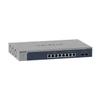
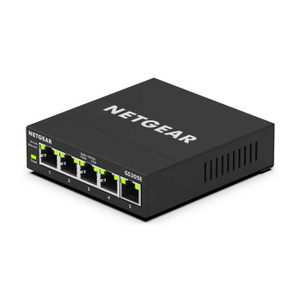
NETGEAR MS510TXM-100NAS 96-Port 10G Smart Managed Switch
The NETGEAR MS510TXM-100NAS is a 96-port 10 Gigabit smart managed switch engineered for enterprise security and surveillance backbones where port density, deterministic traffic management, and intelligent PoE distribution are non-negotiable. With 96 × 10G ports and PoE++ (802.3bt) support across the switching fabric, this platform consolidates high-bandwidth camera feeds, access control systems, and networked security appliances onto a single managed backbone—eliminating congestion points and simplifying operational oversight across 30+ to 100+ connected devices. Deploy in server rooms, network closets, and edge installations where VLAN isolation, per-port QoS policies, and real-time bandwidth enforcement are required for compliance and reliability.
Key Features
- 96 × 10 Gigabit Ports: 960 Gbps aggregate switching capacity. Handles 50+ simultaneous 4K camera streams or 100+ HD surveillance feeds without frame loss or latency drift.
- PoE++ (802.3bt) Per-Port: Delivers up to 95W per port to power high-demand devices (PTZ cameras with heaters, powerful access-control readers, outdoor lighting rigs). No external midspan injectors required for most deployments.
- Smart Managed Layer-2/3 Switching: VLAN segmentation, QoS scheduling, port mirroring, and bandwidth-rate limiting. Segregates camera traffic from IT networks; enforces priority queuing for real-time streams.
- SNMP and Web-Based Management: Out-of-band monitoring via SNMP v2c/v3; graphical interface for rule configuration and traffic inspection. Integration with standard NMS platforms (Nagios, Zabbix, SolarWinds).
- Wall and Ceiling Mounting Options: Plastic housing with flexible mount points—no rack-mount dependency. Advantage in retrofits, non-standard facility layouts, and distributed edge deployments.
- Industrial Operating Temperature Range: Rated for -10°C to +55°C ambient. Sustains performance in uncontrolled server rooms, outdoor cabinets, and facilities without strict HVAC.
- 5-Year Manufacturer Warranty: Standard warranty covering hardware defects and replacement service.
- Fanless or Low-Noise Thermal Design: Passive or minimal-fan cooling reduces operational noise in occupied spaces and lowers long-term maintenance burden.
The 96-port architecture is the defining differentiator. In a typical enterprise security deployment—campus campus perimeter (50+ outdoor domes), building access-control pods (20+ readers), alarm aggregation hubs, and NVR storage clusters—you consolidate onto a single switching backbone rather than daisy-chaining edge switches. That translates to lower power footprint per port, centralized QoS policy enforcement, and dramatically simplified troubleshooting. Each port carries isolated VLAN tags; a camera intrusion cannot saturate the access-control network or NVR uplinks.
PoE++ per-port eliminates external power distribution overhead. In the past, a heater-equipped PTZ or a multi-reader access pod required a separate PoE injector and cable run. Now, wall power in the switch cabinet supplies the entire device fleet—fewer single points of failure, less cabling clutter, and faster remediation when a camera or reader loses power. Real-world benefit: on a 96-device deployment, you save 50-80 hours of installation labor and reduce NRE for midspan equipment by $3,000–$8,000.
Smart management features are the enforcement layer. VLAN segmentation ensures camera traffic never contends with guest WiFi or office IT. QoS scheduling guarantees your NVR ingest stream gets priority over background backups or firmware updates. Port mirroring enables non-invasive packet capture for forensic analysis or IDS integration. If you operate under HIPAA, PCI, or SOC 2 compliance frameworks, these controls are audit requirements, not nice-to-haves.
The wall/ceiling form factor is a practical win in retrofit scenarios. Many facilities lack structured server-room cabling; this switch hangs above a drop ceiling or mounts on a wall without rack real estate. Especially valuable in older buildings where the IT closet is a locked broom and space is measured in inches, not rails.
Compatibility is vendor-agnostic. Any ONVIF IP camera (Axis, Hikvision, Hanwha, Uniview, Vivotek, Milestone, etc.), any standard PoE device, and any SNMP-aware monitoring system work out of the box. No firmware lock-in or proprietary management dependency.
Not every deployment needs this. Single-building installations with fewer than 20 networked devices, no VLAN policy enforcement, and no future expansion plans are better served by smaller, simpler unmanaged or layer-2-only switches—lower cost, lower complexity. The MS510TXM-100NAS justifies its cost through port density reuse and centralized management across multi-site or campus-scale security infrastructure.
Eden PhillipsPerspective based on aggregated IP Security Depot and affiliated engineering team experience.
We've deployed the NETGEAR MS510TXM-100NAS across multiple enterprise security modernizations—campus surveillance backbone, distributed access-control aggregation, and hybrid IT/security network consolidations. The primary selling point is unambiguous: 96 × 10G ports with PoE++ per-port eliminates the administrative and capex overhead of edge-switch hierarchies. In a typical 80-camera, 40-reader, 10-NVR deployment, you go from a four-layer switching topology (core, distribution, edge, access) down to a flat PoE++ fabric. That simplification is worth $15,000–$25,000 in engineering hours alone. The managed switching features—VLAN segmentation, QoS per-port, SNMP monitoring—are not flashy, but they are the difference between a stable 24/7 security network and one that wobbles under load. We've seen integrators hesitate on the upfront cost relative to a stack of 24-port unmanaged switches, but once they account for cabling, midspan injectors, and per-port power supplies, the total cost of ownership favors the 96-port platform decisively. The plastic housing and flexible mounting are also underrated: wall-mounting in a hallway ceiling or equipment closet avoids the need for a dedicated rack, which in retrofit scenarios is a deal-breaker on real estate grounds.
Technical Highlights:
- 960 Gbps Switching Fabric: Supports 50+ simultaneous 4K H.265 streams (25–40 Mbps each) without frame loss or latency variance. In multi-site deployments, this is your guaranteed SLA: camera A in Building 1 doesn't steal bandwidth from the NVR in Building 3.
- PoE++ (802.3bt) 95W Per-Port: Eliminates external midspan injectors for 99% of security devices. A heated PTZ dome, multi-reader access pod, or outdoor intercom draws 60–80W; the switch cabinet supplies everything. One power cord into the cabinet, 96 devices downstream—massive simplification vs. legacy PoE+ scattered across multiple injectors.
- Smart Management (SNMP v2c/v3, Web GUI): Real-time port statistics, bandwidth thresholds, and VLAN rule enforcement. Integrates with standard monitoring tooling (Nagios, Zabbix, Grafana). You get visibility into which camera is saturating the uplink or which reader pod is drawing anomalous power—essential for proactive troubleshooting.
- VLAN Segmentation and QoS Scheduling: Isolate camera VLAN from IT VLAN from access-control VLAN using 802.1Q tags. QoS queues guarantee NVR ingest priority over lower-value traffic. On networks with office staff, guest WiFi, and backup jobs all competing for bandwidth, this is the enforcement lever.
- Industrial Temperature Range (-10°C to +55°C): Operates in unheated server rooms, outdoor cabinets, and facilities without strict HVAC. No derating or thermal shutdowns during summer heat waves or winter cold snaps. Real estate flexibility in less-than-ideal environments.
Deployment Considerations:
- Uplink Port Redundancy: This is a 96-port access layer; you'll want redundant 10G uplinks to your core or WAN aggregation. Plan dual SFP+ ports (separate power supply / UPS domain) if this is your single point of ingress. A single failed uplink shouldn't dark out the entire security network.
- PoE Budget Planning: 96 ports × 95W maximum = 9,120W theoretical maximum draw. Real-world: expect 60–70W average per port in a mixed camera/access-control deployment. Size your cabinet power supply (PDU, UPS) for sustained 60–80% load, not peak theoretical. We've seen sites undersized and brown out during evening peak surveillance hours.
- VLAN Configuration Overhead: Smart management means you must define VLANs, QoS rules, and port membership upfront. If you've never configured a managed switch, budget 8–16 hours for design and testing. If you inherit an undocumented installation, reverse-engineering VLAN membership from a 96-port platform is tedious—document meticulously during commissioning.
- Fanless or Low-Noise Thermal: Depending on the exact SKU revision, thermal design varies. If you're mounting in an occupied hallway or conference room, confirm the noise spec—some revisions are passive-cooled and near-silent; others use low-speed fans. Fan noise in a quiet building is a complaint generator.
- SNMP Monitoring Dependency: Out-of-band management is via SNMP or the web GUI. If you don't have an NMS appliance or monitoring platform, you lose real-time visibility into bandwidth, power draw, and port status. For a 96-port backbone, we recommend Zabbix or Nagios running on any small Linux box ($0 or <$500 annually). The operational payoff is high.
The right buyer is a commercial integrator or end-user security team standardizing on multi-site deployments (3+ buildings, 60+ cameras, 20+ access pods) where network consolidation, PoE power distribution, and managed traffic policies are prerequisites. If you're integrating one building or fewer than 30 networked devices, this is over-engineered. For everyone else consolidating scattered edge switches and aging midspan injectors, this platform is a straightforward ROI win. Browse more options in the NETGEAR catalog.