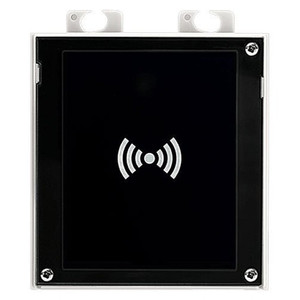
2N 02444-001 IP VERSO Reader Intercom Access Control
Overview
The 2N 02444-001 is an IP-networked access control reader that consolidates multiple credential technologies into a single endpoint. Unlike traditional Wiegand-based readers tied to local controllers, this device connects directly to your IP infrastructure via Ethernet with PoE support, eliminating dedicated access control wiring and enabling credential updates from a central management platform. It's built for organizations managing mixed-credential environments—where some buildings still use legacy 125kHz cards, others have migrated to 13.56MHz, and access policies require mobile authentication.
If your facility runs multiple credential standards simultaneously, or you're transitioning from one technology to another without replacing every reader at once, the 02444-001 addresses that directly. The integrated intercom functionality means access readers and tenant communication run through the same network device, reducing hardware count and simplifying on-site wiring complexity.
Key Features
- Dual-frequency RFID (125kHz and 13.56MHz): Supports both legacy Low Frequency (LF) and High Frequency (HF) credentials from the same reader. This matters when you have tenants or departments using different card standards—no separate readers per credential type. You can phase in new technology without orphaning existing infrastructure, cutting replacement costs significantly over time.
- BLE (Bluetooth Low Energy) authentication: Enables smartphone-based access without requiring physical cards. Useful for BYOD environments, visitor management via temporary mobile credentials, or seamless mobile check-in at secure entrances. BLE operates effectively within 2–5 meters with line-of-sight, making it well-suited for access gates and entry vestibules rather than parking lot or perimeter readers.
- PICard encrypted communication: Credential data is encrypted in transit over your network. This prevents packet-sniffing attacks on shared network segments—a real concern in larger facilities where IT and physical security networks intersect. Without encryption, a compromised network segment could expose credential tokens, creating unauthorized access risk.
- PoE-powered IP architecture: Connects via standard Ethernet with PoE or hardwired power, eliminating the need for dedicated access control wiring runs. Credentials are validated centrally, so you can update access policies in real time across all readers without on-site visits. This reduces operational overhead significantly compared to standalone readers with local decision logic and removes the need for separate 12VDC or 24VDC power infrastructure.
- Integrated two-way intercom: Voice communication capability is built into the same device that handles credential validation. Simplifies installation—one wall opening instead of separate access and intercom hardware—and reduces cabling by consolidating audio, power, and network connections into a single connection point.
- OSDP and third-party platform integration: Connects to centralized access control systems via the Open Supervised Device Protocol (OSDP), alongside native Axis platform support. This prevents vendor lock-in and lets you integrate the 02444-001 into systems built on different manufacturers' components without custom development or middleware.
Integration & Compatibility
The 02444-001 integrates with centralized access control platforms and network-based video management systems via OSDP and standard IP protocols. Its network architecture means it works alongside other networked infrastructure—managed network switches with sufficient PoE budget (verify power delivery capacity if deploying multiple readers across a campus or multi-building facility) are recommended to ensure consistent availability and bandwidth.
Compatibility is straightforward with Axis products and third-party access control software that supports OSDP. Before procurement, verify your VMS or access control platform documentation explicitly supports the 02444-001 or the OSDP standard to avoid integration surprises, especially if you're retrofitting into an existing system with legacy controller dependencies.
When to Choose a Different Model
If your facility operates exclusively on a single RFID frequency and has no near-term plans to migrate credentials or support mobile authentication, a single-frequency reader may reduce initial cost. If your installation requires extended outdoor range (parking lots, perimeter gates) without line-of-sight, BLE is not suitable—consider a reader focused on long-range RFID with fixed mounting. For facilities requiring only local intercom without integrated access, deploying separate intercom devices may simplify system architecture if access logic remains on-premise.
Frequently Asked Questions
Q: Does the 2N 02444-001 support legacy Wiegand readers or controllers?
A: No. The 02444-001 is an IP endpoint and does not interface with Wiegand-based systems. If you have existing Wiegand readers or controllers, you will need to replace them or deploy a Wiegand-to-IP gateway device. Verify compatibility with your access control platform before procurement.
Q: What is the maximum BLE range for the 02444-001?
A: BLE operates effectively within 2–5 meters with line-of-sight. Range depends on antenna orientation, environmental obstacles, and smartphone hardware. It is not suitable for long-range outdoor applications such as parking lots or perimeter gates.
Q: Can the 02444-001 work with systems that don't support OSDP?
A: The device is optimized for OSDP and Axis platform integration. If your access control system does not support OSDP, you will need to verify that the manufacturer provides a documented driver or API for the 02444-001. Contact your access control vendor or integrator to confirm compatibility before ordering.
Q: What power budget should I plan for when deploying multiple 02444-001 readers?
A: Verify the exact power draw from your 2N datasheet (PoE or hardwired specifications). When deploying multiple readers, calculate total power demand and confirm your switch has sufficient PoE budget. A single 802.3af port (up to 15.4W at the source) may support the 02444-001, but multi-reader deployments should use a PoE+ or managed switch with dedicated power accounting.
Q: Does the 02444-001 require a local access control controller, or is it fully networked?
A: The 02444-001 is a networked endpoint. Credential validation and access decisions are made centrally by your access control platform or VMS. No local controller is required, but you must have a compatible centralized access control or OSDP-enabled system to validate credentials and unlock doors.
Q: Is the PICard encryption compatible with standard 802.1X network security?
A: PICard is a credential-level encryption framework; 802.1X is network-level authentication. Both can coexist, but verify with your network security team and the access control vendor that the encryption methods are compatible within your planned architecture.
Jerry TildsenPerspective based on aggregated IPSD and affiliated engineering team experience.
The 02444-001 solves a real problem: mixed-credential estates. Most facilities aren't built on a single standard—they're built over time, with legacy 125kHz infrastructure still running alongside newer 13.56MHz systems. Replacing every reader simultaneously is expensive and operationally disruptive. The 02444-001 lets you deploy one device that handles both, reducing hardware count and simplifying the migration path.
Technical Highlights:
- Dual-frequency RFID (125kHz + 13.56MHz): One reader replaces what would normally be two separate endpoints. In a 50-door facility with mixed credentials, that's significant hardware and cabling savings—50 doors × 1 device instead of 50 doors × 2 device types.
- BLE support with line-of-sight operation (2–5m): Smartphone-based access is increasingly expected; however, BLE range is limited. Plan for it at access gates and vestibules, not parking perimeter. If you need long-range mobile access, reconsider the deployment location.
- PICard encrypted credential transit: Encryption at the credential level (not just network-level) prevents token replay attacks on a compromised segment. Non-trivial in mixed IT/security networks where isolation is difficult.
- PoE-powered, IP-networked validation: Central credential validation means policy changes propagate instantly across all readers. Compare this to standalone readers with local decision logic—those require site visits to update access rules.
Deployment Considerations:
- OSDP is not universal—verify before purchase. If your access control system predates OSDP standardization (common in systems from 2015 and earlier), integration may require custom work or a middleware layer.
- PoE budget matters. Calculate total power draw across all readers and confirm your switch has headroom. A single PoE+ switch port (30W) can typically support multiple 02444-001 readers, but don't assume—verify with your 2N datasheet wattage specs.
- BLE range limitation is not a gotcha if you understand it upfront. Many integrators try to use BLE for parking lot readers and then blame the hardware. It's a vestibule and gate technology, not a perimeter technology.
The 02444-001 is a solid fit for campuses or multi-building facilities where you have legacy and modern credential types running in parallel, and where centralized IP-based access control is already deployed or planned. If you're still running analog intercoms and standalone controllers, this device won't solve that problem alone—you'll need a broader access control refresh.