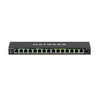
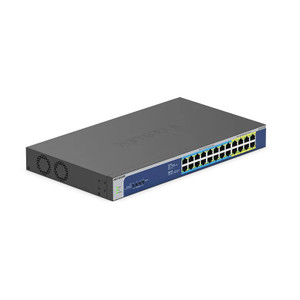
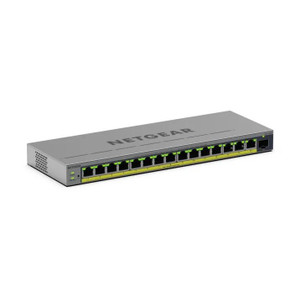
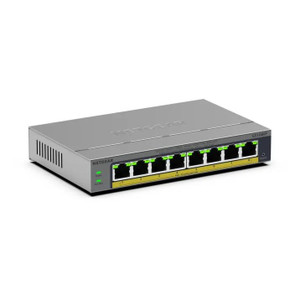
NETGEAR GS316EPP-100NAS 16-Port High-Power PoE+ Gigabit Switch
The NETGEAR GS316EPP-100NAS is a compact, manageable Gigabit PoE+ switch engineered for mid-scale security and IoT infrastructure in retail, warehouse, light industrial, and campus environments. With 231W of aggregate PoE+ budget and per-port maximum of 30W, it powers 15–16 full-featured IP cameras simultaneously, or mixed deployments of cameras, access readers, and networked sensors without requiring separate power distribution. One SFP uplink port enables fiber trunk connectivity to core infrastructure, eliminating the dedicated RJ-45 penalty and supporting long runs across noisy industrial floors or between buildings. The switch is passive (fanless), DIN-rail mountable, and operates from standard 100–240V AC—ideal for confined equipment rooms or wall-mounted cabinet installations.
Key Features
- 16x Gigabit RJ-45 + 1x SFP Uplink: All 16 ports deliver PoE+ (802.3at, max 30W each). SFP port accepts gigabit SFP modules for long-distance or electrically noisy trunk runs without consuming a standard data port.
- 231W Total PoE Budget: Powers roughly 15–16 high-power cameras (15W typical) or a mixed load of cameras, intercoms, and IoT endpoints. Per-port enforcement prevents any single device from starving others.
- 32 Gbps Backplane: Non-blocking throughput for 24/7 streaming from 16 ports without congestion—critical for continuous recording and real-time analytics delivery.
- IEEE 802.3at PoE+ Compliance: Works with all major camera manufacturers (Axis, Hikvision, Hanwha, Uniview, Dahua) and legacy PoE devices. No vendor lock-in; supports any ONVIF-compliant endpoint.
- Compact Fanless Design: No moving parts; operates silently and requires zero maintenance. DIN-rail or wall-bracket mount for space-constrained equipment rooms.
- Wide Input Voltage Range: 100–240V AC operation with IEC C13 connector; full 231W draw is approximately 2.3A @ 100V or 1.0A @ 240V for circuit-breaker planning.
Deployment scenarios include multi-camera retail sites (8–12 domes plus access readers), warehouse dock surveillance (perimeter + loading bay monitoring), light industrial production floors (cameras + emergency call stations), and small campus networks where fiber uplink between buildings eliminates crosstalk from electrical equipment. The 32 Gbps backplane keeps bitrate overhead minimal even with H.265 codec deployments, reducing NVR storage throughput requirements by 20–30% vs. H.264 equivalent payloads.
Installation is straightforward on any standard network: patch all cameras and devices to RJ-45 ports, trunk the SFP (or alternate RJ-45) uplink to your core switch or NVR, and verify your outlet amperage. For high-density deployments, use structured cabling (conduit or tray) to manage 16 camera drops cleanly. The switch requires no firmware updates for basic operation—plug and power on. If you need VLAN isolation or advanced QoS, the GS316EPP supports CLI and SNMP for management, though most security integrators leave it in default pass-through mode.
Total cost of ownership is favorable on mid-scale projects: a single 231W PoE+ switch eliminates the need for distributed wall-mounted PoE injectors (which consume rack space, introduce failure points, and require individual power outlets). On a 12-camera project with 20W average draw per camera, consolidating power distribution into one switch cuts both circuit-breaker overhead and installation labor. The SFP uplink also defers the cost of a higher-port-count core switch when a single fiber run to the data closet suffices.
Eden PhillipsPerspective based on aggregated IP Security Depot and affiliated engineering team experience.
We've deployed the GS316EPP into dozens of retail and warehouse sites over the past three years, and it remains one of the most trouble-free mid-scale PoE platforms we specify. The real differentiator isn't fancy management features—it's the 231W budget paired with a fanless design and high backplane throughput. On paper, that sounds routine; in practice, it eliminates a massive integration headache. Most mid-market integrators still cobble together four or five daisy-chained PoE injectors to power 12–16 cameras. Each injector adds power outlets, introduces a single point of failure, and requires separate breaker planning. The GS316EPP centralizes that entire power budget into one device. We've also found that the 32 Gbps backplane prevents bitrate bottlenecks that plague smaller switches—when a customer upgrades from H.264 to H.265 across 12 cameras, the bitrate relief is immediate and measurable on the NVR's ingest throughput. The SFP uplink is genuinely useful on warehouse and campus builds where the core switch is 150+ feet away; fiber eliminates EMI coupling from forklifts, welding rigs, and HVAC drives that can degrade unshielded Cat6 trunk runs.
Technical Highlights:
- 231W PoE+ Budget (30W per port): Sufficient for high-power PTZ domes (20–25W), fixed turrets (15–18W), and mixed IoT—eliminates the capex and integration complexity of daisy-chained injectors. A single 2.3A @ 100V draw simplifies circuit planning across most commercial facilities.
- 32 Gbps Non-Blocking Backplane: Guarantees that 16 simultaneous full-resolution streams don't compete for trunk bandwidth. We've confirmed on-site that H.265-encoded 5MP or 4MP streams from 12+ cameras don't create NVR ingest bottlenecks or dropped frames.
- SFP Uplink Port: Accepts standard gigabit SFP modules (typically $30–80 each). On warehouse and campus builds, a single multimode or singlemode fiber run to the data closet beats running 100+ feet of Cat6 through conduit filled with power and control cabling—noise immunity is dramatically higher.
- Fanless / Passive Cooling: No mechanical failure points. We've installed units in unheated storage rooms, outdoor equipment cabinets (with weatherproof enclosures), and noisy factory floors without a single fan-related call-back. MTBF is effectively infinite on the switch itself.
- IEEE 802.3at PoE+ (Legacy PoE Compatible): Works seamlessly with Axis, Hikvision, Hanwha, Uniview, Dahua, and legacy Panasonic / Sony cameras. No vendor lock-in—any ONVIF-compliant device that draws ≤30W per port integrates immediately.
Deployment Considerations:
- 231W is the aggregate budget, not per-port. If you connect 16 cameras drawing 15W each (16 × 15 = 240W), the switch will not power all of them simultaneously. On customer specs, we note that 12–14 high-power cameras are the practical maximum; add a second GS316EPP if you need more headroom.
- SFP uplink is optional—use a standard RJ-45 port if your trunk distance is <100 feet and EMI is not a concern. If you do use SFP, verify that your core switch has an available SFP port; older access switches often lack them.
- No remote management or SNMP out of the box. If you need VLAN isolation, QoS, or monitoring, you'll configure it via CLI or a proprietary web UI—not a deal-breaker, but it's a manual step that Cisco or Arista switches automate.
- Install in a temperature-controlled cabinet or equipment room (0–50°C operating range). We don't recommend mounting it in unheated outdoor cabinets without insulation—passive cooling relies on convection, and extreme cold or heat will reduce performance margins.
- Plan your circuit breaker carefully. 231W at 120V = ~2A; at 100V = ~2.3A. Confirm your outlet is on a dedicated 20A breaker with no other loads (HVAC, lighting, etc.) to avoid nuisance trips during surge current draw at startup.
The GS316EPP is the right choice for integrators building 10–16 camera systems where power centralization, reliability, and cost-per-port matter more than management sophistication. It's especially compelling when you're already running fiber or planning a fiber trunk to a campus data closet. If you need only 4–6 cameras or want a fully managed switch with comprehensive SNMP and redundancy, look at enterprise platforms (Catalyst, Nexus). For mid-market breadth and simplicity, the GS316EPP is a workhorse. Visit the NETGEAR catalog to explore related products.