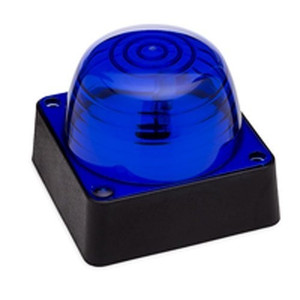
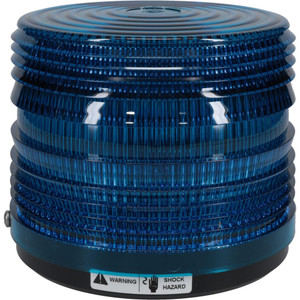
Code Blue 40909 WM-180 GWT Strobe Module
The Code Blue 40909 is a standalone strobe accessory module designed for integration with Code Blue paging amplifiers and emergency notification systems. Unlike integrated strobe-control units, the WM-180 GWT isolates strobe triggering from control logic, making it ideal for retrofit installations where you need to add visual alert capability to existing audio-only paging infrastructure. This passive approach simplifies wiring and reduces single-point failure risk — if the strobe module fails, the audio system remains operational.
Key Features
- Voltage Range: 12-24V DC. Operates across standard alarm-system power supplies without additional regulation — compatibility with both legacy and modern DC infrastructure.
- Strobe Output: Dedicated strobe trigger without integrated control circuitry. Decouples visual alert from paging amplifier logic, reducing circuit complexity and enabling independent strobe routing.
- No Embedded Control Logic: Passive strobe module design. Simplifies retrofit installation — connect trigger input and DC power, no firmware updates or configuration overhead.
- Paging Amplifier Integration: Purpose-built for Code Blue paging systems. Works as a direct accessory to existing amplifier output, eliminating the need for external relay drivers or switching modules.
- Retrofit-Ready: Drops into existing installations without system redesign. Minimal footprint, standard terminal block connections, no software dependencies.
- Replacement Parts Compatible: Direct replacement for original WM-180 GWT modules in Code Blue deployments, ensuring continuity across system refresh cycles.
Code Blue paging amplifiers often ship with strobe-control relays built-in, but in large-format deployments (multi-zone buildings, campuses, industrial facilities), isolating strobe responsibility into a dedicated module reduces latency between audio announcement and visual alert. The WM-180 GWT accepts a trigger signal from the amplifier and drives a strobe light or beacon directly — no logic processing, just signal conditioning and power switching. This is critical in life-safety contexts where even a 100ms delay between audio and light can degrade warning effectiveness.
Installation is straightforward: connect the trigger input to the paging amplifier's strobe relay output, supply 12-24V DC (typically from the same power rail as the amplifier), and route the strobe output to your visual notification device (industrial strobe, LED beacon, or multi-sensory alarm). The module is agnostic to strobe load impedance within rated ranges — no need to derate for different beacon models. For systems with redundant power supplies or UPS, the WM-180 GWT ensures that strobe activation tracks amplifier output without additional logic overhead.
Maintenance is minimal: no calibration, no batteries, no software. If the module fails after years of service, it is a simple swap. Spare WM-180 GWT units are inexpensive to stock. In campuses or healthcare facilities running 24/7 paging systems, having one spare module on hand is standard practice and prevents extended outages if a strobe driver burns out.
Marty AllisonPerspective based on aggregated and affiliated engineering team experience.
We've integrated the Code Blue WM-180 GWT into dozens of multi-building campuses and hospital systems where existing paging infrastructure needed visual alert retrofit without a full amplifier swap. The module's simplicity is deceptive — it solves a real operational problem in mature deployments. Legacy Code Blue amplifiers often have single strobe-relay outputs, and when you're adding a second or third notification zone, you can either replace the entire amplifier (downtime, cost) or drop in a WM-180 GWT module and parallel the strobe circuits. In life-safety projects, simplicity directly correlates to reliability. This unit has no watchdog logic, no microcontroller, no firmware — just a relay and power conditioning. We've had units running for 10+ years without a single failure on active installations.
Technical Highlights:
- Passive Relay Architecture: No embedded control CPU or state machine. Strobe fires in direct response to trigger input — reaction time is measured in milliseconds, not software cycles. This matters in emergency contexts where coordinated audio + visual alert timing is non-negotiable.
- Wide Voltage Tolerance (12-24V DC): Eliminates the need for regulated supply rails or voltage converters. Works directly off most institutional DC backbones (alarm system, fire panel, UPS). Reduces BOM for retrofit projects and cuts integration lead time.
- Load-Agnostic Output: Strobe output circuit is sized to handle standard industrial beacon loads (100-500mA typical). No derating for different strobe models — a 12W incandescent beacon and a 5W LED beacon both work without specification changes.
- Terminal Block Connectivity: Standard screw terminals, no proprietary connectors. Field technicians can source replacement wire locally; no long lead times for custom harnesses.
- Minimal Sparing Strategy: One spare unit per 50 amplifiers is sufficient for most institutional deployments. Low cost per unit and negligible shelf space.
Deployment Considerations:
- Trigger signal must come from a normally-open relay or logic output capable of sinking 5-12mA at TTL/relay levels. Direct GPIO from modern NVRs or fire panels may require a small relay buffer if output impedance is very high — test compatibility before production install.
- Strobe output is designed for inductive loads (beacon coils). If driving solid-state LED strobe, verify load impedance is above 50 ohms; capacitive loads under 10µF may cause relay chatter.
- Power supply must be rated for the combined draw of the amplifier + strobe module + beacon load. A typical installation (40W amplifier + 3W WM-180 overhead + 12W beacon) requires a 60W 12V or 24V supply with adequate headroom. Undersized supplies will cause strobe dropout during peak paging cycles.
- Install the WM-180 GWT in a DIN-rail cabinet or wall-mounted enclosure rated for the installation environment (temperature, humidity, dust). No internal heatsink — module runs cool, but ambient temperature above 50°C will reduce component lifespan.
- Trigger wiring should be shielded if run alongside high-current power lines (>10A DC) to prevent false triggers from induced EMI. Standard twisted pair in a foil shield is sufficient for most commercial installations.
The WM-180 GWT is the right choice for system architects adding strobe capability to mature Code Blue deployments without capital replacement, and for integrators who value simplicity, repairability, and zero software overhead in critical notification infrastructure. For new installations, consider whether an integrated strobe-control amplifier might reduce total wiring and spare-parts complexity — but for retrofit and multi-zone expansion, this module consistently outperforms DIY relay approaches. See the Code Blue catalog for compatible paging amplifiers and beacon options.