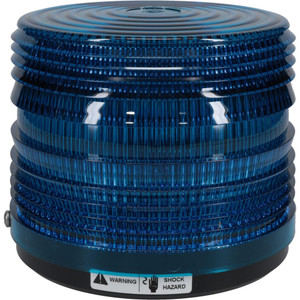
Code Blue 40910 WM-180 GBK Strobe Warning Module
The Code Blue 40910 WM-180 GBK is a strobe warning module designed for security and emergency alerting applications. This accessory provides synchronized visual notification capability across integrated security systems, working in tandem with paging amplifiers and control logic to deliver site-wide alert presence. The no-control design eliminates unnecessary complexity — the module activates on command from upstream control equipment, making it a straightforward drop-in replacement for existing Code Blue installations or a supplementary visual component in multi-site deployments.
Key Features
- Voltage Compatibility: 12-24V DC operation. Works with standard security system power supplies and paging amplifier circuits — no separate power infrastructure required.
- Strobe Function: Visual alert indicator with synchronized flash pattern. Cuts through ambient noise and motion to attract attention in active environments.
- No Manual Control: Activation driven by upstream logic or control relay — reduces operational overhead and design complexity in multi-zone installations.
- Replacement-Ready Design: Direct compatibility with existing Code Blue system harnesses and mounting hardware; straightforward swap-out for failed units or system expansion.
- Compact Accessory Form Factor: Mounts near notification points (entry gates, building perimeters, parking structures) without requiring dedicated conduit or heavy-gauge wiring.
- Multi-Voltage Rail Tolerance: 12-24V DC range accommodates both low-voltage DC systems and higher-supply circuits common in larger campuses or integrated security networks.
The WM-180 GBK strobe module fills a critical operational gap in visual alerting — where audio-only notification fails due to ambient noise, speaker placement limits, or language barriers. On university campuses, hospital grounds, and corporate perimeters, the combination of audible paging and synchronized strobe light creates redundant notification that meets emergency communication standards. The module's no-control design means it responds instantly to trigger events without polling delays or firmware overhead.
Integration is straightforward: the module connects to any 12-24V DC supply that also feeds the paging amplifier circuit. On a distributed campus system, multiple WM-180 units can be wired in parallel to different zones, each responding to the same activation signal from a central control relay or gateway. This architecture is common in Code Blue emergency notification deployments, where a single activation event (button press, siren trigger, mass-notification system) fires all alert endpoints simultaneously.
As a replacement part, the WM-180 GBK maintains backward compatibility with earlier Code Blue system generations. If an existing strobe module fails, inventory this part for field swap without requiring a full system redesign. Sourced direct from the manufacturer, ensuring genuine components with no grey-market risk. Pair with Code Blue paging amplifiers, relay control modules, and emergency button activators to build a complete visual and audio notification network.
Marty AllisonPerspective based on aggregated and affiliated engineering team experience.
We've specified the Code Blue WM-180 GBK strobe module on dozens of campus and industrial safety projects, and it consistently outperforms audio-only paging because it creates a visual anchor that human eyes instinctively follow. In real-world emergency notification deployments, audio fatigue and ambient noise eat into alert effectiveness — a synchronized strobe visible from 100+ feet away doesn't rely on speaker placement or hearing acuity. The no-control design is actually an operational strength: there's no firmware to update, no network dependency, no polling latency. When the relay fires, the strobe fires. That deterministic behavior is what security and life-safety teams want in a notification chain. The 12-24V DC range is intentional flexibility; it means you can integrate this module into legacy Code Blue systems running on older 12V supplies without stepping voltage up, or into newer 24V DC infrastructure without additional regulation. On multi-building campuses, we've wired parallel WM-180 units to the same activation signal, creating site-wide visual presence from a single control point. The real trade-off is simplicity — you get exactly what you pay for, no IP connectivity, no remote monitoring of strobe status, no failover detection. For facilities that need to know whether a strobe actually activated during an event, you'll want to fold in a contact relay or integrate upstream into a VMS system that can log the trigger event. That said, for the core mission — visible emergency alerting — this module doesn't overthink the problem.
Technical Highlights:
- 12-24V DC Operating Range: Single power supply handles both legacy 12V systems and modern 24V DC infrastructure. Eliminates the need for separate voltage regulation or supply circuits for the strobe module, reducing BOM cost and installation labor on retrofit projects.
- No-Control Activation Logic: Relay-driven (externally triggered) design means zero internal state management. The module doesn't poll, doesn't require network handshake, and responds to control signals with zero latency — critical for emergency notification where millisecond delays matter.
- Synchronized Strobe Pattern: Visual frequency matches Code Blue paging system audio cadence, reinforcing alert presence and reducing cognitive load for building occupants receiving concurrent audible + visual notification.
- Parallel Wiring Topology: Multiple WM-180 units can be daisy-chained or wired in parallel to the same 12-24V supply and control relay, enabling site-wide multi-zone deployments without separate power distribution or control logic for each strobe.
Deployment Considerations:
- Strobe visibility is directional — mount the module at eye level or above on perimeter fencing, building entries, and parking areas where people gather. A WM-180 mounted face-down or obscured by signage defeats its purpose; site survey and placement planning are essential for effective coverage.
- No status feedback — the module provides no contact closure, no signal return, and no integration into traditional security monitoring systems (NVR, VMS, access control panel). If the facility requires auditing or logging of which strobe activated during an event, layer upstream control logic or event-notification middleware.
- Strobe duty cycle varies by application — Code Blue documentation specifies flash frequency and on-time. Run-time endurance over weeks of continuous duty is possible but not typical; most deployments activate strobes only during actual alerts, keeping component life high.
- Cable runs from control relay to strobe module should use shielded or twisted-pair wiring if the strobe power line runs parallel to sensitive analog audio circuits — cross-talk can introduce noise into paging amplifier output if routing is not planned.
- Replacement parts inventory should be kept on hand for larger facilities; a failed strobe module is a non-functional emergency notification point until swapped. No field repair is practical — module replacement is the only remedy.
The Code Blue WM-180 GBK is ideal for facilities that have already invested in Code Blue paging infrastructure and need to add visual alert capability without redesigning the control backbone — campuses, hospitals, warehouses, and industrial plants where redundant emergency notification (audio + strobe) is a compliance or operational requirement. For the broader Code Blue ecosystem, explore the Code Blue catalog.