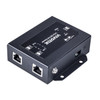
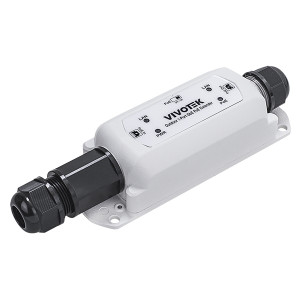
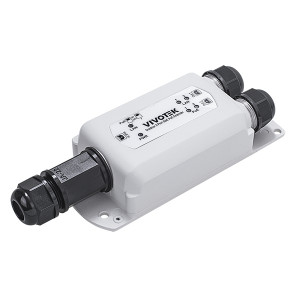
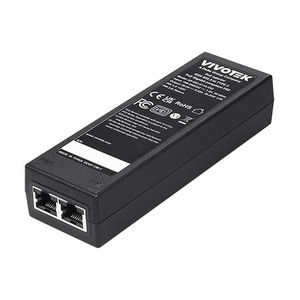
Vivotek AP-GXC-0200 1-Port PoE Splitter
The Vivotek AP-GXC-0200 bridges legacy non-PoE equipment and modern Power over Ethernet infrastructure without additional power outlets or cabling overhaul. This compact passive PoE splitter (often searched as AP GXC 0200) accepts input from two independent PoE sources and delivers consolidated power and data through a single Gigabit output—useful when integrating older access points, wireless gear, or fixed-lens cameras into systems that require native PoE power.
Key Features
- Dual PSE Input Ports: Two Gigabit Ethernet inputs accept IEEE 802.3af, 802.3at, and 802.3bt power up to 95W total—redundancy on power sourcing means one upstream PSE failure does not black out the downstream device.
- 68W Passive PoE Output: Maximum 48–55VDC delivery on the single PD port covers most powered devices beyond cameras: lightweight access points, edge switches, and powered sensors that specify passive PoE input.
- 12KV Surge Protection per Port: Withstands electrical transients common in sites with lightning exposure or noisy power distribution—a critical insurance layer that cuts the cost of replacing burned-out equipment mid-deployment.
- Daisy-Chain Extension to 300m: Two units in sequence extend PoE delivery across longer cable runs without intermediate power injection or local 12VDC supplies, shrinking the number of PSE switches or injectors required in warehouse or perimeter applications.
- DIP Switch Power Control: Toggle PSE power on/off per unit in multi-splitter chains, optimizing power load and allowing selective activation in distributed surveillance topologies without unplugging cables.
- 6 Gbps Switching Capacity: Gigabit bandwidth on all three ports ensures no data throughput penalty when splitting power; 10/100/1000 Mbps auto-negotiation adapts to legacy and modern devices.
- Compact Footprint (89 × 86.5 × 28 mm): Weighs only 0.21 kg and mounts discretely on rails or inside cabinets without consuming meaningful rack or shelf space.
- Auto-MDI/MDI-X & Auto-Negotiation: No manual cable-type selection or speed configuration needed—plug straight in and operate.
- Wide Temperature Range (−40°C to 65°C): Operates reliably in climate-controlled server rooms, outdoor electrical enclosures, and light industrial environments; storage rated to 85°C ensures durability during shipment and warehousing.
- Global Certifications (CE, FCC, VCCI, C-Tick): Compliance across North America, Europe, and Australia simplifies procurement and avoids customs delays on international projects.
Integration & Compatibility
The AP-GXC-0200 integrates into any network topology where a network switch or PoE injector connects upstream. Because it is passive (draws no local power), installation requires only Ethernet cabling—no separate 12VDC supply or wall outlet. Compatible with any device drawing passive PoE: legacy IP cameras, access points, and powered sensors that do not require active negotiation. Its 2K MAC address table supports small-to-medium multi-device networks without bridging loops.
For large-scale deployments, consult a PoE planning guide to verify that upstream switches or injectors provide sufficient wattage for cascaded splitters. Each daisy-chained unit consumes roughly 0.5W internally.
When to Choose a Different Approach
If downstream devices require active PoE negotiation (802.3at/bt handshake) or draw more than 68W, this passive model will not work. Consider an active PoE switch or multi-output injector instead. The AP-GXC-0200 is strictly a passive power consolidator—it does not amplify or regenerate PoE voltage, so lengthy upstream cable runs (beyond standard switch port reach) require a fresh PoE source.
Frequently Asked Questions
Q: Can I daisy-chain more than two AP-GXC-0200 units?
A: Yes, but total extension is capped at 300m (984 ft) per the manufacturer specification. Beyond two units, downstream devices may experience voltage drop—validate with your PoE source's documentation and actual cable lengths on site before committing.
Q: Does the AP-GXC-0200 require a local power supply or UPS backup?
A: No. The unit is fully passive and draws power entirely from the upstream PSE ports. No 12VDC supply or AC outlet is needed, simplifying installation in remote or distributed locations.
Q: What surge protection rating does the 12KV specification represent?
A: 12KV per port means the device can tolerate brief, high-voltage transients without latch-up or component failure. It is not a full lightning-strike guarantee but significantly reduces risk in outdoor-adjacent or electrically noisy environments. For severe lightning zones, add external surge arrestors on outdoor cable runs.
Q: Will the AP-GXC-0200 work with my non-PoE camera if I feed it passive PoE input?
A: Yes, provided the camera expects passive PoE (48–55VDC on pins 1/2 and 3/6, or 4/5 and 7/8). Check the camera's power input specification; if it lists '12VDC connector' or 'active PoE negotiation required,' the splitter will not work. Legacy IP cameras and wireless access points with passive PoE inputs are common candidates.
Q: Can I use the AP-GXC-0200 to split power to multiple devices?
A: No. The device has one PD (powered device) output port. To power multiple devices, deploy separate PoE switches or multi-output injectors, or cascade multiple AP-GXC-0200 units in a chain with one unit per downstream device.
Q: What is the warranty?
A: 24 months from the date of manufacture, covering defects in material and workmanship under normal operating conditions.
Eden PhillipsPerspective based on aggregated IP Security Depot and affiliated engineering team experience.
The AP-GXC-0200 stands out as a pragmatic solution for integrators managing mixed-generation surveillance and network infrastructure. Its dual PSE input design and daisy-chain capability—supporting up to 300m extension with two units—provide exceptional flexibility for complex warehouse, perimeter, and facility layouts without requiring additional power infrastructure investment. The passive-only architecture means zero local power dependency, a significant logistical advantage in distributed installations where AC outlets or UPS integration would add cost and complexity.
Technical Highlights:
- 68W Passive PoE Output with 95W Input Capacity: Accommodates a wider range of powered devices beyond cameras—lightweight access points, industrial sensors, and edge switches all fall within the power envelope. The dual PSE inputs provide genuine redundancy; a single upstream switch failure does not silence the downstream device.
- 12KV Surge Protection per Port: Protects against transients common in electrically noisy environments. A single surge event can destroy an unpowered device; this protection layer justifies its inclusion in outdoor-adjacent or warehouse automation deployments prone to lightning or switching spikes.
- 6 Gbps Switching Capacity with Auto-Negotiation: No throughput compromise—full gigabit data rates across all three ports without manual configuration. The 2K MAC address table and auto-MDI/MDI-X support keep commissioning friction minimal.
Deployment Considerations:
- Passive PoE devices (target downstream equipment) are less common than active-negotiated units. Verify that your legacy cameras, access points, or sensors explicitly list passive PoE input—active PoE devices will not recognize or power up from this unit.
- Daisy-chaining beyond 300m or adding more than two units risks voltage drop at the final powered device. Test actual cable runs and wattage on site; if the downstream device browns out or reboots intermittently, inject fresh PoE at an intermediate point.
- The DIP switch power control is useful in multi-unit cascades but requires physical access and a reset cycle—ideal for staged deployments, less so for continuous live production systems.
Deploy the AP-GXC-0200 in warehouse automation or distributed perimeter camera setups where passive PoE equipment is already specified and you need to consolidate power from two separate switches into a single cable run. It is not a workaround for active-negotiated PoE devices and should not be viewed as a general-purpose PoE multiplier.