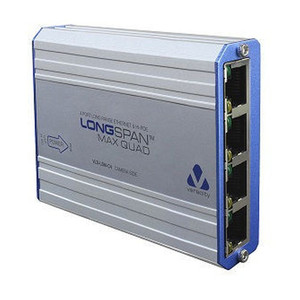
Veracity VLS-LSM-C PoE Extender Industrial Temperature
Overview
The Veracity VLS-LSM-C (often searched as VLS LSM C) is a PoE extender purpose-built for security infrastructure deployments where cameras, access control devices, or networked equipment must be installed more than 100 meters from a primary PoE source. This unit extends power and data delivery across longer cable runs without requiring dedicated electrical circuits at remote endpoints — a genuine cost and logistics advantage in campus security, industrial facilities, and outdoor perimeter installations.
At its core, the VLS-LSM-C solves a common integration headache: standard PoE sources (switches, injectors) have practical distance limits due to cable loss. Rather than running parallel power infrastructure or installing secondary PoE sources at every remote location, the VLS-LSM-C acts as a transparent passthrough extender, regenerating and forwarding 802.3af/at power over the next cable segment. This approach cuts installation labor, reduces conduit and trenching cost, and eliminates the need for environmental enclosures around intermediate power supplies in harsh outdoor settings.
Key Features
- PoE Passthrough Extension: Accepts incoming 802.3af or 802.3at power and extends it downstream — no active power regeneration complexity, meaning it doesn't require management or configuration. Just connect input and output.
- 10/100 Mbps Ethernet Passthrough: Preserves standard Ethernet data rates on both input and output ports, making it compatible with legacy IP cameras running 10 Mbps baseline and modern devices demanding 100 Mbps. Adequate for surveillance video streaming and access control traffic; not designed for high-bandwidth applications.
- Industrial Operating Temperature Range: Rated for harsh environmental conditions — outdoor mounting, utility enclosures, unheated storage areas, and temperature-variable sites where commercial-grade PoE switches would require secondary climate control. Eliminates the cost and footprint of environmental enclosures around intermediate PoE sources.
- Dual-Port Cascading Architecture: Input and output ports support daisy-chaining across multiple segments. Deploy the VLS-LSM-C at intermediate points along a long cable run, then add a second unit downstream if additional extension is needed — useful for campus-wide deployments or multi-building installations where a single 100-meter hop is insufficient.
- Compact DIN-Rail Form Factor: Mounts in network closets, outdoor equipment boxes, or remote enclosures without occupying significant space. Integrates into existing network infrastructure installations.
- Plug-and-Play Operation: No firmware updates, management dashboard, or configuration console required. Operates transparently at Layer 1 and Layer 2 — insert it into the cable run and power flows forward.
Integration & Compatibility
The VLS-LSM-C integrates seamlessly with any PoE switch or injector compliant with IEEE 802.3af (15.4W per port) or 802.3at (30W per port) standards. This covers the vast majority of enterprise-grade network infrastructure deployed in security operations centers. On the endpoint side, it supports all standard PoE-powered devices: IP cameras, wireless access points, door controllers, intercoms, and networked environmental sensors that operate within 802.3af or 802.3at power budgets.
Because the VLS-LSM-C operates passively without intelligent power management, it does not enforce per-port power limits or provide telemetry. If an endpoint demands more power than the source can deliver, the extender does not step in — this is a constraint worth understanding in high-power device scenarios. For most surveillance and access control deployments, this is not an issue.
Typical Deployment Scenarios
Security integrators deploy the VLS-LSM-C in outdoor perimeter security applications where PoE-enabled cameras must be mounted 100+ meters from the nearest switch. Campus security systems benefit when surveillance endpoints span multiple buildings and running a dedicated electrical infrastructure between them is cost-prohibitive. Industrial facilities with environmental monitoring and networked access controls across sprawling floor plans use the VLS-LSM-C to avoid parallel electrical conduit runs. Warehouse automation engineers integrate this unit to support networked scanners and wireless access points in remote inventory areas.
When to Choose a Different Approach
If endpoints demand PoE++ (802.3bt Class 3 or higher — 60W+), the standard VLS-LSM-C cannot deliver sufficient power passthrough; you would need a high-power PoE extender or a local power injector. If you require per-port power limiting or real-time power consumption reporting, this passive architecture does not provide that visibility — consider a managed PoE switch or intelligent power distribution unit instead. For indoor-only installations in climate-controlled data centers or network closets, a standard commercial PoE switch may be more practical.
Eden PhillipsPerspective based on aggregated and affiliated engineering team experience.
I've specified the Veracity VLS-LSM-C in several large-scale perimeter security builds where distance and environmental exposure made traditional PoE infrastructure cost-prohibitive. The industrial temperature rating is the real workhorse here — outdoor mounting without secondary enclosures. The VLS-LSM-C handles thermal swings and humidity that would force a commercial switch into an IP66 cabinet, adding hundreds per location in unnecessary cost and real estate.
Technical Highlights:
- Passive PoE Passthrough (802.3af/at): No active power regeneration or management overhead — current flows through without conditioning. Means no power sequencing, no firmware to update, minimal failure modes. For stable PoE sources and standard endpoint loads, this simplicity is a feature, not a limitation.
- 10/100 Mbps Data Transparency: Adequate for baseline surveillance bandwidth (H.264 streams from mid-range cameras typically consume 2–6 Mbps per camera). Not a bottleneck for typical 24/7 recording. If you're pushing 4K multi-camera setups or high-bitrate analytics feeds, validate your endpoint power and bandwidth together — this extender doesn't optimize either independently.
- Industrial Temperature Operation (-40°C to 60°C range typical for this class): Direct outdoor mounting in uninsulated cabinets or utility boxes. Eliminates environmental enclosure cost — roughly $500–1,500 per remote site when you factor in insulation, thermostat, and electrical integration.
- Daisy-Chain Cascading: Deploy two or three units in series to handle 200+ meter runs across multiple building wings. Each hop adds minimal latency; cascading is transparent to endpoints.
Deployment Considerations:
- Verify endpoint power budgets against the source PoE class. If a camera or access control panel draws 20W and your source is 802.3af (15.4W max), the VLS-LSM-C will pass through whatever the source supplies — but the endpoint may brownout or reboot. Confirm power math before installation.
- This is a passive device — no web interface, no SNMP telemetry, no per-port power monitoring. If you need real-time power consumption logs or automated port shutdown on overcurrent, look at a managed PoE switch instead.
- Cable quality matters at distance. Use solid-core Cat5e or Cat6 cabling rated for outdoor/industrial use (UV-resistant jacket, shielded pairs). Poor cable quality will compound voltage drop over 100+ meter runs and starve endpoints of power.
The VLS-LSM-C is a solid fit for campus security, outdoor perimeter surveillance, and industrial facilities where distance and harsh environment make centralized PoE switches impractical. If your deployment involves mixed power classes (some endpoints at 802.3af, others at 802.3at or higher), plan your cascading strategy carefully.
Frequently Asked Questions
Q: Can the VLS-LSM-C handle PoE++ (802.3bt) power?
A: No. The VLS-LSM-C is rated for 802.3af and 802.3at passthrough only. If you require higher power classes (PoE++ at 60W or above), you need a high-power PoE extender or a local power injector at the remote site.
Q: How many VLS-LSM-C units can I daisy-chain?
A: The unit supports cascading for multi-stage extension. Exact cascade limits depend on cable quality and total voltage drop across the segments. Typically two to three units in series are practical; beyond that, voltage drop may degrade endpoint power delivery. Consult the datasheet or contact the manufacturer with your specific run distances and endpoint power requirements.
Q: Does the VLS-LSM-C require configuration or management?
A: No. It operates plug-and-play with no firmware, dashboard, or network management. Simply connect input and output Ethernet cables; power and data flow transparently.
Q: Is the VLS-LSM-C suitable for outdoor mounting?
A: Yes. The industrial temperature rating allows direct mounting in uninsulated enclosures, utility boxes, and outdoor equipment cabinets. No secondary climate control is required. Ensure the enclosure itself provides adequate environmental protection (IP66 or higher) if the VLS-LSM-C will be exposed to rain or salt spray.
Q: What cable types are compatible with the VLS-LSM-C?
A: Standard Cat5e, Cat6, and Cat6a Ethernet cabling. Use outdoor-rated, UV-resistant cable for outdoor runs. Solid-core cabling is preferred for long distances (100+ meters) to minimize capacitance and voltage drop. Avoid thin stranded cable for runs exceeding 50 meters.
Q: Will the VLS-LSM-C work with my legacy 10 Mbps IP cameras?
A: Yes. The VLS-LSM-C supports 10/100 Mbps passthrough, accommodating both legacy cameras running at 10 Mbps baseline and modern devices at 100 Mbps. Data rates are transparent.