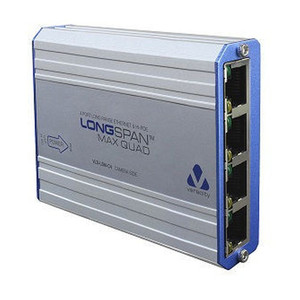
Veracity VLS-LSM-B PoE Extender Industrial 10/100
Overview
The Veracity VLS-LSM-B (often searched as VLS LSM B) is a passive PoE extender engineered to push Power over Ethernet and network connectivity beyond the standard 100m Ethernet reach. Purpose-built for PoE infrastructure in security and industrial deployments, this device eliminates the need to run separate power lines to remote endpoints—cameras, access control readers, wireless access points, and IoT sensors can stay powered and networked via a single cable run, even when distance would normally force you to add a second injector or power supply.
The VLS-LSM-B operates across industrial temperature ranges (-40°C to 60°C), meaning it works reliably in unheated outdoor cabinets, rooftop equipment enclosures, and non-climate-controlled network closets. This removes a common deployment friction: you no longer need to thermally insulate or heat conduit runs just to keep a PoE device functional. For integrators managing analog-to-IP camera migrations, perimeter access control, or distributed campus deployments, this temperature tolerance translates directly to lower installation cost and higher system uptime.
Key Features
- PoE Pass-Through Extension: Extends passive PoE sourcing devices (PoE injectors, powered switches) beyond standard 100m single-cable limits. Practical for 150–200m+ runs depending on cable gauge and load. Means one camera installation 180m away doesn't require you to install an expensive powered midspan or run a second power line from the building.
- 10/100 Mbps Network Speed: Supports 10 and 100 Mbps connectivity, sufficient for HD video at 30 fps, access control transactions, and sensor telemetry. Not suitable for 4K or high-frame-rate video—a real limitation if your roadmap includes 8MP+ cameras, but fine for 1080p and sub-2MP analytics cameras common in perimeter and facility access applications.
- Industrial Temperature Rating (-40°C to 60°C): Operates reliably in outdoor, unheated, and harsh environments without enclosure upgrades or thermal management. If you're deploying in a rooftop cabinet in a cold climate or an unheated warehouse perimeter, you can mount this extender at an intermediate distribution point without worrying about cold-shutdown or thermal throttling.
- LONGSPAN Proprietary Technology: Optimizes signal and power delivery across extended cable runs, reducing voltage drop and signal degradation. In practice, this means longer distances are more reliable than passive repeaters alone—important if you're pushing the 150–200m envelope and can't afford cameras blinking offline due to power sag.
- Passive PoE Compatible: Works with passive PoE injectors and powered Ethernet switches—the most common sourcing architecture in security and industrial deployments. No special active PoE controller required. If your existing switch or injector already supplies passive PoE (usually 48V or 56V), the VLS-LSM-B integrates immediately without additional gear.
- No External Power Required: Operates entirely from the PoE supply. Zero additional power infrastructure, conduit runs, or 110V outlets needed at the extension point. Simplifies cabinet design, reduces wiring complexity, and lowers total cost of ownership in remote locations.
Integration and Deployment
Install the VLS-LSM-B at any intermediate point between your PoE source and the remote endpoint: midway down a long cable run, inside a distribution box, in an equipment rack, or at a conduit junction. No configuration required—it's a transparent pass-through device. Patch standard Cat5e or Cat6 cable on the input side, and the extender regenerates and re-supplies PoE to the output side, allowing the next segment of cable to carry both data and power as if it were a fresh 100m run.
For perimeter camera installations where you can't justify a powered cabinet, mount the VLS-LSM-B in a weatherproof junction box at a pole or fence line. The industrial temperature rating ensures it functions whether deployed in summer heat or winter cold. Architects and facility managers appreciate this flexibility—no heated enclosures, no climate control bills, no maintenance visits to reset thermal shutdowns.
The device is compact and low-profile, designed to fit in tight network closets, conduit termination boxes, and DIN-rail mounting scenarios common in industrial control and security infrastructure. It occupies minimal rack space and requires no cooling or ventilation beyond standard ambient air.
When to Choose a Different Model
If you need gigabit (1000 Mbps) throughput for high-bitrate video, multi-camera IP video servers, or network services beyond security and access control, consider an active PoE extender or a multi-port managed switch in the PoE extender family. The VLS-LSM-B's 10/100 speed is a real ceiling—you cannot upgrade it via firmware or configuration. Similarly, if your deployment requires managed switching features (VLAN tagging, QoS, SNMP) or PoE+ (higher power for PTZ cameras or dome heaters), this passive design won't suit you.
Frequently Asked Questions
Q: How much distance can the VLS-LSM-B actually extend?
A: Typical range is 150–200m beyond the initial 100m PoE segment, depending on cable gauge, load current, and source voltage. Test with your actual cable and endpoint before committing to a full installation. Voltage drop and signal attenuation increase nonlinearly, so 200m is not guaranteed in all conditions.
Q: Does the VLS-LSM-B work with active PoE sources like a Cisco PoE switch?
A: Yes, it is compatible with both passive and active PoE injectors and switches. It is transparent to the PoE source—it simply regenerates and re-supplies power on the output side.
Q: Can I use the VLS-LSM-B with gigabit cameras or high-bandwidth devices?
A: No. The VLS-LSM-B is limited to 10/100 Mbps. If you need gigabit throughput, you will require an active managed PoE extender or a higher-tier network switch.
Q: What happens if the ambient temperature drops below -40°C or exceeds 60°C?
A: The device is not rated for operation outside this range. In arctic or extreme-heat climates, you may need to add thermal insulation or active climate control to the enclosure housing the extender.
Q: Do I need to configure or manage the VLS-LSM-B?
A: No. It is a passive, non-managed device. Plug it in and it operates transparently. There is no web interface, CLI, or IP address to assign.
Q: Is the VLS-LSM-B suitable for outdoor pole-mounted cabinets?
A: Yes. The industrial temperature rating and passive, non-powered design make it well-suited for unheated outdoor enclosures. Ensure the cabinet itself is IP65 or better to protect the device from moisture and dust ingress.
Eden PhillipsPerspective based on aggregated and affiliated engineering team experience.
The Veracity VLS-LSM-B is a workhorse for one specific problem: you have a remote camera or access reader 150–200m away, and you cannot or will not run a second power line. The industrial temperature rating (-40°C to 60°C) is the real differentiator here—it means you can deploy the extender in an unheated cabinet without worrying about cold-start failures or thermal shutdowns. I've seen integrators avoid entire outdoor pole deployments because they didn't want to manage heated enclosures. The VLS-LSM-B removes that friction.
Technical Highlights:
- Passive PoE Regeneration: The device intelligently redrives PoE voltage and current on the output side, effectively giving you a fresh 100m budget for the next cable segment. This is better than simple repeaters because it actively maintains voltage, not just signal integrity. Real-world result: you can push 150–200m reliably instead of 130m at best with passive copper.
- Industrial Temp Rating (-40°C to 60°C): This is why you choose the VLS-LSM-B over cheaper repeaters. Outdoor cabinets, rooftop enclosures, and unheated warehouse perimeters stay operational year-round without supplemental heating. No thermal shutdowns, no maintenance visits to reset thermostats. If you're in a climate with cold winters, this is non-negotiable.
- 10/100 Mbps Speed Ceiling: A real limitation. If your roadmap includes 4K cameras, high-frame-rate video, or converged IP services beyond security, this device won't scale. But for 1080p cameras, access control, and sensor telemetry, it's plenty. Don't retrofit it into gigabit-class networks expecting it to disappear—it will become a bottleneck.
Deployment Considerations:
- Installation point matters. Mount the VLS-LSM-B as close to the midpoint of your cable run as practical—don't try to run 250m on a single segment and expect the extender at the end to fix voltage sag. Voltage drop is cumulative; the extender can compensate for some, not all.
- Test with your actual endpoint device and cable gauge before deploying to production. Power consumption varies by endpoint (cameras draw more than access readers), and cable gauge affects voltage drop nonlinearly. A 150m run on 24 AWG is very different from 150m on 18 AWG.
- No management interface. If your monitoring or alarm system expects SNMP or syslog from every infrastructure device, this won't report status. It's a silent, fire-and-forget extender—works great until it doesn't, at which point you have to physically inspect or swap it.
The VLS-LSM-B fits best in warehouse perimeter security, remote tank-farm or substation monitoring, and analog-to-IP migration projects where you're transitioning a few strategic locations to IP without redesigning the entire backbone. Specify it when the alternative is a powered cabinet or a second injector—both of which cost more to install and maintain.