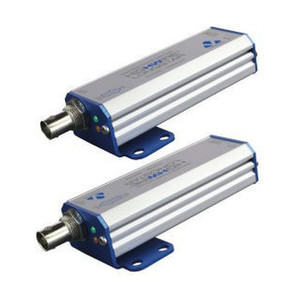
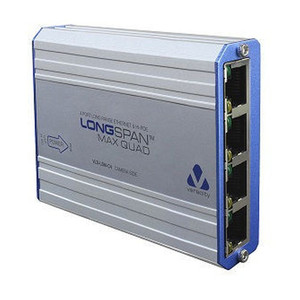
Veracity VLS-1P-CC PoE Extender
The Veracity VLS-1P-CC (often searched as VLS 1P CC) is a passive PoE extender purpose-built to overcome the fundamental distance limitation of IEEE 802.3af and 802.3at standards — the 100-meter cable run ceiling. For security integrators and IT infrastructure teams deploying network power solutions, this unit eliminates the need for intermediate electrical circuits or redundant power supplies at remote endpoints, directly reducing installation labor and material cost in large-scale deployments.
Overview
Standard PoE sources (managed switches, standalone injectors, midspan devices) can reliably deliver power and data up to 100 meters over a single Cat5e/Cat6 run. Beyond that distance, signal and power both degrade. The VLS-1P-CC intercepts the PoE signal at any point along the cable run, regenerates both the data signal and power envelope, and continues delivery to the remote device — effectively resetting the distance budget. This is essential for parking lot camera arrays, perimeter fence monitoring, utility cabinet surveillance, and any multi-building campus where standard PoE reach falls short. Consult detailed datasheets for maximum chaining capability and cumulative distance performance when multiple extenders are deployed in series.
Key Features
- 10/100 Mbps Fast Ethernet: Operates at standard Fast Ethernet data rates, adequate for IP security cameras, access control readers, intercoms, and networked sensors that do not demand Gigabit throughput. This speed tier is cost-effective for surveillance and perimeter applications where video bitrate and control latency do not exceed 100 Mbps capacity.
- Extended PoE Reach: Pushes power delivery well beyond the standard 100-meter IEEE limit, reducing infrastructure complexity. Single-run cable designs eliminate intermediate splice boxes, junction enclosures, and the labor cost of running separate power circuits to remote locations.
- Passive Power Extension: Extends both data signal and PoE power over the same twisted-pair cable without active amplification or additional power inputs. This simplifies deployment logistics — no separate 12VDC or 24VAC supplies to install, route, and maintain at the extension point.
- IEEE 802.3af/at Compatibility: Accepts standard PoE sources and passes power to standard IEEE-compliant endpoint devices. Works with any PoE injector, managed PoE switch, or midspan power source that outputs 802.3af (15.4W) or 802.3at (30W) power signatures.
- Compact Mounting Profile: Minimal footprint allows installation in cable trays, conduit junction boxes, equipment racks, or wall-mounted enclosures. Form factor does not demand dedicated cabinet space or environmental conditioning.
- Low-Latency Signal Regeneration: Maintains signal integrity and minimal transmission delay for real-time security applications. Preserves data fidelity over extended distances without introducing frame loss or timing drift that would compromise video stream continuity or access control response times.
Integration and Deployment
Install the VLS-1P-CC at any intermediate point between the PoE source and the remote device. This can be at a cable junction, intermediate utility cabinet, or climbing a vertical cable run. The unit regenerates the signal and resets the distance budget, allowing an additional 100-meter segment (or more, depending on cable quality and cumulative load) beyond the standard limit. For campus-wide deployments, multiple VLS-1P-CC units can be chained in series to cover very long cable runs; consult the datasheet for cumulative power-loss curves when daisy-chaining multiple extenders.
Common deployment scenarios include outdoor camera arrays where trenching additional electrical service is prohibitive, multi-building networks across parking areas or industrial sites, and temporary or relocatable monitoring stations where cabling must span areas with limited infrastructure. The VLS-1P-CC is also valuable in retrofit installations where adding power sources requires architectural or electrical review — a single-run cable extension is often faster to approve and deploy.
Specification Summary
The VLS-1P-CC operates at 10/100 Mbps Ethernet speeds and is engineered for extended-range PoE power delivery. The unit maintains full IEEE 802.3af and 802.3at compliance, ensuring compatibility with standard PoE sources and devices. For exact maximum extension distances, operating temperature ranges, cumulative power consumption, and chaining performance, refer to the PoE planning guide or contact technical support with your specific cable gauge, ambient conditions, and device power requirements.
When to Choose a Different Model
If your remote devices require Gigabit data throughput (high-bitrate video, bulk data transfer, or modern multi-sensor cameras), evaluate higher-speed PoE extenders or alternative power delivery architectures such as PoE++ injectors or dedicated power distribution panels. If your installation spans beyond two or three serial extension segments, or if daisy-chaining introduces unacceptable cumulative power loss, consider running a secondary electrical service to an intermediate cabinet instead — the infrastructure cost may offset the complexity of managing multiple extender units.
Frequently Asked Questions
Q: Can I chain multiple VLS-1P-CC units to extend PoE over very long distances?
A: Yes, the VLS-1P-CC can be deployed in series, but cumulative power loss increases with each additional extender and cable segment. Consult the datasheet for maximum daisy-chaining recommendations and performance curves based on your specific cable gauge and total distance.
Q: Does the VLS-1P-CC work with both 802.3af and 802.3at PoE sources?
A: Yes, the unit is compatible with both IEEE 802.3af (15.4W) and 802.3at (30W) PoE standards. Ensure your source and endpoint device are IEEE-compliant to avoid power signature conflicts.
Q: Will the VLS-1P-CC add latency or jitter to my security application?
A: The extender maintains low-latency signal regeneration, preserving data integrity and minimal transmission delay. For real-time surveillance and access control applications, the delay is negligible.
Q: What cable gauge should I use with the VLS-1P-CC?
A: Standard Cat5e or Cat6 cable is compatible. Heavier cable gauge (22 AWG or better) reduces resistive loss and is preferred for extended runs; refer to the datasheet for recommended gauge by total cable length.
Q: Can I install the VLS-1P-CC outdoors?
A: The unit is designed for secure, sheltered mounting in conduit, junction boxes, or protected enclosures. For fully outdoor exposure, consult the datasheet for environmental operating ranges and consider protective weatherproof housings.
Q: Does the VLS-1P-CC support PoE++ (802.3bt) or higher power classes?
A: The VLS-1P-CC is engineered for standard 802.3af and 802.3at delivery. For PoE++ and higher-power applications, contact the manufacturer for alternative extender models designed to handle Class 4 and Class 5 power signatures.
Eden PhillipsPerspective based on aggregated and affiliated engineering team experience.
During large-scale campus surveillance deployments, the VLS-1P-CC has proven itself a cost-effective workaround to the stubborn 100-meter PoE distance ceiling. By installing the unit at intermediate cable runs — typically in utility cabinets or conduit boxes — you reset the distance budget and eliminate the need for costly electrical contracting to run separate power circuits to remote corners of the site. The passive extension model is particularly valuable because it requires no additional power supply, no separate control wiring, and no active management.
Technical Highlights:
- 10/100 Mbps Data Throughput: Perfectly adequate for IP cameras, intercom systems, and access control readers typical in perimeter and utility monitoring. You won't see bandwidth bottlenecks unless you're streaming multiple 4K feeds or running bulk data transfers — neither of which is common in extended-range PoE deployments.
- IEEE 802.3af/at Full Compatibility: Works with any standard PoE switch or injector. No proprietary power handshaking, no firmware compatibility quirks. If your source outputs 802.3af or 802.3at, the VLS-1P-CC will regenerate it and pass it downstream without signal degradation.
- Passive Signal Regeneration: No active amplification means no additional power supply to install at the extension point. Single cable run from source to extender to device — simplified cabling design, fewer failure points, lower maintenance burden.
Deployment Considerations:
- Cumulative power loss increases when chaining multiple units in series. If you're planning to daisy-chain more than two or three extenders, model the total cable length and device power draw against the datasheet curve — you may hit practical limits faster than you expect.
- The unit itself draws negligible power (operates passively), but the regenerated PoE signal still has to reach the endpoint device. A camera drawing 13W at 100 meters may draw closer to 15–16W after passing through two extenders over another 100 meters — ensure your PoE source can handle the cumulative load.
- Placement in a weatherproof enclosure is essential if the intermediate cabinet or conduit location experiences temperature swings, moisture, or dust. The VLS-1P-CC itself is compact, but protecting the connection points (RJ-45 connectors) from corrosion will extend its service life significantly.
The VLS-1P-CC is the right choice when you're already committed to single-run cabling and want to avoid the infrastructure work of pulling a separate electrical service. It's particularly effective in retrofit installations, temporary deployments, and campus networks where the electrical plan is fixed. For permanent, mission-critical installations with very long distances (beyond 300 meters cumulative), evaluate whether a dedicated power panel at an intermediate location is more cost-effective over the system lifecycle.