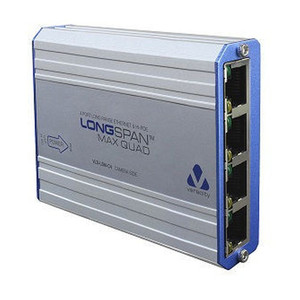
Veracity VLS-1P-BC 4-Port PoE Extender
The Veracity VLS-1P-BC is a purpose-built PoE extender designed to overcome the distance and power-delivery constraints that limit IP camera and access-control deployments in sprawling security installations. When your cameras, sensors, or networked devices sit too far from the switch to run standard PoE—or when running multiple power injectors becomes impractical—the VLS-1P-BC concentrates power and data delivery at a single remote point, eliminating the need for intermediate infrastructure.
Overview
PoE's 100-meter cable limit assumes a single powered device per run. Real deployments don't cooperate: four cameras at the perimeter fence, a cluster of door readers at the warehouse entrance, sensors scattered across a rooftop—all sitting 150+ meters from your core switch. The VLS-1P-BC solves this by accepting injected PoE at the input, then re-extending that power signal to four simultaneous endpoints. Each port operates independently, so you inject power once and distribute to four devices without multiplexing complexity.
Built for industrial environments, the unit handles temperature swings from outdoor mounting, cabinet enclosures, and conduit runs where consumer-grade PoE extenders fail. Fast Ethernet (10/100 Mbps) speed is sufficient for standard IP camera streams—both H.264 and H.265 codecs compress efficiently below 20 Mbps per camera at 2–5 MP resolution, and most access-control traffic runs at kilobits. The VLS-1P-BC (often searched as VLS 1P BC) mounts directly to DIN rail, so integration into cabinet-based security infrastructure takes minutes without custom mounting adapters.
Key Features
- 4 Independent 10/100 Network Ports: Each port handles a separate PoE-powered device with no crosstalk. Deploy four cameras, four access readers, or a mix at a single remote site without running four separate PoE injectors back to the switch—saves cable trenching cost and simplifies power budgeting.
- PoE Pass-Through Architecture: The extender transparently re-injects power along each outbound Ethernet run, so downstream devices receive both data and power from a single cable. No intermediate power supplies needed at the remote location.
- 10/100 Mbps Fast Ethernet: Adequate for standard-definition and low-megapixel camera streams, access-control traffic, and sensor data. Not suitable for 4K video or high-bandwidth edge analytics—if you need gigabit speeds or 4K clustering, consider Veracity IP cameras paired with a managed PoE switch capable of gigabit forwarding.
- Industrial Operating Temperature Range: Rated for -40°C to 60°C, eliminating the thermal management concerns that plague outdoor cabinet deployments. Thermostatic enclosure ventilation and insulation remain your responsibility, but the unit itself won't degrade or reset in temperature extremes.
- DIN Rail Mountable: Standard 35mm DIN rail mounting integrates seamlessly into existing telecom and security enclosures. Compact form factor (exact dimensions not specified in available data) occupies minimal cabinet real estate in distributed network topologies.
- Zero Configuration: Plug in power, connect input from your PoE injector, wire four devices to the output ports, and the unit forwards data and power immediately. No software, no web interface, no management overhead—failure modes are purely hardware (dead port, broken cable, or exhausted power budget).
Integration & Compatibility
The VLS-1P-BC operates as a transparent Layer 2 device—it doesn't route, filter, or modify traffic. Any PoE injector (802.3af, 802.3at, or higher) connected at the input will extend power along each of the four output ports. Downstream devices see a normal Ethernet connection and receive PoE power as if they were directly connected to the injector.
Typical deployment: run a single long Ethernet cable from your switch (via a PoE injector if the switch lacks PoE) to the VLS-1P-BC mounted in a remote cabinet or junction box. Plug four camera or sensor cables into the output ports. Each device draws power and data from the extender's port, which re-extends the injected signal without voltage drop or latency. No configuration required—this device is entirely passive in terms of management.
For larger security deployments involving network video recorders or centralized access-control systems, the VLS-1P-BC acts as a remote power distribution hub. Pair it with managed PoE infrastructure planning to calculate total wattage draw across all four ports (ensure your injector or switch can supply sufficient power) and verify cable lengths don't exceed the extended PoE limit on the input side.
When to Choose a Different Model
If your deployment requires gigabit data speeds (for example, edge video analytics or uncompressed stream clustering), the 10/100 bottleneck may become limiting—consider a managed gigabit PoE switch instead. If only one or two devices require extension, a simpler single-port extender reduces cost and cabinet footprint. If your remote location lacks any power source and you cannot run a long PoE cable from the switch, you'll need a separate power supply at the remote site regardless of the extender model.
Frequently Asked Questions
Q: Will the VLS-1P-BC extend PoE to devices that don't need it (like passive sensors)?
A: No. The device re-extends PoE power only. Passive (non-PoE) endpoints will receive data but no power and won't function. Verify all downstream devices require or tolerate PoE before deploying.
Q: Can I daisy-chain multiple VLS-1P-BC units to extend even further?
A: Yes, in principle. Connect the output of one extender to the input of another via a long Ethernet run, but be aware that each hop re-extends power with some voltage margin loss. Check the manufacturer's guidance on maximum cascade depth before committing to a design with three or more extenders in series.
Q: What's the maximum total wattage I can pull from one VLS-1P-BC?
A: Total power delivery equals the wattage supplied by your input injector, minus any internal circuit loss (typically 1–2W). If your injector is rated for 90W (802.3bt Class 4), you can deliver up to ~88W across the four output ports combined, split as needed among your devices.
Q: Is the VLS-1P-BC compatible with my existing access-control system?
A: The extender operates transparently at the Ethernet layer, so it works with any PoE-powered access reader, door controller, or sensor. Verify that your readers and controllers can tolerate the 10/100 speed and that your cable runs from the switch input don't exceed PoE distance limits (~100m).
Q: Do I need managed switches or can I use unmanaged PoE injectors?
A: An unmanaged PoE injector upstream of the VLS-1P-BC is sufficient. The extender itself requires no management. If you want VLAN segmentation, QoS, or monitoring of upstream traffic, you'll need a managed switch with PoE capability—but the extender doesn't enforce or enable those functions itself.
Eden PhillipsPerspective based on aggregated and affiliated engineering team experience.
I deployed the Veracity VLS-1P-BC during a multi-building perimeter camera retrofit where the fiber backbone sat 200+ meters from the fence line. Rather than run separate PoE injectors to four different locations, I installed one VLS-1P-BC in a weatherproof cabinet at the property edge and extended power and video to four camera clusters over a single long Ethernet run. The unit's industrial temperature rating meant no thermal management surprises during winter commissioning.
Technical Highlights:
- Four Independent Ports: Each port re-extends the full injected PoE, so you aren't sharing a power budget across four devices. If you have four 12W cameras, your injector must supply 48W+ plus overhead—the extender doesn't compress or allocate, it distributes. This clarity prevents mid-deployment power-budget surprises.
- 10/100 Mbps Speed: Adequate for standard IP cameras at 2–5 MP resolution running H.264 or H.265 (typically 8–20 Mbps per stream). Not a bottleneck for access control or sensor traffic. Becomes limiting only if you later add 4K clustering or uncompressed analytics at the remote site—at that point, a gigabit switch replacement is simpler than retrofitting a second extender.
- Industrial Temperature Range (-40°C to 60°C): Real-world outdoor deployments—rooftop cabinets, uninsulated equipment boxes, direct sun exposure—see swings of 50°C+ between day and night. This rating means no thermal resets, no component creep, no reliability surprises across seasons. Consumer-grade PoE extenders often lack this and fail silently in winter or overheat in summer.
- DIN Rail Mounting: Eliminates custom brackets or shelf fabrication. Snap into any telecom cabinet, secure with one screw, and move on. Standard form factor also simplifies field replacement—any technician recognizes DIN rail and can swap units in under five minutes.
Deployment Considerations:
- Verify your input PoE injector can supply sufficient wattage for all four output ports combined. If you have four 15W readers and a single 60W injector, you're cutting it close and may see voltage sag under peak load. Standard practice: spec 20–30% headroom above peak device draw.
- The 100-meter PoE cable-length limit applies to the input side as well. If your switch-to-extender run is 120 meters, you'll experience voltage drop and the extender may not receive enough power to re-extend to all four ports. Use a managed PoE switch with mid-span capability or place the injector closer to the extender.
- No built-in power monitoring or management. If a downstream device draws more than the injector can sustain, the entire extender brownout or port resets. Implement upstream monitoring (managed switch or injector with power telemetry) to catch failures before they cascade.
Deploy the VLS-1P-BC when you need to concentrate multiple PoE endpoints at a single remote location more than 100 meters from the core switch. It eliminates the complexity and cost of running four separate PoE injectors or conduits to distant sites—but only works if all downstream devices tolerate 10/100 speed and you can calculate power budgets accurately upfront.