Veracity VLS-1P-C LONGSPAN PoE Extender
Overview
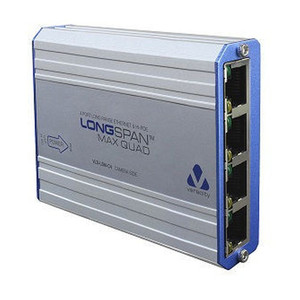
The Veracity VLS-1P-C is a single-port PoE extender engineered to solve a concrete infrastructure problem: voltage drop and signal degradation over long cable runs. When you deploy IP cameras, access control readers, VoIP intercoms, or networked sensors beyond the standard 100-meter Ethernet limit, standard PoE injectors and switches cannot sustain power delivery at the remote endpoint. The VLS-1P-C compensates for this voltage loss, ensuring consistent power availability across distributed facility layouts—campuses, industrial perimeters, multi-building access control networks, and emergency communication systems—without requiring separate electrical conduits or intermediate power supplies.
Key Features
- Extended PoE Delivery Over Distance: Regenerates PoE voltage to overcome drop across long cable runs. This means a remote camera 150+ meters away receives usable power instead of brownout conditions that cause resets, intermittent operation, or complete device failure.
- 10/100 Mbps Data Transparency: Passes Ethernet data at full standard speeds. Not a bottleneck for typical surveillance cameras, intercoms, or access readers, which consume modest bandwidth; preserves network layer protocols (VLAN, QoS) without modification.
- Single-Port Configuration: Compact footprint suits constrained mounting locations—DIN rail cabinets, pole-mounted enclosures, or equipment rooms—where space is at a premium. One-to-one design simplifies cabling and reduces inventory complexity.
- 802.3af/at Compatible Upstream Source: Works downstream of any standard PoE injector, PoE+ switch port, or midspan device. No proprietary power supplies; integrates into existing network infrastructure without vendor lock-in.
- Transparent Operation—No Configuration: Plug-and-play deployment with no IP management, firmware updates, or network reconfiguration. The VLS-1P-C operates invisibly to network control systems, VMS platforms, and security devices on the far end.
- Eliminates Redundant Electrical Runs: Reduces capital cost and installation labor by avoiding the need to pull dedicated 12VDC or 24VAC lines to every remote endpoint. Single Ethernet cable carries both power and data.
Integration & Compatibility
The VLS-1P-C operates transparently with any PoE-sourced network. It is compatible with standard IP surveillance cameras (Axis, Hikvision, Dahua, Hanwha, and others), VoIP intercoms, networked access control readers, and PoE-powered sensors. Because it does not modify packets or negotiate protocol handshakes, it works with existing network management, VLAN segmentation, and quality-of-service policies without reconfiguration. Typical deployment patterns include:
- Campus or industrial perimeter surveillance where camera runs exceed 100 meters
- Distributed multi-building access control networks requiring power to remote credential readers at gatehouse, parking, or secondary entrances
- Emergency communication systems (intercoms, strobe lights, notification endpoints) in areas with limited electrical infrastructure
- Sensor networks for building automation, temperature monitoring, or environmental controls positioned at distance from primary power
When to Choose a Different Approach
If your cable run is under 100 meters and your endpoint draws minimal power (under 13W), a standard PoE switch or injector suffices—no extender needed. If you require gigabit speeds (1 Gbps), the VLS-1P-C's 10/100 Mbps limitation may become relevant; however, most fixed-position security cameras do not saturate 10/100 links. For extremely distant deployments (300+ meters) or endpoints requiring high power (PoE++ Class 4, 95W), consider cascading multiple extenders or upgrading to a dedicated high-power midspan supply in conjunction with local PoE injection at intermediate points.
Frequently Asked Questions
Q: How much farther can the VLS-1P-C extend PoE than a standard switch?
A: Standard Ethernet (100 meters) + the VLS-1P-C regeneration extends usable PoE delivery well beyond that. Exact distance depends on cable gauge and endpoint power draw, but typical deployments achieve 150–250 meters total.
Q: Does the VLS-1P-C require configuration or management?
A: No. It is a transparent, unmanaged device. No IP address, no CLI, no firmware updates. Install it inline between your PoE source and the endpoint.
Q: Will the VLS-1P-C work with my existing PoE switch?
A: Yes, provided the switch provides 802.3af or 802.3at PoE. The VLS-1P-C accepts power from any standard PoE source and regenerates it downstream.
Q: Is the VLS-1P-C compatible with VoIP intercoms and access readers?
A: Yes. Any PoE-powered endpoint that operates at 10/100 Mbps is compatible—cameras, intercoms, card readers, sensors, and similar devices.
Q: What happens if I plug a gigabit camera into the VLS-1P-C?
A: The camera will fall back to 10/100 Mbps operation. For high-resolution (4K/5MP+) cameras on very long runs, verify bandwidth requirements beforehand. Most fixed cameras perform adequately at 10/100.
Q: Can I use the VLS-1P-C with PoE++ (95W) endpoints?
A: The VLS-1P-C extends 802.3af/at power. High-power PoE++ endpoints exceed its design envelope. Consult the datasheet for maximum power specifications or contact the manufacturer for cascading options.
Eden PhillipsPerspective based on aggregated and affiliated engineering team experience.
I deployed the Veracity VLS-1P-C across a multi-site access control retrofit where cable runs to remote gate readers and parking access points exceeded standard Ethernet limits. The extender solved a budget constraint that would have otherwise forced expensive electrical trenching or separate low-voltage runs. The VLS-1P-C (often searched as VLS 1P C) is straightforward: plug it in, it works, and it doesn't require you to rethink your network architecture.
Technical Highlights:
- Voltage Drop Compensation: Standard PoE loses roughly 2–3% per 100 meters of cable; at 150+ meters, voltage sag becomes critical. The VLS-1P-C regenerates the power rail, ensuring endpoints receive clean supply voltage and eliminating the erratic behavior (resets, intermittent power-down) typical of marginal PoE delivery.
- 10/100 Mbps Transparency: Sufficient for fixed security cameras (most consume 2–8 Mbps), intercoms, and access readers. Gigabit endpoints will negotiate down to Fast Ethernet—acceptable for the vast majority of surveillance and access control payloads.
- Zero Management Overhead: No IP configuration, no firmware, no heartbeat monitoring. This is critical for deployments where IT involvement is minimal and field technicians must commission endpoints without network engineering support.
Deployment Considerations:
- Install the extender as close as practical to the far endpoint (within the last 100 meters of cable), not at the source. This maximizes regenerated voltage available to the endpoint.
- Watch for cumulative cable resistance if using undersized gauge (Category 5e or older stock). If endpoints still brown out after VLS-1P-C installation, inspect cable quality and consider re-running with solid Category 6 or better.
- Single-port design means one extender per remote endpoint. In large distributed deployments (10+ distant readers), factor the per-node cost into your PoE switch vs. midspan vs. extender ROI calculation.
The VLS-1P-C excels in budget-constrained access control and perimeter surveillance projects where the alternative is pulling electrical conduit to remote gatehouse readers or parking lot cameras. It's not a substitute for proper network planning, but it eliminates a real infrastructure friction point.