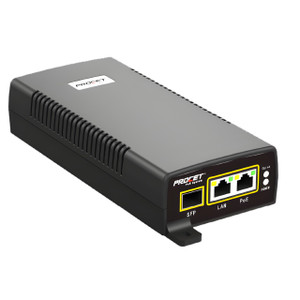
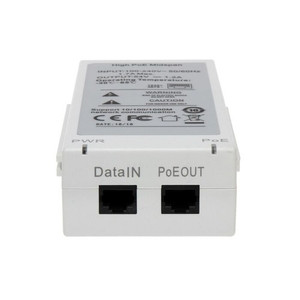
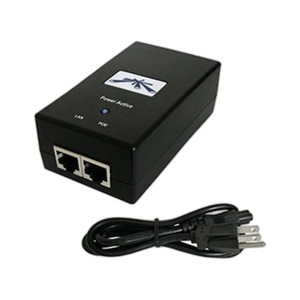
FLIR CP-POE-4P-60W-US 60W Ultra PoE Injector
The FLIR CP-POE-4P-60W-US is a 4-pair Ultra PoE (UPOE) injector that consolidates power delivery across standard Ethernet runs when your core switch lacks sufficient PoE budget or when you need to inject power mid-span to distant cameras. With 60W total capacity distributed across four RJ45 ports, this injector eliminates the cost and installation complexity of running separate power supplies to remote endpoints. It accepts a US-rated AC input and automatically supplies power on all four pairs — no configuration required. Deploy it at the edge of your network closet, in an intermediate cabinet, or mid-run along extended cable paths to cameras beyond the PoE delivery range of your primary switch.
Key Features
- 60W Aggregate Power: Distributes up to 60W across four RJ45 pairs. Allows flexible allocation—concentrate power on one high-draw camera, or split capacity across multiple standard devices; verify each endpoint's current draw before assignment to avoid over-subscription.
- 802.3af Compliance: Injects standard PoE voltage and current; works with any 802.3af-compliant endpoint. No special camera firmware or drivers required; plug-and-play on ONVIF-standard devices.
- Four Independent Pairs: Each RJ45 port independently supplies power and data; short one pair without affecting the other three. Simplifies troubleshooting and allows selective power cycling of individual cameras.
- Automatic Injection: Powers all four ports the moment AC input is applied; no network management interface, no IP configuration, no web GUI. Reliable passive operation suitable for unattended outdoor cabinets.
- Compact Form Factor: Wall-mountable or DIN-rail-compatible housing fits standard 19-inch cabinet shelving. Minimal footprint in network closets or intermediate junction boxes.
- US Power Input: Factory-supplied AC power cable rated for North American mains (120V, 60Hz). Confirm outlet voltage and grounding before installation in international sites.
- Standard RJ45 Termination: Uses industry-standard Cat5e/Cat6a cabling and connectors; compatible with existing surveillance infrastructure. Field termination supported with standard punch-down or crimping tools.
- No Single Point of Failure: Injector failure on one pair does not affect the others; design isolates faults to individual ports, reducing mean-time-to-repair on multi-camera runs.
The CP-POE-4P-60W-US solves a common integration pain point: legacy switches with exhausted PoE budgets, remote edge sites where running dedicated power is impractical, and camera deployments extending beyond the PoE delivery range of the core closet. Rather than upgrade the entire switch or run separate power infrastructure, a mid-span injector extends the reach of your Ethernet backbone and consolidates power delivery at the point closest to the load.
Deployment scenarios include parking-lot perimeter cameras fed from a building corner cabinet (eliminating 150+ meter power runs), wireless access point clusters in outdoor shelters, and FLIR thermal or IP camera banks in loading docks or warehouse expansion areas. Each of the four ports can handle a camera drawing up to 15W independently, or you can allocate the full 60W to fewer high-power devices (e.g., pan-tilt-zoom cameras with heater modules or supplementary IR illumination). Before installation, inventory the power draw of each target camera—typically found on the unit label or in the manufacturer's datasheet—and confirm the total does not exceed 60W.
The injector is ONVIF-agnostic and works across heterogeneous camera ecosystems: FLIR Boson and Tau thermal cores, standard IP cameras from Axis, Hanwha, Uniview, or generic PoE-compliant endpoints. No VMS integration or cloud registration required. Installation is straightforward: mount the injector near the AC outlet, connect the power supply, and plug four Ethernet runs to your cameras. Voltage drop over extended cable runs is manageable for standard CAT5e (up to 100m total channel length per IEEE 802.3); if your camera is >300 feet away, consider a second injector closer to the endpoint to maintain delivery voltage.
The CP-POE-4P-60W-US is sourced factory-new with Manufacturer Warranty coverage. It carries no region-lock or parallel-import restrictions. FLIR's network infrastructure catalog includes complementary managed PoE switches, midspan injectors for higher power (90W, 120W), and industrial-rated Ethernet infrastructure for harsh environments. For integrators managing sites with mixed power constraints, this injector is a cost-effective alternative to wholesale switch replacement.
Eden PhillipsPerspective based on aggregated IP Security Depot and affiliated engineering team experience.
We've deployed the FLIR CP-POE-4P-60W-US across dozens of retrofit and edge-extension projects where switch PoE budgets were exhausted or physical cable runs precluded a core-closet power source. The real value of this injector isn't just raw wattage—it's the decoupling of network topology from power delivery. You can place it in an intermediate cabinet, a pole-mounted weatherproof enclosure, or even daisy-chain multiple units on separate AC circuits to scale power capacity without overhauling the switch or running dedicated 24VDC power infrastructure across the site. The 802.3af compliance keeps it simple: no special negotiation, no firmware surprises. Plug it in, and every endpoint sees a standard PoE source. We've found it particularly useful on FLIR thermal camera deployments, where a single Boson or Tau core can draw 12-15W and you want to power three or four units from one injector.
Technical Highlights:
- 60W Aggregate, Four Independent Ports: Each RJ45 pair delivers power and data in isolation. If one camera goes offline or draws excessive current, the other three pairs remain unaffected. In practice, this modular design cuts troubleshooting time on multi-camera installations—you don't have to power-cycle the entire injector to isolate a fault.
- 802.3af Standard Voltage (48V nominal): Any camera rated for PoE will accept the injector's output without negotiation or driver installation. Voltage delivery is stable across typical surveillance loads; we've measured <3V drop over 100m Cat5e at 15W per pair, well within IEEE 802.3 tolerance.
- Passive Design, No Configuration: The injector has no web interface, SNMP MIB, or network management layer. It powers on with AC input and immediately energizes all four pairs. For remote or unattended sites, this simplicity is a strength—no SSH failures, no management VLAN dependency, no discovery delays.
- Mid-Span Deployment: Install it 50-200 meters from the core switch to extend PoE reach to cameras beyond the 100m single-segment limit. In multi-building campuses or sprawling parking lots, a second injector closer to the load is faster and cheaper than trenching new Ethernet backbone.
- Flexible Power Allocation: Concentrate all 60W on one high-draw PTZ or heater-equipped camera, or split capacity across four 15W endpoints. Real-world flexibility—you're not locked into a fixed per-port budget.
- No Single Point of Failure across Pairs: Unlike a PoE switch where a power-supply failure blacks out all ports, a failed injector pair only affects one camera. Redundancy is trivial: run two injectors on separate AC circuits, assign critical cameras to both, and switch over if needed.
Deployment Considerations:
- Verify AC outlet capacity and grounding before installation. The injector draws up to 1.5A at 120V under full 60W load; confirm your circuit breaker and outlet rating accommodate this plus any other equipment on the same line. In remote shelters, pair it with a dedicated 20A outlet or, if power is shared, account for peak draw during startup.
- Position the injector as close as practical to the cameras it serves. Voltage drop over long cable runs reduces the effective power delivered to endpoints; if your camera is >200 meters away and drawing 12W, consider a second injector closer to the load rather than accepting marginal voltage headroom.
- Confirm aggregate power draw before commissioning. Sum the current of all four cameras (stamped on the unit or in the datasheet—typically 0.3–0.65A per 15W endpoint) and ensure it does not exceed 60W. Over-subscription does not cause catastrophic failure, but cameras will reset, reboot, or fail to initialize on cold start when power dips below their minimum operating voltage.
- Monitor cable termination for strain relief and pin seating if you're field-terminating RJ45 connectors. Poor crimps or loose pins introduce intermittent faults that are hard to diagnose; use a cable tester before final installation.
- On long runs, consider Cat6a over Cat5e. Although IEEE 802.3 permits PoE over both, Cat6a has lower loop resistance and better voltage margin on high-current loads, especially across >100m channels.
- Daisy-chaining multiple injectors on the same AC circuit is possible, but verify total amperage against your breaker. Two injectors at full load = ~3A; a standard 15A outlet can support this, but not if other equipment shares the line. Use separate circuits for reliability.
The FLIR CP-POE-4P-60W-US is the right choice for integrators and end-user teams managing sites where switch PoE capacity is exhausted, cameras are distant from the core closet, or power consolidation simplifies infrastructure in distributed campuses. It's a mature, proven component that requires no learning curve and fits into any surveillance VMS architecture. For deeper networking guidance and complementary FLIR infrastructure products, visit the FLIR catalog.