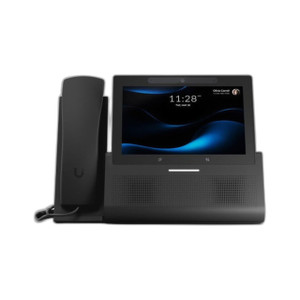
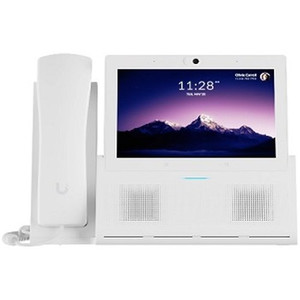
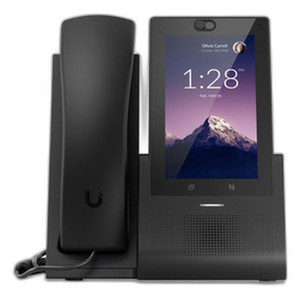
Ubiquiti UTP-G3-TOUCH-PRO Desktop VoIP Phone
Overview
The Ubiquiti UTP-G3-TOUCH-PRO is a purpose-built desktop phone engineered for enterprise VoIP deployments running UniFi Talk. This touch-enabled device integrates directly into Ubiquiti's unified infrastructure ecosystem, delivering carrier-grade telephony over standard network connectivity with zero dependency on external power sources. The UTP-G3-TOUCH-PRO (often searched as UTP G3 TOUCH PRO) operates entirely on Power over Ethernet (PoE), drawing just 10W of power — leaving your switch's power budget intact for cameras and access control. Internally, an Octa-Core ARM Cortex A53 processor paired with 32 GB onboard storage handles call logs, contacts, voicemail, and system operations without requiring a centralized database or cloud sync.
Key Features
- Dual Gigabit Ethernet ports: One port connects upstream to your network; the second lets you daisy-chain a workstation, IP camera, or access point without consuming additional switch ports. Reduces cabling runs on crowded desk deployments.
- 10W PoE power consumption: Standard IEEE 802.3af PoE suffices — no PoE+ injector required. Typical switch power budgets remain untaxed, making it practical to deploy dozens of phones without upgrading infrastructure.
- Touch-enabled color display: Responsive interface handles call transfer, conference bridging, presence management, and on-device directory search. Mute button provides tactile one-touch audio control — critical in open office and call-center environments.
- 802.11a/b/g/n/ac Wi-Fi backup: If wired Ethernet fails, the phone automatically roams to Wi-Fi. Not a replacement for hardwired voice, but bridges gaps during network maintenance or temporary access-point expansion.
- Auto-discovery and zero-touch provisioning: Connect to power and the UTP-G3-TOUCH-PRO discovers your UniFi Talk controller via DHCP/DNS, fetches its configuration, and registers in seconds. No per-phone login, no manual IP entry — IT overhead drops sharply in multi-site rollouts.
- Integrated UniFi Talk client: Unified management through the UniFi Application Suite means phone provisioning, user assignment, and firmware updates all flow through your existing UniFi controller. A single pane of glass for switching, wireless, cameras, and voice.
- Compact desktop form factor: 165.4 × 139.5 × 185.3 mm (6.5 × 5.5 × 7.3 in), weighs 1 kg (2.2 lb). Polycarbonate and aluminum enclosure fits standard desk mounts or wall brackets without dominating space. Temperature operating range 0–40°C supports standard office and light industrial environments.
- NDAA and international compliance: FCC, IC, CE, and Anatel certifications (06740-25-08356) ensure regulatory approval across North America, Europe, and South America. NDAA Section 889 compliance satisfies federal procurement rules for government and defense contractors.
- QoS and VLAN support: Voice traffic can be tagged and prioritized at the network controller, isolating call streams from data congestion. Standard 802.1Q VLAN isolation protects voice from noisy data workloads.
Integration and Deployment
The UTP-G3-TOUCH-PRO assumes your organization is already standardized on Ubiquiti network infrastructure — UniFi switching, wireless access points, and the UniFi controller. If you operate multi-site enterprises with existing UniFi footprints, adding UniFi Talk phones eliminates VoIP as a separate, unmanaged silo. Call routing, presence, and device lifecycle all follow UniFi's centralized, API-driven model. For organizations not yet on UniFi, this phone alone doesn't justify the ecosystem shift; compatibility is tightly coupled to UniFi Talk.
Typical deployments span office reception areas, administrative workspaces, call centers, and multi-tenant commercial buildings. Daisy-chaining via the second Gigabit port is particularly valuable in open-plan layouts where running separate drops to each desk adds cost and clutter. Configuration via the touch display requires no training beyond standard phone operation — user assignment and feature activation happen server-side through the controller.
Installation Workflow
Connect the UTP-G3-TOUCH-PRO to a PoE-enabled port on a UniFi-managed switch, and boot completes in under 30 seconds. The phone auto-discovers the UniFi controller, downloads its configuration, and presents on-device prompts for user authentication. Once assigned, the phone rings with incoming calls immediately — no separate provisioning server, no SIP configuration files, no DNS SRV record hunting. Firmware updates push centrally from the controller, eliminating per-phone patching overhead. If the controller becomes unreachable, the phone retains last-known settings and continues operating for active calls, but cannot register new users or accept updates until connectivity is restored.
Frequently Asked Questions
Q: Does the UTP-G3-TOUCH-PRO work with non-Ubiquiti VoIP platforms like 3CX or Asterisk?
A: No. The UTP-G3-TOUCH-PRO is purpose-built for UniFi Talk only. It does not support standard SIP or other VoIP protocols. If your organization uses a third-party PBX, this phone is not compatible.
Q: What happens to calls if the power or network fails?
A: If PoE power is lost, the phone shuts down immediately — no battery backup is built in. If the Ethernet connection drops but Wi-Fi remains available, the phone automatically switches to Wi-Fi for continued service. However, if both Ethernet and Wi-Fi are unavailable, the phone cannot operate. Plan accordingly for mission-critical lines.
Q: Can I connect the second Gigabit port to a PC or printer?
A: Yes. The second port supports standard Ethernet pass-through. Common use cases include a workstation connected behind the phone or an IP-based desk lamp or scanner. No additional configuration is required — the phone bridges traffic transparently.
Q: Is the UTP-G3-TOUCH-PRO NDAA Section 889 compliant?
A: Yes. The UTP-G3-TOUCH-PRO carries NDAA compliance, satisfying federal procurement rules for government and defense agencies.
Q: How many phones can a single UniFi controller manage?
A: This depends on your UniFi Talk license tier and controller hardware. Consult your Ubiquiti pre-sales engineer or the UniFi Talk capacity matrix for your specific deployment size.
Q: Does the phone support call recording or voicemail?
A: Call recording and voicemail are managed at the UniFi Talk controller, not on the phone itself. The controller stores recordings and voicemail messages. Users access voicemail through the phone's directory interface or via the UniFi mobile app.
Ted PerryPerspective based on aggregated and affiliated engineering team experience.
The UTP-G3-TOUCH-PRO fills a genuine gap for teams already committed to Ubiquiti's infrastructure ecosystem. If you're running UniFi switching, wireless, and cameras, adding UniFi Talk phones eliminates VoIP as a separate, unmanaged system. The 10W PoE draw and dual Gigabit pass-through design are thoughtful engineering choices that reduce installation friction on dense deployments. However, this phone is tightly coupled to UniFi Talk — there's no SIP fallback or interoperability with third-party PBX systems. Lock-in is real, and it's intentional.
Technical Highlights:
- 10W PoE (802.3af): Standard switch ports suffice; no PoE+ injector or power-over-budget headaches. Meaningful when rolling out 50+ phones across multiple sites.
- Dual Gigabit ports with transparent bridging: Daisy-chain workstations or IP devices without consuming additional network ports. Cuts cabling labor and switch congestion in open-plan offices.
- 32 GB onboard storage: Stores call logs, contacts, and voicemail metadata locally. No dependency on centralized database for basic phone operation — if the controller becomes unreachable, active calls persist.
- Octa-Core ARM Cortex A53 processor: Responsive touch interface with sub-second call pickup, transfer, and conference bridging. Handles complex call flows without lag.
- Auto-discovery via DHCP/DNS: Zero-touch provisioning reduces per-phone setup to under 30 seconds. Critical for IT cost containment in multi-site rollouts.
Deployment Considerations:
- This phone requires UniFi Talk and a reachable UniFi controller. No controller, no phone operation. Plan redundancy accordingly — a failed or unreachable controller brings the entire phone fleet offline for new calls.
- No battery backup. Power loss = phone offline. If you need emergency calling resilience, budget separate UPS or analog fallback lines for critical reception areas.
- Wi-Fi is a backup, not a primary interface. Voice quality and reliability degrade significantly on congested Wi-Fi. Design with wired Ethernet as the norm.
- Firmware updates are pushed from the controller. If your change window is tight, test updates on a single phone first — controller-side bugs can affect fleet-wide updates.
Best suited for multi-site enterprises standardizing on UniFi infrastructure where unified voice, data, wireless, and video management across a single pane justify the ecosystem commitment. If your organization already has a third-party VoIP platform or values interoperability and choice, this phone locks you into Ubiquiti's walled garden. Evaluate accordingly.