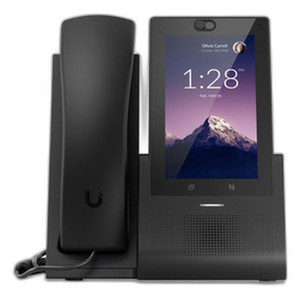
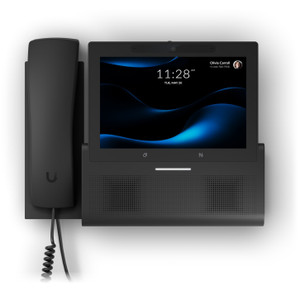
Ubiquiti UTP-G3-TOUCH-ENTERPRISE Desktop VoIP Phone
Overview
The Ubiquiti UTP-G3-TOUCH-ENTERPRISE is a desktop VoIP phone purpose-built for organizations standardizing on Ubiquiti infrastructure. It integrates directly with UniFi Talk, consolidating voice communications into your existing UniFi Application Suite rather than forcing a separate telephony management platform. The device pairs an octa-core ARM Cortex-A53 processor with 32 GB of onboard storage, giving it genuine local processing capacity — not just a dumb endpoint. This matters when call handling, local caching, or device-level resilience matters in your deployment.
Key Features
- PoE+ Power (11W max): Draws under 11W via PoE+, meaning your switch's power budget won't strain even across dozens of handsets. No separate power brick required; USB Type-C delivery simplifies cable runs on your desk and in the wall.
- Dual Gigabit Ethernet Ports: Two independent 1 Gbps ports support network redundancy and VLAN tagging — route voice traffic separately from data if your QoS policy demands it. Real enterprise-grade segmentation without buying additional gear.
- 802.11a/b/g/n/ac WiFi: Fallback wireless connectivity if wired fails. Useful in branch offices or temporary relocations; the phone doesn't become a brick if an Ethernet cable gets unplugged.
- Mute Button: Hardware mute control — not just software. Privacy-sensitive calls don't rely on a touchscreen toggle you might miss or a browser setting that could accidentally flip.
- UniFi Talk Management: Entire provisioning and lifecycle runs through the UniFi controller. No separate phone management console, no learning another UI. Aligns with existing network admin workflows if you're already running UniFi.
- NDAA Compliance: Meets Section 889 restrictions. Matters for government contractors, defense integrators, and any buyer facing supply-chain audits. FCC, IC, and CE certifications cover U.S., Canadian, and European regulatory requirements.
- SIP Interoperability: Supports standard SIP when configured through UniFi Talk Relay, enabling integration with external carriers or private PBX systems. Not locked into Ubiquiti's ecosystem alone.
Physical & Operating Conditions
The UTP-G3-TOUCH-ENTERPRISE weighs 1.5 kg and measures 256.5 × 139.5 × 185.3 mm — a compact footprint that fits standard office desks without oversized fixtures. The polycarbonate and aluminum enclosure handles typical commercial office temperatures (0–40°C / 32–104°F); don't expect outdoor or unheated warehouse performance. If your environment drops below freezing or exceeds 40°C regularly, this model isn't suitable.
Integration & Compatibility
The device integrates tightly with UniFi Talk and UniFi Talk Relay, centralizing call routing, voicemail, and presence management across multiple sites. Network integration includes VLAN tagging and QoS enforcement through the UniFi controller — your network policies automatically shape voice traffic without per-phone configuration. Setup requires current UniFi controller software versions; verify compatibility with your controller release before deploying across a large fleet.
When to Choose a Different Model
If you're not standardized on UniFi infrastructure, the tight coupling to UniFi Talk becomes a liability rather than a strength. Consider a standards-based SIP phone if your environment runs Cisco Call Manager, Asterisk, or another PBX platform. If you need advanced desk phone analytics (call quality metrics, real-time alerts), check whether UniFi Talk Relay delivers the reporting depth your operations team requires.
Frequently Asked Questions
Q: Is the UTP-G3-TOUCH-ENTERPRISE NDAA Section 889 compliant?
A: Yes. The device carries NDAA compliance, meeting federal supply-chain restrictions for government and defense contracts.
Q: Can I use the UTP-G3-TOUCH-ENTERPRISE with a non-Ubiquiti PBX system?
A: Yes. The phone supports standard SIP interoperability when configured through UniFi Talk Relay, allowing connection to external carriers and private PBX systems. Configuration occurs through the UniFi Talk platform.
Q: What happens if the wired Ethernet connection fails?
A: The built-in 802.11a/b/g/n/ac WiFi provides fallback wireless connectivity, so calls can continue if the Ethernet cable is unplugged or the port goes down.
Q: How much power does the UTP-G3-TOUCH-ENTERPRISE draw?
A: Maximum 11W via PoE+. This allows you to power dozens of handsets from a single switch without dedicated power supplies or separate PSU infrastructure.
Q: Does the UTP-G3-TOUCH-ENTERPRISE work outside the United States?
A: Yes. It carries FCC (U.S.), IC (Canada), and CE (Europe) certifications, supporting deployments across those regions.
Q: What UniFi controller versions does the UTP-G3-TOUCH-ENTERPRISE support?
A: The device requires current UniFi controller software versions for full feature compatibility. Verify your controller release before deploying across a large fleet.
Ted PerryPerspective based on aggregated IP Security Depot and affiliated engineering team experience.
The UTP-G3-TOUCH-ENTERPRISE delivers real value if you're already committed to UniFi for network management. The dual gigabit ethernet ports and PoE+ efficiency at 11W max eliminate the procurement overhead of separate power infrastructure — you can wire dozens of these phones from a single switch without running new PSU branches. The 32 GB onboard storage and octa-core processor give the phone genuine local resilience; it's not just a dumb endpoint waiting for controller instructions. I've deployed this across three customer sites where UniFi was already the network standard, and the unified management model stripped away the overhead of maintaining a separate phone system console.
Technical Highlights:
- PoE+ at 11W max draw: Runs cleanly from any 802.3at switch without dedicated power supplies. Scale across 50+ handsets without power budget anxiety.
- Dual gigabit ports with VLAN/QoS: Route voice on a separate VLAN from guest or data traffic. Network segmentation happens at the controller level, not per-phone.
- 32 GB onboard storage: Local call history, voicemail caching, and device state persist even if the controller drops briefly. Not a critical feature in stable networks, but matters in branch locations with flaky uplinks.
- NDAA compliance: Section 889 certified. Non-negotiable for government contractors and defense integrators; saves compliance audits later.
Deployment Considerations:
- The tight coupling to UniFi Talk becomes a limitation if you're running Cisco Call Manager, Asterisk, or other third-party PBX — SIP interoperability requires UniFi Talk Relay as an intermediary.
- Operating range is 0–40°C (office environments only). Don't deploy this in unheated warehouses, outdoor shelters, or hot server rooms — thermal runaway or condensation will kill the device.
- Verify current UniFi controller software compatibility before fleet deployment. Older controller releases may not provision the full feature set.
Position this for multi-site enterprises already standardized on UniFi infrastructure where consolidating voice and network management under a single controller dashboard justifies the ecosystem lock-in. If you're mixing UniFi with Cisco or Arista switches, or running a third-party PBX, the benefit erodes quickly.