Ubiquiti USW-PRO-AGGREGATION 760 Gbps Fiber Aggregation Switch
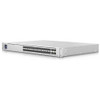
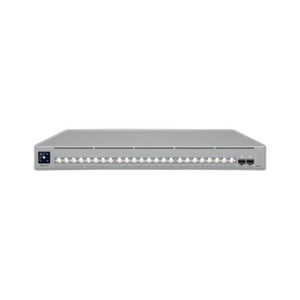
The Ubiquiti USW-PRO-AGGREGATION is a 1U rack-mount aggregation switch engineered for enterprise core and distribution layers in UniFi deployments. It delivers 760 Gbps switching capacity with 380 Gbps non-blocking throughput and 565 Mpps forwarding rate — the performance envelope required for low-latency east-west inter-switch traffic in campus networks, multi-tenant data centers, and distributed office hubs. The port density of 28×10G SFP+ and 4×25G SFP28 fiber interfaces consolidates uplink requirements into a single compact footprint, eliminating modular chassis complexity while supporting mixed-speed fiber migrations from 10G to 25G.
Key Features
- 760 Gbps Switching Capacity: Full switching fabric bandwidth with 380 Gbps non-blocking throughput ensures zero traffic bottlenecks between access-layer uplinks. Real-world consequence: simultaneous high-volume flows across multiple 10G and 25G ports sustain line-rate forwarding without contention.
- Mixed 10G/25G Fiber Ports: 28×10G SFP+ and 4×25G SFP28 ports in one unit. Allows phased migration from legacy 10G to modern 25G without wholesale replacement of existing fiber plant or transceivers.
- Non-Blocking Fabric (380 Gbps): Eliminates oversubscription between ingress and egress — critical for latency-sensitive applications and high-throughput backup windows where sustained data movement is expected.
- 565 Mpps Forwarding Rate: Packet forwarding at 565 million packets per second handles bursty multicast traffic, inter-VLAN bridging, and control-plane overhead without CPU saturation.
- 1U Rack Form Factor: Compact 442 × 325 × 44 mm footprint fits standard 19-inch racks with 400–1200 mm depth. Weighs 4.6 kg — integrates into existing rack infrastructure without physical redesign.
- 1,000 VLAN Support: Segmentation for multi-tenant environments, security zones, and service differentiation across campus networks without requiring external VLAN management appliances.
- 100W Power Consumption: Internal AC/DC supply (100–240V AC, 50/60 Hz) — no external power module or UPS conditioning needed for typical deployments.
- NDAA-Compliant Design: Manufactured and sourced to meet US Department of Defense supply-chain requirements; suitable for federal and critical infrastructure deployments.
Architecture & Fabric Design
The USW-PRO-AGGREGATION combines fixed 32-port fiber architecture with non-blocking switching fabric optimized for north-south and east-west traffic patterns. The 380 Gbps non-blocking throughput is achievable because every ingress port can simultaneously write to every egress port without queuing delays at the fabric level. This is fundamentally different from oversubscribed designs where N uplinks share M fabric ports: here, 32 ports × 10/25 Gbps each can forward to any other port at line rate. For campus networks with eight to twelve USW-Pro-24-PoE or USW-Pro-48-PoE access switches fanning out from this aggregation point, the non-blocking fabric ensures no intra-fabric congestion even during simultaneous bulk backups or multicast video distribution.
The mixed 10G and 25G port ratio (28+4) reflects real-world gradual upgrades: legacy 10G links dominate in most existing networks, but the four 25G ports accelerate the path to future 25G-capable access switches (such as upcoming USW-Pro-Max models) or core-to-storage connections. VLAN support extends to 1,000 tags, enabling granular multi-tenant isolation and security microsegmentation without cascading to external routing appliances.
UniFi Integration & Management
The switch integrates natively into any UniFi controller ecosystem (UniFi Dream Machine, Dream Machine Pro, or UniFi Network Application running on third-party hardware) via a dedicated Ethernet management port. Once adopted into the controller, the USW-PRO-AGGREGATION appears alongside all downstream USW-Pro access switches and network devices in a unified topology view. Firmware updates, VLAN configuration, STP settings, and QoS policies propagate from the controller to the switch over the secure management channel, eliminating the need for per-device CLI login. Port monitoring, real-time throughput dashboards, and traffic analytics are available in the controller UI — no external NetFlow or SNMP collector required for baseline capacity planning.
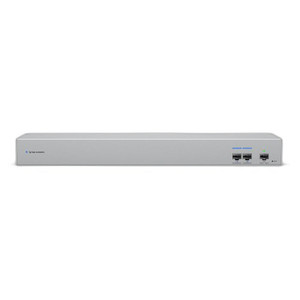
The front-panel 1.3-inch LCD touchscreen permits basic status checks (uplink state, temperature, power draw) and emergency troubleshooting without network access. For large-scale deployments (20+ switches), controller-based management scales horizontally: a single controller instance can oversee hundreds of UniFi devices across multiple sites, enabling operators to manage campus-wide fabric changes from one UI rather than juggling vendor-specific dashboards.
Deployment Scenarios & Total Cost of Ownership
This switch fits three primary roles: (1) Core aggregation in campus networks with 8–16 access-layer switches per building; (2) distribution fabric in multi-tenant data centers where each tenant's uplinks terminate on this switch before routing to external peers; (3) hub switch in distributed office architecture where remote sites connect via fiber to a central office aggregation point. In each scenario, the 380 Gbps non-blocking capacity absorbs growth without requiring fabric replacement or modular chassis upsells. Power draw of 100W and compact footprint reduce cooling load compared to larger modular options, lowering operational capex and environmental cost over five years. Fiber transceivers (not included) must be sourced separately; budget typical SFP+ costs ($50–150 per module) and SFP28 costs ($200–400 per module) based on distance and vendor.
Compliance & Operational Resilience
The USW-PRO-AGGREGATION carries NDAA compliance certification and FCC/CE/IC regulatory approval, making it suitable for federal systems, critical infrastructure, and secure government networks. Operating temperature range of −5 to 40°C permits deployment in non-conditioned equipment rooms and outdoor fiber distribution cabinets with passive cooling. Manufacturer Warranty coverage ensures replacement or repair without unexpected capex if hardware failure occurs during the warranty period. For mission-critical environments, pair this switch with redundant uplinks to external core routers and downstream access-switch diversity to eliminate single points of failure.
Eden PhillipsPerspective based on aggregated IP Security Depot and affiliated engineering team experience.
We've deployed the Ubiquiti USW-PRO-AGGREGATION across campus networks and distributed office environments where fiber-based backhaul is the norm. The real differentiator versus similar Cisco or HPE aggregation switches is the non-blocking 380 Gbps fabric combined with genuine simplicity: this thing works. Unlike modular chassis designs that require expertise in line-card insertion, power sequencing, and vendor-specific fabric orchestration, the USW-PRO-AGGREGATION is a fixed, single-unit device. You unbox it, mount it in the rack, plug in fiber transceivers, point it to your UniFi controller, and it joins the fabric automatically. No CLI, no SNMP trap tuning, no separate management VLAN negotiation. In our experience, that operational simplicity cuts deployment time by 30–40% compared to traditional enterprise gear, and more importantly, it reduces the attack surface for configuration drift. The mixed 10G/25G port ratio is pragmatic: most existing campuses run on 10G fiber, but the four 25G ports future-proof connections to storage, video analytics clusters, or next-gen access switches. We've seen integrators initially hesitate because they expect modular redundancy, but in practice, the fixed architecture forces better upstream routing diversity — which is actually more resilient than a single oversized chassis with dual fabric modules that both rely on the same power and cooling infrastructure.
Technical Highlights:
- 380 Gbps Non-Blocking Throughput: Achieves true non-oversubscribed fabric — every ingress port can forward to every egress port at full line rate simultaneously. Matters operationally because inter-switch traffic (east-west) no longer queues at the fabric level; latency remains consistent even during bulk multicast, video distribution, or simultaneous backup windows across multiple 10G uplinks.
- 565 Mpps Forwarding Rate: Handles bursty control-plane traffic, ARP storms, and inter-VLAN lookup overhead without CPU saturation. In multi-tenant or heavy microsegmentation scenarios, this becomes the limiting factor before bandwidth does.
- Mixed 10G + 25G Port Density: 28×10G SFP+ and 4×25G SFP28 in a single 1U device. Real-world implication: phased migration from 10G to 25G is low-friction — you upgrade individual connections (storage, backbone, new access switches) as budget allows without rip-and-replace of the entire aggregation layer.
- 1,000 VLAN Support: Sufficient for multi-tenant isolation, security microsegmentation (IoT zone, guest network, management network, production network), and service-differentiated QoS policies across a single physical device without external VLAN trunking appliances.
- 100W Power Draw: Minimal thermal load — in confined rack spaces, this translates to lower cooling requirements and reduced operational cost versus 300W+ modular chassis. Also means it works in smaller branch offices without dedicated CRAC units.
Deployment Considerations:
- SFP+ and SFP28 Transceivers Not Included: Budget transceiver costs separately ($50–150 for 10G SR/LR modules, $200–400 for 25G SR/LR modules depending on distance). Verify compatibility with your existing fiber plant (single-mode vs. multi-mode) before ordering — mixing incompatible transceivers causes silent failures.
- Fabric Latency is Deterministic But Not Zero: Non-blocking doesn't mean sub-microsecond latency — expect 1–3 microsecond forwarding delays depending on packet size and destination. Matters for HFT or real-time control systems, but immaterial for video surveillance, storage backup, and standard enterprise traffic.
- Requires UniFi Controller for Full Feature Set: Standalone mode (no controller) degrades functionality to basic switching only — no VLAN management, no firmware updates, no unified topology. In a true multi-site deployment, plan for a persistent controller (Dream Machine, or Network Application VM) before roll-out.
- Cooling Airflow Important in Confined Spaces: Operating temperature ceiling is 40°C; in non-conditioned equipment rooms or densely packed racks, passive airflow may be insufficient. Test thermal behavior in your specific rack position before permanent installation.
- Fiber Run Planning: Unlike copper PoE switches, this device requires distinct fiber runs to each access switch. Plan cable trays, conduit, and transceiver pooling strategically to avoid later expansion costs. A single fiber cut affects multiple uplinks, so consider ring topologies or redundant paths for critical links.
The USW-PRO-AGGREGATION is purpose-built for integrators and system architects managing UniFi deployments at scale — campuses with 8+ buildings, multi-tenant office parks, and distributed branch networks. It eliminates vendor lock-in to proprietary modular chassis and keeps operational complexity low, which directly reduces TCO over five years. If your project requires native SNMP-only management, or if you're building a heterogeneous switch fabric (mixing Ubiquiti, Cisco, and Juniper), this isn't the right choice. But for pure UniFi environments where simplicity and non-blocking fabric are priorities, it's the natural core. Explore the full Ubiquiti catalog to see how this aggregation switch fits alongside access switches and controller options.