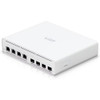
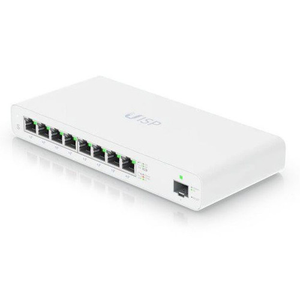
Ubiquiti UISP-S-PLUS 2.5 GbE PoE Management Switch
The Ubiquiti UISP-S-PLUS is a 2.5 GbE PoE management switch purpose-built for regional aggregation and centralized power distribution in mid-to-large ISP and wireless infrastructure deployments. It consolidates management, PoE budget, and fiber uplink capacity in a single unit, eliminating the need for separate power supplies or external PoE injectors across distributed access points, base stations, and field equipment. The hybrid port design—four 2.5 GbE RJ45 copper ports paired with four 10G SFP+ fiber uplinks—accommodates both traditional Ethernet management traffic and high-capacity backbone interconnects without compromise. A 160W PoE budget at 27V passive supports 40W per 4-pair port or 20W per 2-pair cabling, delivering the per-port wattage required by modern WiFi 6 access points and powered outdoor equipment.
Key Features
- 160W PoE Budget at 27V Passive: Powers up to 40W per port on 4-pair cabling, 20W on 2-pair — no external injectors required for compatible downstream devices. Eliminates separate power infrastructure and reduces field installation labor.
- Mixed Copper and Fiber Uplinks: Four 2.5 GbE RJ45 ports + four 10G SFP+ slots enable layered connectivity — standard Ethernet for local management, 10G fiber for high-capacity backbone and multi-site aggregation.
- Four Mounting Configurations: Desk, wall, 1U rack, and outdoor form factors adapt to network closets, splice vaults, field cabinets, and rooftop enclosures without redesign.
- Dual Management Modes: Native UISP Application integration for cloud-connected provisioning and metrics, or standalone local web UI for isolated/air-gapped networks. No forced cloud dependency.
- Port Isolation and DHCP Snooping: Prevents broadcast storms and rogue DHCP servers in large multi-site networks. Critical for sprawling ISP topologies where accidental misconfiguration cascades.
- Passive PoE on All Copper Ports: All four RJ45 ports carry power natively — simplifies cabling and eliminates per-port PoE negotiation complexity on passive 27V infrastructure.
- Per-Port Speed Limiting: Traffic shaping and rate control accommodate mixed bandwidth requirements across heterogeneous endpoints without QoS overhead.
- Redundant Power Input via TransPort: DC redundancy option for critical deployments — dual power feeds prevent single-point-of-failure in revenue-generating or backup network segments.
The UISP-S-PLUS bridges the gap between standard managed switches and purpose-built ISP aggregation hardware. Its design assumes a distributed topology where dozens of outdoor access points, wireless backhaul radios, and field equipment are powered from a handful of central or regional hubs. By consolidating PoE budget and uplink capacity in a single 27V ecosystem, it reduces operational overhead: fewer power circuits to monitor, fewer external injectors to troubleshoot, and less per-site cabling complexity.
The fiber uplink slots are critical for scaling beyond single-site deployments. A typical regional ISP uses four 10G SFP+ connections to tie together 3–5 distributed access points and tie back to a central POP (point of presence) over dark fiber or carrier-provided circuits. The copper ports handle local inter-switch fabric and management traffic, keeping the topology clean and the failure domain isolated. DHCP snooping and port isolation prevent broadcast storms that plague multi-site Ethernet infrastructures — a real problem when a misconfigured device or firmware bug floods all segments with ARP or DHCP traffic.
Management flexibility is a differentiator. Integrators working in carrier or utility environments often need both cloud-connected visibility (UISP Application) and offline fallback (local web UI). The UISP-S-PLUS supports both without firmware toggles or credential juggling. Passive PoE on all copper ports also simplifies deployment in remote or outdoor installations — you don't need to stock separate 802.3at injectors or negotiate per-port power negotiation. If an endpoint is rated for 27V passive, plug it in.
The four mounting options reflect real-world site constraints. Desk mounting suits lab or indoor network-closet deployments. Wall mount and 1U rack fit standard comms cabinets. Outdoor mounting with environmental hardening allows placement in splice vaults or unmanaged shelters where temperature and humidity vary. Total weight of 8.6 lb means it doesn't require reinforced wall anchors or additional structural work.
Marty AllisonPerspective based on aggregated IP Security Depot and affiliated engineering team experience.
We've deployed the UISP-S-PLUS across regional ISP and utility-scale wireless networks where consolidating power and uplink capacity matters. The 160W passive PoE budget is genuinely useful — it removes the capex and operational friction of external injectors and separate 48V circuits. On a typical mid-size deployment with 40–60 powered endpoints spread across 3–4 access points, you're looking at a single 27V 200W supply feeding the switch, which then distributes to all downstream gear. That's simpler than managing a patchwork of PoE injectors, POL (power-over-line) modules, and per-site redundancy schemes. The fiber uplinks are equally pragmatic: four 10G SFP+ slots give you room to grow. We've seen integrators use three SFP+ for multi-site fabric and reserve one for a future aggregation tie-back. The copper 2.5 GbE ports handle local management and access-point interconnect without bottlenecking. Port isolation and DHCP snooping have saved us from broadcast storms caused by misconfigured or failing gear — once you've had a runaway device crash all segments with ARP floods, you appreciate the isolation.
Technical Highlights:
- 160W PoE @ 27V Passive: Supports up to 40W per 4-pair port — enough for dual-radio WiFi 6 access points with integrated PoE-to-local-DC injection, or high-power outdoor wireless bridges. Per-port power metering via UISP Application lets you track real-time draw and forecast capacity on multi-site networks.
- 10G SFP+ Uplinks: Four fiber slots eliminate the 1 GbE bottleneck common on copper-only aggregation switches. We've seen integrators connect three SFP+ to regional POPs and use the fourth for inter-switch fiber backbone. Standard LC connectors and OM3/OM4 multimode or SMF (single-mode fiber) supported — vendor-agnostic transceiver ecosystem.
- 2.5 GbE Copper Ports: Faster than 1 GbE but avoids the cost and power draw of full 10 GbE copper. For local in-cabinet management traffic and access-point fabric, 2.5 GbE is the right balance. Passive PoE on all four means no per-port negotiation or injector staging.
- Dual Management Paths: UISP Application integration provides metrics, alerting, and remote firmware updates; local web UI works offline or in air-gapped networks. No forced cloud dependency — critical for utilities and carriers with data residency rules.
- Port Isolation + DHCP Snooping: Prevents broadcast storms and rogue DHCP from cascading across multi-site fabric. We've seen one misconfigured or buggy device kill an entire ISP segment — this switch doesn't allow that.
Deployment Considerations:
- 27V passive PoE is non-standard — verify all downstream endpoints (access points, radios, switches) support 27V input before ordering. Most modern Ubiquiti gear does; legacy 802.3at or 48V-only equipment will not work. If you have mixed 27V and 48V endpoints, you'll need external injectors or a hybrid power strategy.
- All four copper ports share the 160W PoE budget — if you plug four 40W devices into four 4-pair ports, you'll hit the limit. Real deployments typically use 2–3 powered ports at full draw and 1–2 at lower power. Capacity planning with the UISP Application metrics view is essential before deployment.
- 10G SFP+ transceiver costs scale — LC duplex SFP+ modules range from $20 to $200 per pair depending on reach and vendor. Budget accordingly. Many integrators standardize on Ubiquiti's own SFP+ modules for cross-platform compatibility.
- Outdoor mounting requires UV-resistant enclosure and cable strain relief — UISP-S-PLUS itself has environmental hardening, but the surrounding installation (conduit, cable glands, surge protection) must be site-engineered.
- DHCP snooping and port isolation are enabled by default but require manual per-port configuration in the local web UI or UISP Application. First deployment should include a verification step to confirm isolation rules are live — a common oversight on greenfield builds.
The UISP-S-PLUS is the right device for integrators and carriers building distributed wireless networks where power and uplink capacity are bottlenecks. If you're powering 40+ endpoints from a single hub or tying together 3–5 regional access points over fiber, this switch eliminates infrastructure sprawl. Skip it if your deployment is purely copper-based, under 20 powered endpoints, or requires 48V PoE — a standard 48V managed switch will be cheaper. Start with the Ubiquiti catalog to compare against other UISP ecosystem components and confirm your endpoint power specifications.