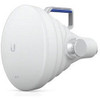
Ubiquiti UISP-HORN UISP Management Device
The Ubiquiti UISP-HORN is a dedicated management appliance purpose-built to serve as the control and monitoring hub for distributed UISP wireless infrastructure deployments. Weighing 14.2 lb and designed in a compact horn form factor, the UISP-HORN consolidates device provisioning, real-time traffic analytics, and service lifecycle management into a single platform—eliminating the need for generic network management middleware that doesn't understand UISP-native workflows. This makes it the natural control plane for ISPs scaling beyond single-site operations.
What This Device Does
The UISP-HORN operates as a centralized management node for airMAX ac and airMAX ad base stations, EdgeMax routers, and other UISP-compatible infrastructure. Rather than forcing integrators to string together generic NMS tools with custom middleware, the UISP-HORN speaks UISP natively—meaning device discovery, firmware provisioning, billing system integration, and customer lifecycle workflows happen without translation layers. This reduces operational overhead and configuration drift, which matters when you're managing dozens or hundreds of distributed access points across a service area.
Key Deployment Characteristics
- Compact form factor (14.2 lb): Small enough to mount in rack cabinets, NOC shelves, or distributed edge locations without space constraints. Weight is meaningful if you're installing in a colocation facility where space and power density matter.
- Centralized and on-premises modes: Deploy the UISP-HORN in a central NOC for nationwide coordination, or position it as a regional hub for carrier-class deployments. Flexibility to run cloud-connected or on-premises gives you control over data residency and uptime dependencies.
- Native UISP ecosystem integration: Device discovery, provisioning, and firmware management flow through UISP APIs and dashboards. No translation; no custom connectors. This is why operators already invested in airMAX hardware don't need a parallel management tool.
- Billing and service provisioning hooks: The UISP-HORN integrates with ISP billing and customer management workflows built into the UISP platform. If you're running subscriber authentication, quota management, or service tier provisioning, this appliance handles those tasks without external middleware.
- Multi-site operational transparency: Real-time monitoring of distributed infrastructure—bandwidth consumption, device health, RF coverage, customer churn—surfaces through unified dashboards. For regional or national ISPs, this centralized visibility is essential for SLA compliance and rapid troubleshooting.
- Redundancy-ready architecture: Integrators should plan for network redundancy to ensure continuous management access. If the UISP-HORN goes offline, downstream device management and provisioning stall, so link redundancy and failover design are non-negotiable in production deployments.
Installation and Integration Context
The UISP-HORN connects via standard Ethernet and power, designed for rack or cabinet mounting in typical network infrastructure environments. Initial configuration occurs through the UISP dashboard. Ongoing provisioning, monitoring, and device lifecycle tasks are handled through centralized APIs and interfaces. Because this is a management appliance—not a carrier-grade router or firewall—it should be placed on a stable, dedicated network segment with appropriate redundancy and backup. For smaller operators managing customer access points across a service area, the UISP-HORN becomes the backbone; for larger carriers, it functions as a regional or national coordination node alongside other management infrastructure.
Frequently Asked Questions
Q: Is the UISP-HORN compatible with non-Ubiquiti wireless infrastructure?
A: No. The UISP-HORN is designed specifically for the UISP ecosystem—airMAX ac/ad base stations, EdgeMax routers, and UISP-compatible devices. It does not manage third-party wireless platforms or generic SNMP-only infrastructure.
Q: Can the UISP-HORN run in the cloud, or is on-premises required?
A: The UISP-HORN supports both cloud-connected and on-premises operational modes, giving you flexibility in how you structure your management architecture. You choose whether data and management logic remain on-premises or integrate with Ubiquiti's cloud services.
Q: What network redundancy should I plan for the UISP-HORN?
A: Because the UISP-HORN is the control plane for your distributed infrastructure, network redundancy is essential. Plan dual Ethernet uplinks, failover routing, and monitoring to ensure continuous management access to downstream devices. Loss of connectivity to the UISP-HORN will interrupt provisioning and device management.
Q: Can the UISP-HORN handle billing and customer lifecycle workflows?
A: Yes. The UISP-HORN integrates with ISP billing, subscriber authentication, quota management, and service tier provisioning as part of the UISP platform ecosystem. These functions don't require external middleware or custom integrations.
Q: What power and network connectivity does the UISP-HORN require?
A: The UISP-HORN operates on standard power (AC 110-240V typical for network appliances) and Ethernet. Exact power draw and connector type are detailed in the manufacturer datasheet. Plan for dual power circuits and redundant Ethernet feeds in production NOC environments.
Q: Is the UISP-HORN suitable for small ISPs or only large carrier deployments?
A: The UISP-HORN scales across ISP sizes. For small operators managing customer access points across a single service area, it serves as the management backbone. For large carriers managing multi-state or multi-national footprints, it functions as a regional coordination hub. Size your deployment around the number of managed devices and geographic scope.
Ted PerryPerspective based on aggregated IP Security Depot and affiliated engineering team experience.
The UISP-HORN fills a hard requirement for ISPs scaling beyond single-site operations: it's purpose-built UISP management, not a generic NMS bolted onto wireless infrastructure. If you're running airMAX base stations across multiple locations and trying to coordinate provisioning, billing, and device lifecycle through a generic tool, you're fighting middleware that doesn't understand ISP workflows. The UISP-HORN (often searched as UISP HORN) eliminates that friction entirely. The 14.2 lb compact form factor means flexible deployment—central NOC, regional hub, or edge location—without rack footprint constraints.
Technical Highlights:
- Native UISP ecosystem integration: Device discovery, firmware provisioning, and service management happen natively through UISP APIs. No middleware, no custom connectors, no translation overhead.
- Cloud-connected and on-premises modes: Choose your control plane. Centralize management in the cloud or keep it on-premises for data residency and uptime independence.
- Billing and subscriber workflows included: Subscriber authentication, quota management, service tier provisioning, and customer lifecycle tasks integrate directly. Reduces dependency on external billing middleware.
- Compact, rack-friendly design (14.2 lb): Fits NOC cabinets, colocation facilities, and distributed edge locations without space or power density penalties.
Deployment Considerations:
- The UISP-HORN is the control plane for your distributed infrastructure. Network redundancy is non-negotiable—plan dual Ethernet uplinks and failover routing. Loss of connectivity will interrupt device provisioning and management.
- This appliance is UISP-specific. If you're mixing airMAX hardware with third-party wireless or non-Ubiquiti infrastructure, the UISP-HORN won't manage those devices. Ecosystem lock-in is real; scope your infrastructure accordingly.
- Initial configuration occurs through the UISP dashboard. Ongoing provisioning is API-driven. Integrators need API documentation and familiarity with UISP workflows—this isn't a plug-and-play black box.
For regional ISPs managing dozens of customer access points across a service area, or for larger carriers coordinating multi-site airMAX infrastructure, the UISP-HORN becomes the operational backbone. It eliminates the need for parallel management tools and lets you consolidate provisioning, analytics, and lifecycle management into one platform. If your infrastructure is 100% Ubiquiti UISP-compatible, this is the right control plane.