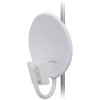
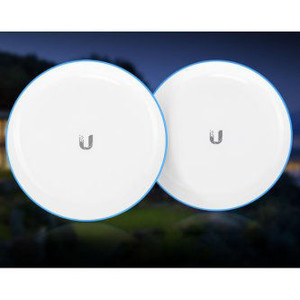
Ubiquiti NB-OD9 Wireless Bridge
Overview
The Ubiquiti NB-OD9 (often searched as NB OD9) is an offset dish wireless bridge purpose-built for outdoor point-to-point and point-to-multipoint backbone deployments. Designed as part of the Ubiquiti wireless infrastructure platform, the NB-OD9 delivers directional RF performance for extended-range links where fiber runs are unavailable or cost-prohibitive. Weighing 56.45 pounds, this industrial-grade device integrates into UISP-based networks with unified controller management, reducing field commissioning time and operational complexity.
Key Features
- Offset Dish Antenna Form Factor: The dish design concentrates RF energy along a narrow beam axis, yielding inherent antenna gain that boosts signal strength over distance. This matters because higher gain means longer usable links and better signal-to-noise ratio in congested RF environments—but requires strict line-of-sight alignment and stable mounting infrastructure to realize the benefit.
- UISP Wireless Platform Integration: The NB-OD9 joins Ubiquiti's unified infrastructure service platform, enabling centralized provisioning, RF parameter tuning, and real-time monitoring from a single UISP controller. No per-device CLI work; configuration cascades across your wireless backbone from the controller console, reducing deployment time on multi-site networks.
- Point-to-Point and Point-to-Multipoint Topology Support: Deploy the NB-OD9 as a dedicated backhaul bridge concentrating traffic from multiple access points toward a central hub, or configure it for direct peer-to-peer links between distant locations. UISP controller handles both topologies without hardware changes—pure software orchestration.
- Industrial Outdoor Construction: IP-rated enclosure and field-hardened electronics withstand temperature swings, rain, and wind loading typical of rooftop and tower installations. Proper grounding and lightning protection are non-negotiable on outdoor mounts; ensure your installation plan accounts for surge protection on the RF path and power connections.
- Layer 2 and Layer 3 Routing: Configure the NB-OD9 for bridged (transparent) operation or routed (IP) operation depending on your network architecture. UISP supports both modes, so integration with existing campus or WAN topologies is straightforward once line-of-sight and azimuth alignment are confirmed.
- Minimal Field Configuration Overhead: RF power, channel settings, and antenna alignment are managed through the UISP interface. Once the dish is mechanically aligned (critical step—misalignment by 5–10 degrees can degrade performance by 50%), the bridge auto-discovers peers and synchronizes with the controller. This reduces site visit duration compared to traditional CLI-based wireless equipment.
Deployment Scenarios
The NB-OD9 addresses backbone-level infrastructure gaps: campus connectivity between buildings where underground fiber is blocked by cost or terrain, remote site extension (warehouses, manufacturing plants, distribution centers) without leased-line dependencies, redundancy paths for critical network segments, and coverage extension into areas where mesh performance falls short. Enterprise IT teams and integrators deploying wireless network infrastructure often install the NB-OD9 as primary backhaul, freeing access points to focus on client-facing coverage rather than relaying distant traffic.
Integration & Compatibility
The NB-OD9 requires an active UISP controller environment; standalone operation is not supported. Throughput and performance scale with RF conditions, distance, and antenna alignment precision. Standard IP routing and VLAN tagging are supported, enabling seamless integration with managed network switches and existing routing policies. Ensure your controller has adequate capacity; Ubiquiti publishes device limits per controller version in the UISP documentation.
Installation & Alignment Notes
The 56.45-pound weight requires robust outdoor mounting infrastructure—pole, tower, or heavy-duty wall brackets rated for sustained wind loading. Clear line-of-sight between bridge endpoints is non-negotiable; even partial obstruction (trees, buildings, terrain) severely degrades performance. Azimuth (horizontal) and elevation (vertical) alignment are critical: use Ubiquiti's alignment tools or a professional RF site survey during commissioning. Cable runs between the antenna and radio should be minimized to reduce insertion loss on the RF path. Grounding and surge protection (lightning arrestors on antenna and power connections) are mandatory in outdoor environments.
Frequently Asked Questions
Q: Does the NB-OD9 require a UISP controller?
A: Yes. The NB-OD9 is a UISP Wireless platform device and must be managed by an active UISP controller. Standalone or ad-hoc operation is not supported.
Q: What is the maximum range of the NB-OD9?
A: Range depends on RF conditions, antenna gain, transmit power, receiver sensitivity, and line-of-sight quality. Ubiquiti's datasheet does not specify a hard distance limit; typical long-distance deployments in clear line-of-sight environments achieve 5–10+ km, but your exact range requires site survey and RF modeling based on terrain and interference.
Q: Can I deploy the NB-OD9 indoors?
A: The NB-OD9 is rated for outdoor use. Indoor deployment negates the weather sealing and may violate RF regulations in your region due to the high-gain antenna and concentrated RF pattern.
Q: Does alignment affect performance significantly?
A: Yes. Misalignment of the offset dish by even 5–10 degrees can reduce signal strength by 50% or more. Precision alignment is essential during commissioning and should be verified with RF measurement tools.
Q: What throughput should I expect from the NB-OD9?
A: Actual throughput varies with RF conditions, distance, modulation rate, and traffic load. Ubiquiti's technical documentation provides theoretical maximum rates; real-world performance is typically 60–80% of theoretical under good line-of-sight conditions.
Q: Is the NB-OD9 compatible with non-UISP Ubiquiti equipment?
A: The NB-OD9 is part of the UISP Wireless ecosystem. Compatibility with legacy or standalone Ubiquiti equipment (UniFi, AirOS) is not supported; integration requires the UISP platform.
Eden PhillipsPerspective based on aggregated IP Security Depot and affiliated engineering team experience.
The Ubiquiti NB-OD9 fills a specific role in enterprise and carrier-class outdoor backhaul deployments. If your campus or remote-site network requires extended-range point-to-point links with centralized management and real-time provisioning, the NB-OD9's offset dish antenna and tight UISP integration make it a pragmatic choice. The model NB-OD9 keeps you within the UISP ecosystem, simplifying spares management and controller compatibility. However, the antenna's high gain is a double-edged sword: it rejects interference and extends range, but demands precision azimuth and elevation alignment and absolute line-of-sight. A 5–10 degree misalignment can cut signal strength by 50%.
Technical Highlights:
- 56.45 lb Weight & Industrial Enclosure: Requires sturdy outdoor mounting infrastructure—pole, tower, or reinforced wall bracket rated for sustained wind loading and thermal cycling. Industrial IP-rated construction handles rain and temperature swings, but lightning protection (surge arrestors on antenna and power) is mandatory.
- UISP Controller Dependency: All RF tuning, throughput management, and topology changes flow through the UISP controller. No standalone operation. This consolidation reduces on-site CLI work but locks you into the UISP platform—verify your controller capacity and licensing before scaling.
- Offset Dish Gain & Directional Pattern: The dish concentrates RF energy into a narrow beam, delivering signal reach and noise rejection. This is excellent for long-distance links but useless if you need omnidirectional or wide-angle coverage. For campus coverage across multiple buildings at varying distances and azimuths, the NB-OD9 is overkill; consider lower-gain access points instead.
Deployment Considerations:
- Line-of-sight is non-negotiable—even partial obstruction (trees, buildings) severely degrades performance. Conduct a professional RF survey if deploying across terrain with hills or vegetation.
- Azimuth and elevation alignment require specialized tools (Ubiquiti alignment utilities or an RF meter). Budget for commissioning time; a 1–2 degree alignment error can be invisible without proper measurement and will degrade throughput by 20–30%.
- Cable runs between antenna and radio introduce insertion loss proportional to length and frequency. Minimize runs and use high-quality low-loss coaxial cable rated for outdoor use.
For enterprise campus backhaul between buildings with clear line-of-sight and established UISP infrastructure, the NB-OD9 is a solid, predictable workhorse. For remote-site extension (warehouses, distribution centers) where you need to avoid leased lines or fiber trenching, the investment in alignment and mounting infrastructure is typically justified by the cost savings and operational independence. Pass if your topology requires redundant, omnidirectional, or ad-hoc wireless coverage—that's a job for mesh or lower-gain point-to-multipoint systems.