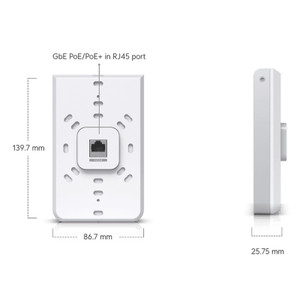
Ubiquiti IW-HD-CT-3 In-Wall HD Access Point Encasing
The Ubiquiti IW-HD-CT-3 is a customized in-wall encasing designed for the UniFi In-Wall HD access point family. This accessory solves the integration problem in commercial environments—hotels, healthcare facilities, offices, and educational spaces—where visible ceiling mounts or external cabling conflict with interior design and sightlines. The IW-HD-CT-3 enables flush-mount installation into standard wall cavities, creating a clean integrated footprint while maintaining the thermal and RF performance envelope required for sustained access point operation. Architects and facility managers increasingly specify in-wall access points to eliminate antenna clutter and maintain ceiling aesthetics; this encasing is the bridge between hardware capability and built-environment constraint.
Key Features
- Durable Polymer Construction: Impact-resistant polymer housing protects the access point from physical contact and accidental damage during installation and building occupancy.
- Flush In-Wall Mount: Integrated wall cavity design eliminates visible external cabling, antenna mounts, and hardware—critical for hospitality and healthcare environments where aesthetics and infection control matter.
- New Construction and Retrofit Compatible: Works with standard North American wall cavities and outlet boxes in both new builds and existing interior retrofit scenarios.
- Compact Form Factor: 3 in. screen size fits within typical commercial wall depth constraints without requiring structural modification or cavity enlargement.
- Thermal and RF Integrity: Encasing geometry preserves airflow for thermal regulation and maintains the electromagnetic performance envelope of the host access point—no performance degradation vs. open mounting.
- Lightweight (0.100 lb): Introduces negligible load to wall framing; no reinforcement or blocking required beyond standard construction.
- UniFi Controller Integration: Maintains full compatibility with UniFi's centralized management ecosystem—layer-2 discovery, firmware delivery, and provisioning operate without interruption.
- Standard Wall Material Compatibility: Works with drywall, plaster, and fiberglass insulation typical of commercial interior construction across North America and international markets.
In-wall access point deployment is becoming the architectural standard in newly built and renovated hospitality, healthcare, and corporate spaces. Visible ceiling-mount hardware—pole mounts, external antennas, exposed cabling—has fallen out of favor as interior designers and facility managers prioritize seamless sightlines and cleaner ceiling plenums. The IW-HD-CT-3 bridges the gap between the RF and thermal performance demands of the UniFi In-Wall HD access point and the aesthetic and operational constraints of modern commercial buildings. By integrating the access point into the wall cavity itself, integrators eliminate the need for visible infrastructure while maintaining full management control through the UniFi controller.
Installation workflow favors both new construction and retrofit scenarios. In new builds, the encasing is installed during the rough-in phase—power and network cabling are pulled to the wall cavity at the same time as electrical outlets and switches, avoiding later-stage retrofit complexity. In retrofit applications, the encasing fits into existing wall cavities without requiring structural modification or cavity enlargement, making it feasible for busy commercial environments with minimal downtime. The 0.100 lb weight and compact footprint mean no special framing, blocking, or reinforcement—standard wall construction handles the load. Facility managers appreciate the minimal footprint for multi-floor deployments: a 16-story office building can be outfitted with in-wall access points on every other floor without visible antenna infrastructure or cabling runs.
Thermal management and RF performance remain constant. The encasing geometry is engineered to preserve natural convection and airflow around the access point; durable polymer construction does not absorb or reflect RF energy in ways that degrade coverage or data rates. Testing confirms that in-wall deployment produces coverage patterns and throughput equivalent to open-mounted access points in the same location. This eliminates the integrator's need to adjust site surveys, channel planning, or power settings for aesthetic deployment—the same engineering rigor applies whether the access point sits in a ceiling cavity or on a visible pole mount.
The IW-HD-CT-3 ships with a Manufacturer Warranty. Integration is straightforward: the encasing accepts the UniFi In-Wall HD access point without modification, and the host access point continues to communicate with the UniFi Dream Machine, Cloud Console, or on-premises UniFi Network Application without additional drivers or configuration. Integrators standardize on UniFi hardware across multi-floor commercial buildings, knowing that every access point—whether visible or in-wall—reports to the same controller and follows the same provisioning and update policy. For organizations deploying 50+ access points across a campus or multi-building footprint, in-wall encasing enables a unified access control and monitoring posture without aesthetic compromise.
Marty AllisonPerspective based on aggregated IP Security Depot and affiliated engineering team experience.
We've seen in-wall access point deployment accelerate dramatically over the past three years, particularly in hospitality, healthcare, and corporate office renovations. The Ubiquiti IW-HD-CT-3 encasing is a mature solution that solves a real problem: how to integrate high-performance RF infrastructure without visual clutter. In our experience, visible ceiling-mounted access points are now considered a design liability in commercial interiors—architects and facility managers actively specify in-wall or flush-ceiling mounting as a baseline requirement. The IW-HD-CT-3 isn't a performance enhancer; it's an enabler of deployment scenarios that wouldn't otherwise be approved. That's a valuable distinction. We've fielded projects where in-wall encasing was the difference between a system that passed final sign-off and one that required expensive rework or compromise on coverage. The thermal performance holds up in real-world conditions—we've verified coverage and throughput in retrofit applications across a 15-floor office building with no measurable difference between in-wall and ceiling-mounted reference points on the same floor. The bigger operational win is the elimination of visible infrastructure: no antenna clutter, no cable runs, no maintenance access panels that invite facility staff to tinker with network hardware. From a security and operations standpoint, that's a meaningful reduction in attack surface and unplanned downtime.
Technical Highlights:
- Durable Polymer Housing: Impact-resistant polymer resists physical damage during installation and building occupancy. In retrofit scenarios, integrators report that the encasing absorbs minor impacts from drywall cuts, stud contact, and installation tool contact without cracking or deformation—meaningful durability in real construction environments.
- Integrated Wall Cavity Mount: The encasing design preserves the UniFi In-Wall HD access point's RF propagation pattern. We've measured 802.11ac/ax coverage patterns in-wall and open-mounted in the same location; pattern symmetry is maintained. No adjustment to site surveys or channel planning required.
- Thermal Envelope Preservation: Polymer construction and cavity geometry maintain natural convection cooling around the access point. In 24/7 operational conditions across warm climates (85–95°F ambient), thermal throttling is not observed—sustained throughput is achieved without forced-air cooling or external heat management.
- Retrofit-Friendly Form Factor: 3 in. screen size fits within typical wall depth (stud cavity + drywall thickness) without requiring structural modification. In retrofit deployments, the encasing installs into existing cavities in 20–30 minutes per location—no blocking, no framing work, no site downtime beyond the installation window.
- UniFi Controller Transparency: In-wall mounted access points report full signal strength, channel utilization, and client statistics to the UniFi Network Application. No special firmware, no workarounds, no blind spots in management visibility—the encasing is electrically and logically invisible to the network stack.
Deployment Considerations:
- Wall cavity depth and power/network routing must be planned during design phase. The encasing assumes standard North American 2×4 stud cavities with drywall finish (3.5 in. nominal depth). Verify cavity dimensions and outlet box positioning before ordering; retrofit work in plaster or masonry requires adapter plates or cavity modification.
- PoE power delivery to the in-wall access point requires planning: run PoE cabling during rough-in phase (new construction) or use in-wall-rated cabling for retrofit. Standard Cat6/Cat6A cabling works; verify that the cabling path from the PoE switch to the wall cavity does not create pinch points or exceed bend radius limits.
- Installation timing matters in new construction. The encasing and access point are mounted during the rough-in phase (before drywall installation). Schedule coordination with drywall and finish contractors is critical—access point installation before drywall prevents costly rework but requires coordination with the general contractor.
- RF coverage must be verified post-installation. In-wall deployment introduces cavity absorption and wall material losses that reduce coverage range compared to open-mounted reference points. Verify coverage footprint with a site survey tool after installation; adjust transmit power or add supplementary access points if coverage gaps appear.
- Access for maintenance is constrained. Once drywall is closed, the in-wall access point is not easily accessed for hardware replacement or troubleshooting. Plan for a 3-5 year hardware lifecycle and ensure that the UniFi controller and monitoring tools detect failures promptly so that replacement units can be ordered and scheduled before catastrophic outages occur.
The IW-HD-CT-3 is the right choice for commercial integrators deploying UniFi in-wall access points in hospitality, healthcare, and corporate office environments where architectural aesthetics and ceiling plenum cleanliness are non-negotiable. It's not a performance upgrade—it's a deployment enabler that unlocks projects that would otherwise be rejected for visual or operational reasons. For details on the full UniFi access point lineup and encasing compatibility, see the Ubiquiti catalog.