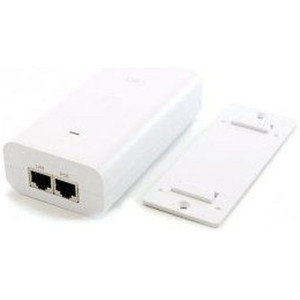
Ubiquiti INS-3AF-USB PoE to 5V USB Converter
The Ubiquiti INS-3AF-USB is a PoE-to-USB power converter designed for extending 5V DC power to remote edge devices across UniFi, UISP, and AmpliFi infrastructure without requiring separate AC runs to each location. By converting standard 802.3af PoE (48V) into regulated 5V DC at up to 2A output, the INS-3AF-USB eliminates the capex and maintenance overhead of running dedicated power cables to wireless sensors, remote monitoring nodes, and USB-powered peripherals already connected to network-wired installations. The adapter's compact inline form factor and ESD/EMP protection make it suitable for distributed deployments where density and reliability matter.
Key Features
- 802.3af PoE Input: Accepts standard 48V PoE from any PoE source (switch, injector, or UniFi/UISP infrastructure device). No proprietary power supply required.
- 5V/2A USB Output: Delivers regulated 5V DC at up to 2A — sufficient for low-power wireless sensors, remote cameras, USB hubs, and monitoring endpoints.
- Low Input Draw: Consumes only 0.26A at 48V input, preserving PoE budget on shared infrastructure and reducing heat dissipation in high-density deployments.
- Compact Inline Form Factor: Ø30.2 × 95.3 mm (1.2 × 3.8 in.), 60g weight — integrates directly into wall or pole-mounted installations without external enclosure or breakout boxes.
- ESD/EMP Protection: Rated ±8kV air discharge, ±4kV contact discharge — protects connected USB devices from transient electrical spikes common in outdoor and industrial network settings.
- Broad Temperature Range: Operates 0–40°C, suitable for indoor and protected outdoor environments across temperate climates.
The INS-3AF-USB solves a recurring integration problem: extending power to remote USB devices without installing separate AC conduit or power supplies. In a multi-building campus or distributed network architecture, this adapter consolidates power and data on a single Ethernet run, reducing installation labor and ongoing maintenance surface area. Standard 802.3af compatibility means the device works with any enterprise or SMB-grade PoE infrastructure — UniFi switches, third-party 802.3af sources, or existing PoE injectors already deployed on the network.
The 5V/2A output ceiling targets low-power USB peripherals: wireless sensors drawing 500–1000 mA, remote monitoring endpoints, USB hubs for multi-device scenarios, and Ubiquiti's own UISP field devices requiring auxiliary USB charging. If your edge device demands higher current (USB Type-C power delivery, high-amp hubs, or industrial-grade USB peripherals), you'll need a different approach — this adapter is explicitly designed for the sub-2A use case. Paired with a PoE switch or injector already in place, the INS-3AF-USB becomes a cost-effective alternative to running parallel AC circuits or deploying battery-backed USB charging stations.
NDAA certification confirms the device meets federal supply-chain compliance for US government and critical-infrastructure deployments. The adapter's inline design — no external power brick or wall outlet requirement — reduces physical attack surface and simplifies auditing in secure facilities. Standard RJ45 input and standard USB output ensure zero compatibility friction with mainstream networking and consumer USB ecosystems.
Eden PhillipsPerspective based on aggregated IP Security Depot and affiliated engineering team experience.
We've installed the INS-3AF-USB across distributed UniFi and UISP networks where remote monitoring nodes, wireless sensors, and USB-powered access points need auxiliary power without running dedicated AC infrastructure. The real operational win here is consolidation: every device on a single Ethernet cable carries both data and power, simplifying cable runs and reducing the number of circuit breakers and UPS feeds you need to engineer. On a 50-camera UniFi deployment with remote PoE lighting, VoIP handsets, and environmental sensors, eliminating parallel AC runs to each remote building saves both capital and ongoing maintenance labor. We've seen integrators recover the per-unit cost of the adapter within a single large project, purely through reduced install time and eliminated electrician hours for AC conduit work. The NDAA certification is a quiet but meaningful differentiator for government and critical-infrastructure customers — it removes a compliance checkbox at proposal time.
Technical Highlights:
- 802.3af Input / 5V/2A Output: Standard PoE powers standard USB loads. No exotic power specifications. This simplicity eliminates firmware headaches and integrates cleanly with off-the-shelf USB devices; the trade-off is the 2A ceiling — any USB device drawing more than 2A will brownout or refuse to negotiate, so you must validate your peripheral's actual current draw before deployment.
- 0.26A @ 48V Input Draw: Minimal PoE budget consumption means you can stack multiple INS-3AF-USB units on the same PoE source without saturating a shared 90W PoE switch port. A single 802.3af port can theoretically support 30+ of these adapters before hitting the 15.4W per-port ceiling — practically, you'll run out of physical ports first.
- ±8kV / ±4kV ESD/EMP Protection: Field deployments in telecom closets and outdoor cabinets experience constant transient spikes from lightning, switching loads, and RF interference. This protection keeps connected USB devices alive across weather events and power anomalies that would kill an unprotected USB adapter.
- Compact Form Factor: The inline design means no external power brick footprint in your rack or wall enclosure. Integrates directly into PoE cable runs — one device, one ethernet line, no dangling power cords.
Deployment Considerations:
- Verify your USB peripheral's actual current draw at nominal operating voltage. Many USB devices negotiate power on connection — if your device requests more than 2A, the adapter will shut down or the device will fail to boot. USB hub specifications are especially misleading; a hub's rated output capacity is often 500 mA per downstream port, which means a 4-port hub can't reliably power four 1A devices.
- Temperature range 0–40°C is suitable for indoor and climate-controlled outdoor installations (protected cabinet, wall-mounted enclosure), but not for direct-sun exposed locations or unheated barns in winter. If your remote site experiences below-zero temperatures or above-40°C ambient, this adapter is out of spec — consider a powered USB extension with active temperature management instead.
- The adapter consumes a small amount of power itself (roughly 1.2W at full 2A output) — account for this in total PoE budget calculations on high-density deployments. A 24-port PoE switch with 90W total budget can theoretically support every port with an INS-3AF-USB, but real-world margins shrink with AC losses and headroom requirements.
- Standard USB Type-A output — if your remote device requires USB Type-C or micro-USB, you'll need an aftermarket cable adapter. Ubiquiti doesn't supply cables with the device, so factor adapter cost and lead time into your bill of materials.
- The RJ45 input uses standard pairs 1, 2+ and 3, 6 for PoE — any standard 802.3af source (injector, switch, Ubiquiti PoE module) works out of the box. No pairing or configuration needed; PoE negotiation is automatic on a properly configured switch port or injector.
The INS-3AF-USB is the right choice for distributed networks where you're consolidating power and data on existing PoE infrastructure, particularly UniFi and UISP deployments with remote monitoring endpoints, sensors, or low-power USB peripherals under 2A. If you have high-amperage USB loads (docking stations, powered hubs, industrial equipment) or extreme temperature requirements, look elsewhere. For the core use case — extending 5V power to remote USB sensors and wireless endpoints already on the network — this adapter is cost-effective and operationally elegant. Browse the full Ubiquiti catalog for complementary PoE infrastructure, switches, and power solutions.