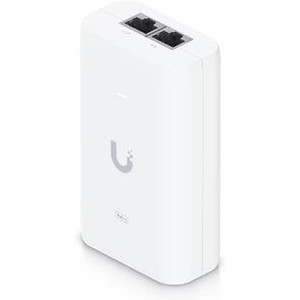
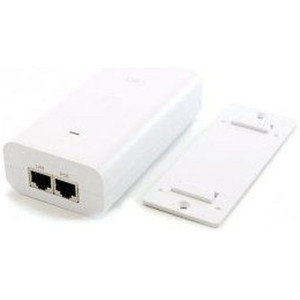
Ubiquiti U-POE+ 30W PoE Injector Adapter
The Ubiquiti U-POE+ is a 30-watt external PoE injector designed to decouple power delivery from your network switch when centralized PoE capacity is constrained or unavailable. It operates at 48V DC, injecting power directly onto the data line via a single output connector, allowing you to extend Ubiquiti IP cameras, access points, and other PoE+ compatible devices beyond your switch's power budget without sacrificing network connectivity.
Key Features
- 30-watt output power: Covers most UniFi access points and compact IP cameras in a single unit. This eliminates the bottleneck when your PoE switch is exhausted—particularly useful in expansions where adding a new switch isn't practical.
- 48V DC injection: Operates at the PoE+ standard voltage, ensuring compatibility with UniFi devices engineered for that specification. No voltage mismatch issues; devices recognize the power source natively.
- External form factor: Compact desktop or wall-mounted placement keeps cable runs clean and simplifies troubleshooting. No DIN-rail mount complexity—plug power, connect input Ethernet, and route the injected feed to your device.
- Single output connector: One injection point per unit. For multi-device scenarios (e.g., a remote cluster of APs), you'll typically daisy-chain multiple U-POE+ adapters or upgrade to a larger PoE switch—plan accordingly in your PoE power planning.
- Gigabit LAN passthrough: Data and power travel on the same cable, preserving your network topology. No separate power-only runs; standard Cat5e or Cat6 cabling works without modification.
- Suited for distributed deployments: Solves the real problem in remote antenna systems, warehouse clusters, and mixed-infrastructure sites where running centralized PoE to every corner is cost-prohibitive or infeasible.
Integration & Compatibility
The U-POE+ integrates directly into UniFi ecosystems. Connect it downstream of your primary network switch or directly to a PoE-capable switch trunk, and inject power into the remote segment. It's commonly deployed in scenarios where you have limited PoE capacity at the source but need to power several devices at a distant location—a common pattern in large warehouse automation, multi-building campuses, and staged rollouts where switch upgrades are deferred.
This adapter is a tactical solution, not a long-term PoE infrastructure replacement. If your deployment consistently exceeds available PoE, upgrading to a higher-wattage PoE switch is often more cost-effective than daisy-chaining multiple injectors. Use the U-POE+ for overflow, edge cases, and temporary expansions.
When to Choose a Different Approach
If you require more than 30 watts of simultaneous power delivery or need to support multiple devices from a single injection point, consider a dedicated PoE switch with higher aggregate wattage in the Ubiquiti lineup. For installations with three or more remote devices, a switch-based architecture typically simplifies management and troubleshooting compared to multiple injectors.
Frequently Asked Questions
Q: Does the U-POE+ pass data and power on the same cable?
A: Yes. The U-POE+ injects 48V DC onto the same Ethernet pair that carries your network signal, following the PoE+ standard. Standard Gigabit Ethernet cabling carries both without degradation.
Q: Can I daisy-chain multiple U-POE+ adapters?
A: No. Each U-POE+ has one output connector. For multiple remote devices, use separate adapters in parallel, each fed from your primary switch, or deploy a remote PoE switch to consolidate power and data delivery.
Q: What's the maximum cable distance from the U-POE+ to my device?
A: Standard Ethernet distance limits apply: up to 100 meters (328 feet) per run. PoE injection itself does not extend this limit.
Q: Is the U-POE+ compatible with non-UniFi PoE+ devices?
A: The U-POE+ outputs standard 48V DC PoE+ compliant power. It will work with any device rated for PoE+ (802.3at or 802.3bt), though Ubiquiti does not certify non-UniFi equipment. Verify input voltage and power requirements before deployment.
Q: What happens if the device draws more than 30 watts?
A: The injector will not supply the additional power. You'll experience brownout behavior—the device may restart, drop features, or fail to boot. Confirm your device's peak power draw before selection.
Q: Do I need a separate switch to use the U-POE+?
A: Yes. The U-POE+ injects power only; it does not provide network switching or port density. It works alongside your existing switch to extend power to remote devices.
Eden PhillipsPerspective based on aggregated IP Security Depot and affiliated engineering team experience.
The Ubiquiti U-POE+ is a straightforward power extender—it does exactly one thing, and does it well. The 30-watt budget is the critical constraint here. That's enough for a single U6-LR access point (~13W) plus a compact turret camera (~18W) in a remote cluster, but not for a high-power device like a UniFi Protect Dream Machine or multiple simultaneous streams from power-hungry PTZ units. Know your load before you buy.
Technical Highlights:
- 30W at 48V DC: Delivers roughly 625mA on the PoE pairs. Sufficient for mid-range UniFi APs and compact IP cameras, but confirm your device's peak draw. An access point ramping up RF output or a camera initiating IR illumination can spike power consumption momentarily—the injector will deliver what it can, but the device won't exceed the budget.
- Single output, Gigabit passthrough: No separate data and power lines. You're running one Cat5e or Cat6 run to the remote location, which simplifies cable management in conduit or cable tray. The trade-off: you can't load-balance or failover to a second injector if this one fails—it's a single point for that injection point.
- External form factor: No wall-mounted PoE switch complexity. Just AC mains input (power adapter not detailed in evidence, verify separately) and one RJ-45 output. This matters in temporary or exploratory deployments where you don't want to rack a full switch yet.
Deployment Considerations:
- The 30W ceiling is hard. If your remote device draws 25W sustained and you need headroom for spike load (e.g., IR at night on a camera), you're cutting it very close. Monitor power draw under real operating conditions before declaring success.
- No redundancy or failover. If the U-POE+ goes offline, that remote segment loses both data and power simultaneously. For critical infrastructure (e.g., building entrance cameras), pair this with a battery backup or a second injector on a separate feed.
The U-POE+ is most valuable in edge-case scenarios: remote outdoor AP clusters where running a dedicated switch isn't justified, staged warehouse rollouts where you're adding cameras two or three at a time, or mixed-vendor sites where you have a main Ubiquiti PoE switch but need to cover one outlying run. It's a tactical patch, not a permanent solution. Size your primary switch correctly, and you'll rarely need this. Use it when you must.