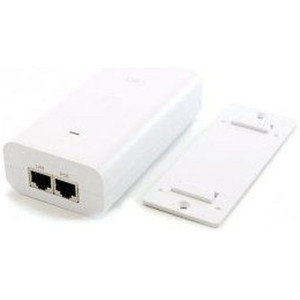
Ubiquiti INS-3AF-O-G Outdoor PoE Injector
The Ubiquiti INS-3AF-O-G is a compact outdoor PoE injector engineered for remote network deployments where centralized PoE switching cannot reach field-mounted endpoints. It converts standard AC mains power into 802.3af compliant PoE delivered over Gigabit Ethernet, eliminating the need to run separate AC lines to distributed access points, outdoor cameras, or UISP field nodes. The unit arrives with a pre-terminated output cable and outdoor-rated enclosure, ready for direct installation at the device location or pole-mounted in exposed environments. Integrators use this when a remote endpoint is >100 meters from the central switch, or when local AC availability makes a localized PoE source more practical than a long power run.
Key Features
- 802.3af PoE Injection: Delivers up to 13W at standard PoE voltage — sufficient for outdoor APs, remote sensors, and low-power surveillance endpoints. Gigabit Ethernet passthrough keeps data throughput at full line speed.
- Outdoor Enclosure Rating: Weatherproof plastic housing designed for pole-mounted or wall-mounted installations in rain, dust, and temperature fluctuation. No additional weatherproof cabinet required at the device site.
- ±15kV ESD/Surge Protection: Built-in transient suppression on both input and output protects against nearby lightning strikes and mains transients — common risk in remote outdoor installations.
- 100-Meter Ethernet Range: Works with standard Cat5e or Cat6 cabling at full Gigabit speeds up to 100 meters, standard Ethernet distance limits. Plan cable runs accordingly in sprawling campus or perimeter deployments.
- Pre-Terminated Output Cable: Fixed pigtail eliminates field termination and labor time on-site. Cable length and connector type are factory-set — verify before purchase that cable reach matches your installation distance.
- AC Power Input 100–240V: Accepts universal mains voltage, compatible with both US (120V) and international (220–240V) power infrastructure. No voltage step-down or conversion needed.
- Compact Form Factor: 10.2 × 10.2 × 8.7 in and 0.25 lb — fits into tight pole-mounted or wall bracket installations without requiring large enclosure space.
The INS-3AF-O-G is purpose-built for UISP deployments and works with any PoE-compatible device that accepts 802.3af standard input at ≤13W draw. Common use cases include outdoor Ubiquiti UniFi APs, UISP access points, remote IP cameras with modest power budgets, and field environmental sensors. Non-Ubiquiti devices are supported provided they comply with 802.3af specifications — verify the endpoint datasheet before specifying.
Deployment scenarios span campus networks, perimeter fencing installations, remote tower-mounted antennas, and distributed surveillance nodes where running dedicated AC lines is cost-prohibitive or infeasible. A single injector at the device location eliminates the operational burden of managing separate power and data feeds. In multi-endpoint installations (e.g., a row of outdoor APs along a building façade), one INS-3AF-O-G per endpoint or a central PoE+ switch with longer cable runs both remain viable — choose based on cable routing, AC availability, and total cost of ownership.
The unit integrates transparently with UISP management and Ubiquiti network products via standard Ethernet and SNMP. AC power should be backed by a UPS or surge strip if the remote endpoint must remain online during utility outages or if the site experiences frequent power transients. The fixed output cable cannot be field-reterminated — confirm cable length and connector type match the endpoint location during the specification phase.
Ubiquiti provides a manufacturer warranty on the injector and includes a datasheet covering electrical specifications, environmental ratings, and compatibility guidance. The unit is sourced from the manufacturer and ships with standard documentation.
Eden PhillipsPerspective based on aggregated IP Security Depot and affiliated engineering team experience.
We've deployed the Ubiquiti INS-3AF-O-G extensively across campus networks and perimeter fence lines where AC power already exists at or near the device location but a centralized PoE switch is too far away. The real operational win here is eliminating one more power run and consolidation point — you're leveraging existing electrical infrastructure instead of upgrading the core switch or running new AC to a central PoE rack. On a 500-meter perimeter fence with outdoor APs every 80 meters, that means five 802.3af injectors powered from mains taps already in place, rather than running Ethernet back to a single PoE+ switch 300+ meters away or installing an intermediate powered cabinet. The pre-terminated cable removes a field-termination risk and saves labor time, but it also locks you into that cable length — you can't adapt on-site if the endpoint needs to relocate 20 feet. The ±15kV surge protection is essential outdoors, especially in lightning-prone regions or near RF transmitters. Pair this with a quality UPS-backed AC source if the endpoint must survive mains dips. The 13W ceiling is real — if your endpoint draws more, you need PoE+ (which this unit doesn't supply). We've caught several integrators trying to power a 25W outdoor heater block with an 802.3af injector; that ends badly. Always verify the target device's datasheet before quotation.
Technical Highlights:
- 802.3af Power Budget (13W): Sufficient for most outdoor APs, remote sensors, and standard IP cameras. Exceeding this limit causes the device to either fail to power up or brownout under load. Know your endpoint's true power draw — marketing specs often understate peak consumption during PoE negotiation.
- Gigabit Ethernet Passthrough: The injector does not drop to 100BASE-T when powered — full 1000 Mbps throughput is maintained. Important for endpoints that stream video or handle high-traffic backhaul.
- ±15kV Surge Protection: Protects both power and Ethernet lines against transient overvoltage. In rural or RF-rich environments (near cell towers, radar, or AC powerline transitions), this is the difference between one-time hardware cost and recurring field failures.
- 100-Meter Ethernet Limit: This is a standard Ethernet distance ceiling, not a degradation of the INS-3AF-O-G itself. Plan cable runs within this boundary. Beyond 100m, use a POE-extender or run a powered intermediate node.
- AC Mains Dependency: The injector requires continuous AC power to deliver PoE. Unlike a battery-backed PoE switch, a power loss at the injector location immediately cuts power to the endpoint. Plan AC UPS backing for mission-critical nodes.
- Fixed Output Cable: The pre-terminated pigtail cannot be replaced or extended in the field. Measure cable run length during site survey and specify the correct output cable variant (if available) or plan to terminate locally at the endpoint enclosure.
Deployment Considerations:
- Verify the target endpoint's power consumption does not exceed 13W. Many outdoor heater blocks, dual-radio APs, and industrial cameras exceed this threshold and will require PoE+ or dedicated AC power instead.
- AC power at the injector location must be reliable or backed by UPS. A single mains glitch cuts power to the endpoint immediately — no graceful shutdown window. Use a surge-protected outlet or small APS/conditioner if the site experiences frequent transients.
- The pre-terminated output cable is fixed and cannot be field-reterminated. Confirm cable length and connector type (typically RJ45) match your endpoint location and enclosure before ordering. If flexibility is required, specify a bulk Ethernet cable run and place the injector closer to the endpoint.
- In lightning-prone areas, pair the injector with a quality AC surge protector and consider additional grounding on the Ethernet shield at the endpoint enclosure. The ±15kV rating is robust but not infinite — layered protection is still prudent.
- The unit generates minimal heat and requires no active cooling, but do not seal it in an airtight enclosure. Allow passive airflow to prevent condensation or thermal buildup during high-ambient-temperature deployments.
The INS-3AF-O-G is the right choice when you have AC power available at the device site, need to avoid a long Ethernet run back to a central PoE switch, and your endpoint draws ≤13W. It's economical, reliable, and reduces operational complexity on sprawling outdoor networks. For a deeper catalog of Ubiquiti outdoor networking and PoE infrastructure, explore our Ubiquiti catalog.