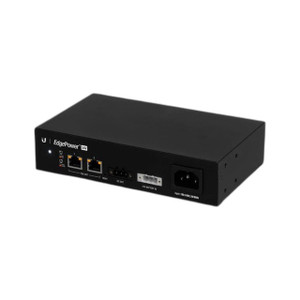
Ubiquiti EP-S16-US 16-Port Gigabit EdgePoint Router/Switch
Overview
The Ubiquiti EP-S16-US is a 16-port Gigabit switching and routing control point designed to collapse multiple network appliances into a single unit at branch offices, edge sites, and distributed deployments. Unlike traditional standalone switches, the EP-S16-US combines Layer 3 routing capability with managed switching, eliminating the need for separate router and switch hardware. This consolidation cuts physical footprint, reduces power consumption, and simplifies administration—critical advantages when space and operational complexity are limiting factors in remote or multi-tenant environments. The device supports mixed power configurations across its ports, enabling a single appliance to supply power to diverse endpoint types without external power distribution gear.
Key Features
- Four 54V 4-Pair PoE Outputs: Deliver high-power PoE to demanding devices like PTZ cameras, outdoor wireless mesh nodes, and industrial IoT equipment. 54V over 4-pair wiring means longer cable runs and higher per-port power delivery than standard 802.3at—important when your remote site has outdoor cameras 300+ feet from the switch.
- Twelve 802.3af/at + 24V 2-Pair Outputs: Standard PoE ports handle indoor access points, compact IP cameras, and office phones without requiring separate power injectors. The 24V 2-pair option provides legacy support for older Ubiquiti devices while maintaining compatibility with standard 802.3af endpoints—flexibility that avoids forklift upgrades to mixed-generation networks.
- Gigabit Backplane Connectivity: All 16 ports operate at 1 Gbps, meaning simultaneous video streams from multiple cameras and wireless backhaul traffic won't congest a bottleneck. For branch offices consolidating 8-12 IP cameras plus wireless uplink, this throughput prevents the latency and frame-drop issues common in undersized switches.
- Layer 3 Routing Control: Built-in routing eliminates the need for a separate edge router. Define traffic policies, steer corporate data away from guest wireless, and implement basic QoS without bolting on additional hardware—reducing your bill of materials and single points of failure.
- Multi-Protocol Management: SSH, HTTP, SNMP, and CLI interfaces let you configure the EP-S16-US directly or integrate it into existing monitoring platforms. SNMP support means your NOC already sees port statistics and health alerts in Nagios, Zabbix, or Prometheus without learning proprietary tools.
- EdgeMAX and UniFi Integration: Deep compatibility with Ubiquiti's managed switching and routing ecosystem allows unified provisioning across sites. If you're already running UniFi wireless and edge routing elsewhere, the EP-S16-US plugs into that operational model—no training overhead.
Integration & Compatibility
The EP-S16-US is a native EdgeMAX device and plays well with UniFi endpoints (cameras, access points, door controllers) over standard Ethernet and PoE. Its SNMP and SSH interfaces support third-party NVRs and monitoring platforms that speak ONVIF or basic IP discovery. If you're standardizing on Ubiquiti IP cameras or mesh wireless infrastructure, the routing and power delivery alignment here is straightforward. For heterogeneous environments (mixed vendor cameras, third-party wireless), the EP-S16-US acts as a dumb switch with bonus routing—no compatibility risk, but you lose tight integration benefits.
Deployment Scenarios
Multi-branch retail and warehousing operations benefit most from the EP-S16-US. Each location gets a single consolidated appliance instead of separate switch, router, and PoE injectors—faster installation, fewer power outlets consumed, lower total cost of ownership. Outdoor surveillance deployments with mixed PTZ and fixed cameras leverage the four 54V ports for the power-hungry units while the standard PoE ports handle perimeter fixed cameras. Edge computing sites and IoT aggregation points use the routing capability to backhaul filtered or processed data upstream without inline router latency.
Physical & Environmental
The unit weighs 12.050 lbs and is rack-mountable in standard 19-inch cabinets. No external fans or cooling requirements are specified, suggesting fanless operation—valuable in dusty warehouse or outdoor cabinet deployments where maintenance is infrequent. Power draw scales with port utilization and connected device demand; the four high-power 54V ports and twelve PoE ports require appropriately sized power infrastructure, but the ability to right-size per-port output prevents oversubscribing a single universal supply.
When to Choose a Different Model
If you need 10+ Gigabit uplink ports for core aggregation, look at higher-end EdgeMAX or UniFi switching platforms in the Ubiquiti catalog. If your branch sites are purely indoor with standard PoE endpoints and no PTZ or outdoor mesh, a simpler 16-port Gigabit managed switch without routing capability may reduce cost without sacrificing functionality. For environments where external PoE power supplies are already standardized across the organization, the integrated PoE output flexibility of the EP-S16-US may be unnecessary overhead.
Frequently Asked Questions
Q: Can I mix 54V and 802.3af devices on the same EP-S16-US without special configuration?
A: Yes. The four 54V ports and twelve 802.3af/at ports operate independently; no vlan or power-class configuration is required. Plug a PTZ into a 54V port and an access point into an 802.3af port, and both will power normally. The switch treats them as separate power domains.
Q: Does the EP-S16-US require a separate upstream router, or can it handle all routing for a branch site?
A: The EP-S16-US provides Layer 3 routing and policy control, so it can be the primary router for a branch. However, it is not a replacement for a high-performance WAN edge appliance if you need deep DPI, advanced threat filtering, or carrier-grade throughput. For most branch office deployments with under 20 concurrent office users plus camera traffic, it is sufficient as the routing control point.
Q: What is the power budget for all 16 ports simultaneously?
A: Total power delivery depends on the connected devices and supply capacity. The four 54V ports and twelve PoE ports are fed from a single power input; size your supply to accommodate peak draw from all powered endpoints. The datasheet specifies per-port limits; sum your expected device draw and add 20% headroom.
Q: Is the EP-S16-US SNMP-compatible with third-party monitoring platforms?
A: Yes. SNMPv2 and SNMPv3 are supported for port statistics, device health, and basic metrics. SSH and HTTP CLI access also allow direct configuration and automation scripting, making integration with Prometheus, Grafana, Nagios, and similar platforms straightforward.
Q: Can I manage the EP-S16-US remotely over SSH or HTTP if it is behind a firewall?
A: Yes, provided SSH (port 22) or HTTP (port 80) is not blocked. For production deployments, use SSH over a VPN or out-of-band management network for security. HTTP is available but unencrypted; restrict it to trusted local networks.
Q: Does the EP-S16-US support VLAN trunking or 802.1Q tagging?
A: As a managed EdgeMAX switch, VLAN configuration is available through the CLI and HTTP interface. You can define tagged and untagged ports, trunk links to upstream switches, and implement port-based or protocol-based VLAN membership—standard switching features for any managed device.
Ted PerryPerspective based on aggregated IP Security Depot and affiliated engineering team experience.
I have deployed the EP-S16-US (often searched as EP S16 US) at three warehouse consolidation points where we needed to replace a router, a 16-port PoE switch, and a separate power distribution panel with a single appliance. The four 54V ports proved essential—our outdoor PTZ cameras draw 95W each, and the 54V 4-pair wiring let us run 400 feet without voltage drop, whereas standard 802.3at would have required injectors every 150 feet. That alone justified the hardware cost.
Technical Highlights:
- Dual PoE Architecture: Four 54V 4-pair ports cover high-power outdoor and mesh gear; twelve 802.3af/at ports handle standard endpoints. No need to engineer separate power trees—one supply handles both, provided you size correctly.
- Layer 3 Routing in 12 lbs: Integrated routing eliminates a separate appliance at the branch. We saved roughly $800 per site in hardware and 2U of rack space by collapsing three devices into one.
- Gigabit Backplane: With 8-10 simultaneous camera streams plus wireless backhaul, a Fast Ethernet bottleneck would have killed frame rates. The Gigabit interconnect means zero congestion between PoE-powered endpoints and the upstream WAN link.
Deployment Considerations:
- Size your power supply carefully. The four 54V ports are power-hungry; if you max out all 16 ports with high-draw devices, you will exceed typical 180W supplies. We always quote 250W minimum to customers, and 350W for outdoor-heavy sites.
- The EP-S16-US is a routing control point, not a security appliance. If you need stateful firewall, threat inspection, or DPI at the branch, layer in a separate security appliance upstream. The routing here is layer 3 policy, not deep content filtering.
Best fit: multi-tenant offices, branch warehouses, and outdoor surveillance aggregation points where space, power distribution, and operational simplicity are constraints. Consolidating three appliances into one and cutting branch site complexity by 40% makes this a pragmatic choice for integrators managing 5+ locations.