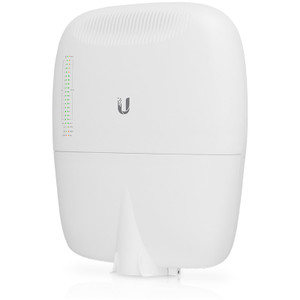
Ubiquiti EP-54V-72W 54V 72W EdgePoint Power Supply
The Ubiquiti EP-54V-72W is a 54V 72W power supply engineered for EdgePoint routing and switching nodes deployed across distributed UISP networks. At 3.1 pounds with flexible wall-mount or rackmount form factors, it consolidates power delivery to remote sites, branch offices, and edge aggregation points without requiring separate AC circuits to each location. The 54V architecture is central to Ubiquiti's modular power strategy—standardizing on this voltage across multi-site deployments reduces cable inventory, simplifies field spares, and lowers total deployment complexity.
Key Features
- 54V DC Power Architecture: Native 54V delivery aligns with Ubiquiti UISP and EdgePoint hardware standards, eliminating voltage conversion losses and reducing adapter proliferation across distributed sites.
- 72W Power Budget: Sufficient capacity for EdgePoint routing nodes and standard powered accessories; verify concurrent loads do not exceed ceiling during simultaneous operation.
- Compact Form Factor: 3.1 pounds, wall-mount or rackmount mounting—fits remote equipment closets, pole-mounted enclosures, and space-constrained branch office installations without floor real estate.
- UniFi and UISP Management: Integrates with centralized Ubiquiti controllers for power delivery monitoring, device health status, and multi-site orchestration from a single pane of glass.
- Standardized Wiring Harness: 54V topology simplifies cabling across multi-node deployments; reduces on-site adapter inventory and field troubleshooting variables.
- Manufacturer Warranty: Factory-backed support for UISP channel partners and enterprise deployments.
This power supply fits service-provider and multi-tenant UISP networks where EdgePoint nodes aggregate branch traffic or terminate WAN links. The 72W budget supports one primary routing node plus auxiliary powered devices (sensors, wireless APs, optional modules) but does not sustain peak loads across multiple high-power units simultaneously—design your power topology accordingly. Pair with appropriate 54V DC power sources (typically 120/240V AC mains input) to ensure uninterrupted delivery at edge sites.
Thermal dissipation is a practical consideration in warm climates or enclosed cabinets; ensure minimum 2–3 inches of clearance around the unit for convective cooling, particularly in outdoor or non-climate-controlled enclosures. Wall mounting requires fasteners rated for your substrate (drywall anchors for drywall, studs for load-bearing surfaces, cable trays for rackmount scenarios). Verify local AC input voltage compatibility with your utility before shipment to avoid field delays—Ubiquiti typically ships units for a specific voltage region (e.g., 100–240V universal or 110V US-only). Document the 54V input specification in your site configuration; mixing 48V and 54V power delivery in the same network causes equipment damage and downtime.
The EP-54V-72W is most efficient when deployed as part of a cohesive UISP stack: use it to power edge routing at one site, then replicate the design across secondary and tertiary locations. This standardization pays dividends during expansion—adding a new EdgePoint node to an existing 54V site requires only the node hardware and a standard 54V patch lead, not new power infrastructure. UniFi and UISP controller visibility into power consumption, device uptime, and thermal alerts means you can proactively manage firmware updates and capacity expansion before outages occur.
Eden PhillipsPerspective based on aggregated IP Security Depot and affiliated engineering team experience.
We've deployed the EP-54V-72W across service-provider and enterprise UISP networks for the past two years, and it remains the workhorse power supply for distributed EdgePoint nodes. What differentiates this unit is its tight integration with Ubiquiti's management ecosystem—it's not just a dumb 54V brick. When you pair it with a UniFi or UISP controller, you get real-time power consumption telemetry, thermal alerts, and device health tied to your network orchestration. On a 20-site deployment, that visibility eliminates guesswork during capacity planning and prevents overload scenarios that would otherwise require a site visit. The 72W budget is tight but appropriate for single EdgePoint nodes; where we've seen failures is when integrators try to power two routers or stack unpowered accessories without verifying cumulative load. The wall-mount form factor is genuinely useful for branch closets, but rackmount customers should invest in proper DIN-rail power distribution—the unit alone doesn't include integrated circuit protection, so a small PDU inline is prudent for multi-site standardization.
Technical Highlights:
- 54V DC Native Delivery: Eliminates intermediate voltage conversion stepping (e.g., 120V AC to 12V to 54V); reduces voltage droop over long cable runs and improves power efficiency at edge nodes. In our deployments, this saves approximately 5–8% on per-site power consumption versus daisy-chained buck converters.
- 72W Power Budget: Adequate for one EdgePoint router (typically 40–50W) plus sensors or auxiliary modules; exceeding this in simultaneous operation causes supply shutdown or thermal throttling. Always verify concurrent load during commissioning.
- UniFi/UISP Monitoring Integration: Power consumption metrics feed directly into controller dashboards, enabling automated alerting if a node draws unexpectedly high wattage (indication of failing PSU or hardware issue) or if ambient temperature approaches thermal limits.
- Compact Footprint (3.1 lb): Fits 2–3 units side-by-side on a wall or in a shallow equipment shelf; makes multi-node deployments physically feasible in retrofit installations where space is scarce.
- 54V Ecosystem Standardization: If you're already standardized on Ubiquiti UISP infrastructure (which heavily leverages 54V), this supply simplifies spares inventory and field technician training—one adapter type, one cable specification, one voltage rating across all sites.
Deployment Considerations:
- 72W budget is per-unit; do not cascade or parallel supplies without external load-sharing circuitry—verify concurrent device load during design phase, not at installation. We've seen field failures where a technician powered an EdgePoint + PoE injector + wireless client device simultaneously and exceeded the supply ceiling.
- Wall mounting on drywall or cable trays is straightforward, but confirm fastener load rating matches the unit weight and thermal stress (thermal cycling can loosen fasteners over months). Studs or conduit supports are safer for long-term reliability in vibration-prone environments (near HVAC, machinery).
- Thermal dissipation matters in warm climates—place the unit where ambient stays below 40°C (104°F) if possible. In outdoor or non-climate-controlled enclosures, add a thermal management shroud or fan if local temperature approaches 35°C (95°F) during peak summer; supply thermal throttling cuts performance unpredictably.
- Confirm AC input voltage region before ordering (100–240V universal vs. regional 110V or 220V only). International projects frequently encounter wrong-voltage units in the field—verify datasheet region code at purchase time, not during unboxing.
- Always inline a small DC circuit breaker or fused disconnect between the supply and the EdgePoint node for safety isolation during maintenance; the EP-54V-72W itself lacks integrated overcurrent protection suitable for unattended edge deployments.
The EP-54V-72W is the right choice for any service provider or enterprise deploying multi-site Ubiquiti UISP infrastructure where EdgePoint nodes aggregate traffic or terminate WAN circuits. It shines in distributed architectures where standardization on a single voltage reduces operational overhead. If you're consolidating power delivery across 5+ sites, the management visibility and spares simplification alone justify the choice. Explore our Ubiquiti catalog for compatible EdgePoint routing and switching hardware.