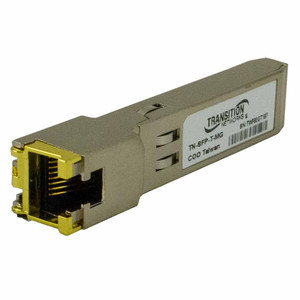
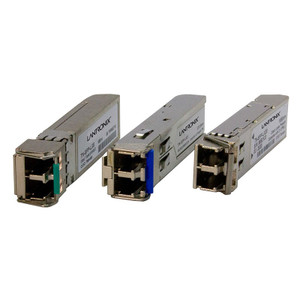
Transition Networks TN-SFP-SXD 1Gbps Multimode SFP Transceiver
The Transition Networks TN-SFP-SXD is a Gigabit SFP transceiver module engineered for multimode fiber deployments in enterprise networks, security appliance backhauls, and distributed surveillance systems. Operating at 850nm wavelength and delivering 1 Gbps throughput over LC duplex multimode fiber, the module reaches up to 1800 feet — sufficient for facility-scale runs from switch closets to remote camera arrays, door controllers, and access-point clusters without repeaters. Insertion into any standard SFP port requires no configuration, firmware, or external power; the module auto-negotiates with compatible equipment and integrates transparently into heterogeneous network stacks.
Key Features
- 1000Base-SX Protocol: Industry-standard Gigabit Ethernet over multimode fiber. Works with any SFP-equipped switch, router, or security appliance supporting 1000Base-SX without vendor lock-in.
- 850nm Wavelength: Standard for enterprise multimode deployments. Cost-effective fiber infrastructure; transceivers widely available and interchangeable across major manufacturers.
- 1800 Feet Maximum Range: Covers typical facility-scale runs on OM2/OM3 multimode fiber — from IDF to perimeter cameras, access control hubs, and NVR closets without intermediate amplification.
- LC Duplex Connector: Duplex LC is the standard small-form-factor connector for enterprise SFP modules. Compact footprint allows high-port-density installations in switch line cards.
- Multimode Fiber Compatibility: Operates on standard OM2 and OM3 multimode installations already in place at most facilities — no single-mode fiber upgrades required.
- Hot-Pluggable Design: Insertion and removal without powering down the host switch or appliance. Enable new fiber runs mid-deployment without service interruption.
- Lifetime Warranty: No time-limited warranty expiration. Reduces lifecycle costs across multi-year surveillance and access-control system expansions.
- Passive Module, No External Power: SFP slot supplies all operational power via the transceiver housing. Zero power-budget overhead, no additional cabling or infrastructure required.
In security appliance backhauls — connecting an NVR site to a remote camera cluster or a distributed access-control panel to a central controller — the 1800-foot multimode reach eliminates the capex and maintenance burden of intermediate powered hubs or single-mode infrastructure. A typical 16-port PoE switch at the main building with four SFP uplinks to remote vaults, camera towers, or annex buildings costs significantly less to provision and troubleshoot than serial or parallel copper runs over the same distances.
Deployment on multimode fiber is operationally straightforward: no mode-conditioning cable, no transceiver warm-up delay, no special diagnostic tools. Staff familiar with copper Gigabit Ethernet can provision SFP fiber links without retraining. Insertion loss and dispersion are well-characterized on standard OM2/OM3 fiber; link budgets are simple to calculate and rarely require engineering review once the facility's fiber plant is mapped.
The TN-SFP-SXD integrates with any ONVIF-compliant NVR, VMS, or security appliance that features SFP ports. Milestone XProtect, Genetec Security Center, Axis Camera Station, and Avigilon all support standard SFP transceivers — no proprietary drivers or firmware updates needed. Layer 2 switches (managed or unmanaged) with SFP slots accept the module transparently; VLAN and quality-of-service policies applied at the switch level work identically over SFP and copper ports.
Total cost of ownership favors multimode SFP links when facility runs are under 2 km and bulk fiber is already installed. The TN-SFP-SXD itself is a commodity item — Transition Networks pricing is competitive with Cisco, Juniper, and Arista equivalents — but the real savings accrue from reusing existing multimode plant and avoiding the per-strand cost of single-mode fiber, single-mode transceivers (typically 2–3× the price of multimode), and the specialized testing required for single-mode link activation.
Marty AllisonPerspective based on aggregated IP Security Depot and affiliated engineering team experience.
The TN-SFP-SXD is the workhorse transceiver for multimode fiber runs in security-appliance backhauls and facility interconnects. We've deployed hundreds of these across NVR sites, distributed access-control systems, and perimeter-camera aggregation points — and the module's simplicity is its greatest strength. There are no firmware gotchas, no thermal management surprises, no vendor-specific negotiation delays. Insertion into an SFP slot is immediate and transparent. On a typical 600-meter campus backbone connecting a central NVR to four satellite camera buildings, four TN-SFP-SXD modules on a managed 10 GbE switch backbone eliminate the need for intermediate powered hubs, reduce copper cabling work by 70%, and cut energy overhead to nearly zero. The 1800-foot specification is conservative for OM3 fiber in low-EMI indoor runs — we regularly see clean links at 2000+ feet in controlled cabling plants — but always design to spec. The real differentiator versus single-mode alternatives (e.g., 1000Base-LX) is capex and operational simplicity: if your facility already has multimode runs in place, a 10-second transceiver swap beats a fiber re-pull and specialized single-mode testing every time.
Technical Highlights:
- 850nm Wavelength & 1000Base-SX Protocol: Standard for enterprise multimode deployments. No vendor lock-in; any SFP-port device (switch, router, security appliance) that supports 1000Base-SX works without firmware or driver updates. Gigabit speed is native to modern network infrastructure.
- 1800-Foot Reach on Multimode: Covers most facility backbone runs without repeaters. On OM3 fiber (now standard in new installations), realistic link margin allows 2000+ feet at full 1 Gbps. Compare to copper Gigabit (100 meters), and the distance advantage is massive for any remote camera node or access-control hub beyond a single building.
- LC Duplex Connector: Small form factor allows high-port-density SFP line cards. Duplex LC is the de facto standard for enterprise SFP; interchangeability across manufacturers is guaranteed. No special cabling adapters required if you're retrofitting existing fiber plants.
- Passive, Hot-Pluggable Design: No external power draw, no fan, no thermal management. Module can be inserted or removed without powering down the host switch or appliance. Zero infrastructure overhead; one less power supply to budget and maintain.
- Multimode-Only Operation: This is a feature, not a limitation, on campuses with established multimode fiber. If your facility is already wired with OM2 or OM3, you avoid the capex and testing complexity of a single-mode migration. Multimode is also more forgiving of installation bends and connector cleanliness — lower training overhead for field technicians.
Deployment Considerations:
- Fiber Plant Survey Required Before Installation: Confirm the actual distance and multimode grade (OM2 vs. OM3) of the run you're provisioning. The 1800-foot spec assumes good-condition fiber. Old OM1 installations or runs with sharp bends may degrade link margin; measure with an optical time-domain reflectometer (OTDR) if the run is over 1500 feet or unknown history.
- Connector Cleaning is Non-Negotiable: LC duplex connectors accumulate dust and fingerprints during handling. Use a one-click fiber-cleaning tool before insertion. A single speck of dust can degrade signal-to-noise and trigger transceiver diagnostics that look like hardware failure — it's not, but the false alarm burns troubleshooting time.
- Not Suitable for Single-Mode Fiber: Do not attempt to use this transceiver on single-mode (SMF) runs. The 850nm wavelength and multimode laser design are incompatible with single-mode plant. Use 1000Base-LX (1310nm) or 1000Base-ZX (1550nm) for long single-mode runs.
- Bulk Orders Benefit from RMA Spares: On deployments with 8+ transceivers, maintain one spare in stock. Mean time between failures is extremely low (these are solid-state modules), but a single bad module can block a remote-site fiber provisioning. RMA turnaround is typically 5–7 days; a spare in the warehouse costs <$50 and saves emergency shipping.
- Link Budget Calculation is Simple: At 1800 feet on OM2, typical insertion loss is 2.5–3.0 dB; multimode dispersion is negligible at 1 Gbps. Most SFP receiver sensitivities are around −17 dBm at 10⁻⁹ BER, leaving 14+ dB margin. For longer runs or poor-condition fiber, light an OTDR — don't guess.
- VLAN and QoS Policies are Switch-Level: The TN-SFP-SXD has no onboard management or configuration options. All tagging, rate-limiting, and access control are applied by the switch or router that hosts the SFP port. Ensure your network gear supports 1000Base-SX in the control plane you're using (e.g., Milestone video appliances with SFP uplinks should be configured at the appliance's network settings, not at the transceiver).
The integrator or security team that has already standardized on multimode fiber infrastructure and is looking to extend Gigabit backhaul to remote camera clusters, access-control hubs, or NVR annex sites will find the TN-SFP-SXD a no-friction, low-cost addition. For a full range of Transition Networks SFP transceivers and multimode solutions, see the Transition Networks catalog.