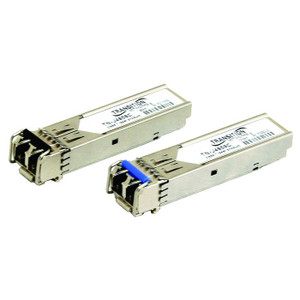
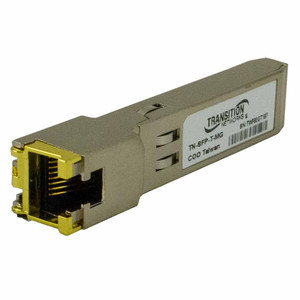
Transition Networks TN-J4859C 1GbE SFP Transceiver Module
The Transition Networks TN-J4859C is a 1000Base-LX SFP transceiver module designed for long-distance Gigabit Ethernet connectivity over single-mode fiber. Operating at 1310 nm wavelength, this module supports point-to-point fiber runs up to 12.4 miles without repeaters—ideal for campus backhaul, remote facility links, and security camera network aggregation where fiber is already in place. The compact mini-GBIC form factor plugs directly into standard SFP ports on network equipment, switches, and media converters with zero external power consumption. TAA-compliant design and lifetime warranty backing make this a cost-effective, low-maintenance component for integrators managing distributed IP surveillance and access-control systems across sprawling properties.
Key Features
- 1000Base-LX at 1310 nm: Single-mode fiber transmission at standard 1 GbE data rate. Leverages existing campus fiber infrastructure without upgrading to multimode or purchasing new cable runs.
- 12.4-Mile Maximum Range: Sufficient for inter-building links on large properties, remote parking lots, and perimeter fence lines. Eliminates the need for intermediate repeaters on typical enterprise distances.
- SFP (Mini-GBIC) Plug-and-Play: Fits any standard SFP port—Cisco, Juniper, Arista, Transition, or OEM switches. No external power supply, drivers, or firmware updates required.
- Passive Cooling, Zero Power Draw: Operates passively without fans or active cooling. Saves power budget on switch line cards and simplifies thermal design in cabinet-constrained network rooms.
- TAA-Compliant Manufacturing: Meets Buy American Act requirements for US federal, state, and local government procurement. Genuine Transition Networks component with full supply-chain traceability.
- Lifetime Warranty: Factory-backed lifetime hardware warranty—no surprise replacement costs, standard support terms with Transition Networks direct or channel partner.
- Compact Form Factor: Mini-GBIC footprint (2.5" × 0.5") allows high-density SFP slot utilization. Fits in tight patch panel and line-card layouts without mechanical rework.
Single-mode fiber (SMF) backhaul is the default choice for IP surveillance and access-control networks spanning multiple buildings or outdoor perimeter coverage. Multimode fiber—common in older installs—introduces dispersion over long distances and requires expensive multimode-to-singlemode conversion. The TN-J4859C operates natively on standard ITU G.652 single-mode fiber at 1310 nm, a wavelength widely available from fiber plant audits and commissioned runs. If you're extending a campus network or aggregating remote camera feeds, this transceiver avoids the capex penalty of ripping and replacing fiber and the opex burden of managing mixed transceiver types.
Integration is straightforward across heterogeneous network fabrics. The SFP format is carrier-agnostic—plug it into Transition media converters, Cisco Catalyst switches, Arista EOS platforms, or any OEM device with a vacant SFP slot. ONVIF IP cameras and access-control appliances on remote segments see transparent Layer 2 connectivity; no special provisioning or VPN tunneling needed for camera discovery and management traffic. For security integrators managing 50+ distributed sites, the ability to mix and match transceiver vendors without introducing firmware lock-in or licensing restrictions is a genuine operational win.
TAA compliance and lifetime warranty address federal and enterprise procurement requirements. If your integration scope includes any US government, university, or municipal customer, the TAA mark on this module simplifies buy-in and eliminates downstream audit friction. Lifetime coverage—even on obsolete stock—means a failed transceiver on a 7-year-old campus network doesn't force you to buy a new platform or negotiate with out-of-warranty vendors.
Marty AllisonPerspective based on aggregated IP Security Depot and affiliated engineering team experience.
We've deployed the TN-J4859C across university campuses, corporate parks, and public-safety perimeter networks where single-mode fiber was already in the ground. The real strength here is simplicity—no power budget surprises, no wavelength tuning, no driver headaches. A lot of integrators default to buying premade fiber patch cables with fixed transceivers molded in, which works for pre-canned distances but locks you into vendor pricing and creates e-waste when you need to re-provision. The modular SFP approach, especially on a TAA-compliant part, gives you flexibility. If a transceiver fails mid-deployment, you buy a replacement at standard pricing, swap it into any SFP slot on the network, and you're back online. We've also seen integrators use the TN-J4859C to bridge older Transition media converters or third-party switches without committing to a wholesale platform swap. The 12.4-mile spec is conservative for 1310 nm over standard SMF—real-world loss budgets often allow 15+ miles, but Transition publishes conservatively, which we respect. Where this part truly differentiates is in mixed-vendor environments: a university with Cisco core switches, Transition edge media converters, and Hikvision camera networks can outfit all three with this same SFP and avoid transceiver compatibility matrices entirely.
Technical Highlights:
- 1310 nm Wavelength: Standard ITU C-band single-mode window with minimal chromatic dispersion over 12.4-mile runs. Pairs seamlessly with any G.652-grade campus fiber plant without attenuation penalty or nonlinear effects that plague longer multimode links.
- Zero External Power: Passive optical design eliminates DC supply requirements and reduces switch line-card power consumption. Useful constraint in remote cabinet installations or solar-powered outdoor network nodes where power budget is tight.
- 1000Base-LX Standard Compliance: IEEE 802.3z certified—interoperates with any 1GbE interface recognizing LX wavelength and bit rate. No proprietary firmware, no vendor lock-in, no deprecated chipset risks.
- SFP Hot-Swap Capability: Most modern switches support live transceiver insertion/removal without link-state disruption. Useful for maintenance windows where you swap a suspect module without bringing down the backhaul.
- TAA Compliance & Lifetime Warranty: Genuine domestic-origin supply chain and unlimited hardware replacement. Eliminates gray-market risk and simplifies federal/state procurement documentation.
Deployment Considerations:
- SMF requires proper fiber termination and polishing—use angled physical contact (APC, blue connectors) or ultra-physical contact (UPC, beige) depending on your existing plant. Mismatched connector types or dirt on ferrules will spike attenuation and cause dropped frames. Test your fiber with an OTDR or light meter before blaming the transceiver.
- SFP ports on older switches or media converters may not auto-detect 1310 nm wavelength without manual port configuration. Check your switch or converter documentation for wavelength auto-sensing; some older hardware requires explicit transceiver ID configuration in CLI or web UI.
- Fiber patch panels and distribution frames should include wavelength-segregated slots if you're mixing 1310 nm and 1550 nm (CWDM/DWDM) on the same fiber plant. Labeling is your friend here—one mislabeled transceiver swapped into the wrong wavelength slot creates silent duplex mismatches and intermittent frame loss that are brutal to diagnose.
- If your camera or NVR is on a remote network segment 12+ miles away, ensure your switch or media converter has a large enough frame-forwarding buffer and MTU settings that accommodate full 1500-byte IP packets plus any VPN or VLAN encapsulation overhead. Jumbo frame support (9000 MTU) on both ends of the link is a nice-to-have for HD/4K camera multicast streams.
- Environmental: SFP form factor has no heatsink. In outdoor cabinets or sun-exposed switch rooms, ensure ambient temp stays below 70°C and fiber-entry conduits don't radiate infrared onto the module. Passive cooling is reliable, but localized heat soak will degrade laser wavelength stability and bit-error rate.
The TN-J4859C is the right choice for integrators and system architects who already have campus or long-distance single-mode fiber installed and need a plug-and-play, vendor-agnostic way to connect remote cameras, access panels, and intercom networks without repeaters or active amplification. If your customer has a federal compliance mandate or requires lifetime support without surprise end-of-life obsolescence, this TAA-backed lifetime-warranty module eliminates procurement friction and future replacement guesswork. See the Transition Networks catalog for matching media converters and fiber-management products.