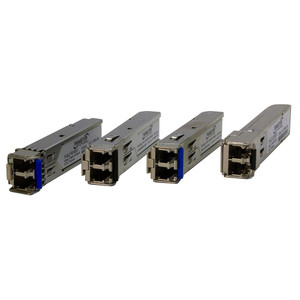
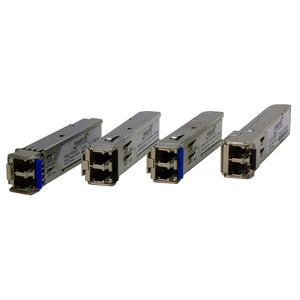
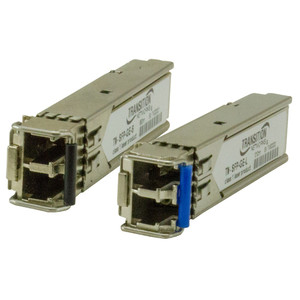
Transition Networks TN-SFP-GE-100FX 100Base-FX SFP Transceiver
Overview
The Transition Networks TN-SFP-GE-100FX is a plug-in SFP (small form-factor pluggable) transceiver module that delivers 100Base-FX fiber connectivity for network switches, routers, and managed devices. This single-port module bridges fiber infrastructure to equipment requiring 100 Mbps fast Ethernet over multimode or single-mode fiber, making it ideal for expanding legacy or emerging fiber-based deployments without replacing core networking hardware.
Key Features
- Hot-swappable SFP form factor: Install or replace the module in the field without powering down the host device. Reduces mean time to repair and eliminates scheduled downtime for transceiver swaps.
- 100Base-FX fiber support: Delivers 100 Mbps Ethernet over multimode or single-mode fiber cable, extending connectivity beyond copper distances. Eliminates electromagnetic interference and enables longer cable runs in industrial or multi-floor environments.
- Compact module design: The SFP footprint consumes minimal chassis space, enabling dense port configurations on switches and routers. Useful when you need to add fiber ports without a hardware overhaul.
- Broad compatibility: Designed for Transition Networks switches and other standards-compliant SFP-capable equipment. Verify your host device supports standard SFP optical modules and 100Base-FX wavelengths before purchase.
- Passive optical module: No external power required beyond the host device's SFP slot. Reduces power consumption and simplifies field deployment compared to active transceiver designs.
Integration and Compatibility
The TN-SFP-GE-100FX (often searched as TN SFP GE 100FX) integrates into any network architecture using standard SFP slots and 100Base-FX fiber infrastructure. Before ordering, confirm your switch or router has an available SFP port and supports 100Base-FX transceiver modules. Fiber cable type—multimode or single-mode—depends on your existing infrastructure and distance requirements. Multimode fiber supports shorter distances (up to ~2 km) but is more cost-effective for campus environments; single-mode fiber extends to 10 km or beyond, essential for distributed warehouse or multi-site deployments.
This transceiver is a network layer component suited for integrating warehouse automation networks, distributed IP camera systems, or any fiber-based security infrastructure into existing switched environments. For network video recorders and IP cameras connected across fiber, having standardized SFP transceiver inventory reduces spare-parts complexity and deployment timelines.
Deployment Considerations
SFP transceiver modules are standardized, but wavelength, fiber type (MM vs. SM), and distance rating vary significantly. Verify the 100Base-FX standard supports your exact fiber plant and distance requirements—100Base-FX is well-suited for campus and warehouse environments up to 2 km on multimode, or longer on single-mode. If your site already uses 1000Base-SX or 1000Base-LX infrastructure, you may benefit from a gigabit-class transceiver in the same family to future-proof the deployment, though 100 Mbps is often sufficient for legacy or bandwidth-limited automation networks.
Frequently Asked Questions
Q: Does the TN-SFP-GE-100FX work in any SFP slot?
A: The module is compatible with any standards-compliant SFP slot, but the host device must support 100Base-FX transceivers. Gigabit-capable SFP slots often accept 100Base-FX modules, but verify with your switch or router documentation before purchase.
Q: What is the maximum fiber distance for the TN-SFP-GE-100FX?
A: 100Base-FX supports up to approximately 2 km on multimode fiber and longer distances on single-mode fiber. Actual distance depends on fiber quality and cable specifications. Verify your fiber plant meets the standard's requirements for your deployment distance.
Q: Can I use this transceiver to replace a failed module without equipment downtime?
A: Yes. The SFP form factor is hot-swappable, meaning you can remove and install the module while the host device remains powered and operational. This enables field repair without scheduled maintenance windows.
Q: Is external power required for the TN-SFP-GE-100FX?
A: No. The module is passive and powered entirely through the SFP slot on the host device. No external power supply or adapter is needed.
Q: What fiber types does this transceiver support?
A: The TN-SFP-GE-100FX supports both multimode and single-mode fiber, depending on the optical design of your module. Verify the specific variant of this transceiver matches your fiber plant before installation.
Ted PerryPerspective based on aggregated IP Security Depot and affiliated engineering team experience.
The Transition Networks TN-SFP-GE-100FX is a straightforward fiber transceiver for sites still operating 100Base-FX infrastructure or sites needing to add fiber connectivity to existing switched equipment without full hardware replacement. It's a commodity component, but choosing the right one depends on understanding your fiber plant's wavelength and distance specifications.
Technical Highlights:
- 100Base-FX standard compliance: Delivers 100 Mbps over multimode or single-mode fiber. Sufficient for legacy automation networks and useful for avoiding copper run length limitations in large warehouses or multi-floor facilities.
- Hot-swappable SFP module: No host device downtime required for transceiver replacement. Field swap capability is critical in production environments where even brief network outages ripple through warehousing or security systems.
- Passive design, no external power: Power draw is negligible—the module draws power only through the SFP slot. Simplifies field installation and reduces power budget consumption on the host switch.
Deployment Considerations:
- Verify your switch or router supports standard SFP form-factor transceivers and 100Base-FX wavelengths before ordering. Gigabit-capable devices often accept 100Base-FX modules, but compatibility is not universal.
- Distance limitations: 100Base-FX maxes out around 2 km on multimode fiber. If you need to bridge multiple buildings or a large outdoor site, confirm your fiber plant meets this distance requirement, or consider a single-mode variant and test before production deployment.
Best suited for retrofit or expansion scenarios where you're adding fiber ports to an existing switch to serve distributed IP cameras, industrial sensors, or access control networks that already sit on fiber infrastructure. Not a performance upgrade path—if you need gigabit speeds, a 1000Base-SX or 1000Base-LX transceiver from the same vendor is the practical choice.