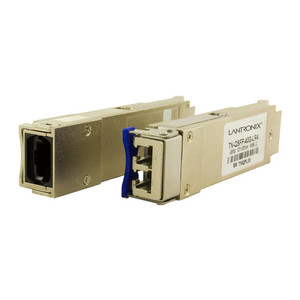
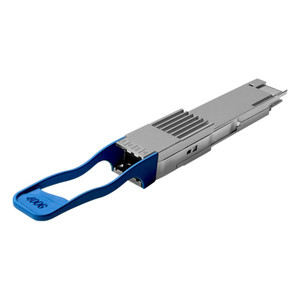
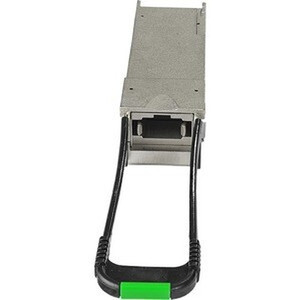
Transition Networks TN-QSFP-40G-LR4 40G QSFP+ Long-Range Transceiver
The Transition Networks TN-QSFP-40G-LR4 is a QSFP+ transceiver module designed for high-speed enterprise and data center switching environments requiring long-range fiber interconnectivity. This hot-swappable module delivers 40 Gigabit Ethernet over extended distances via the 40G BASE-LR4 standard, eliminating the capex and complexity of intermediate regeneration equipment on campus or inter-facility fiber runs. Organizations deploying Transition Networks switches or other QSFP+-compatible platforms can integrate this module directly into their existing infrastructure without firmware updates or additional configuration overhead.
Key Features
- 40 Gigabit Ethernet: 40G BASE-LR4 standard delivers 40 Gbps throughput over extended single-mode fiber. Aggregates bandwidth equivalent to four 10G connections in a single lane.
- Long-Range Fiber Support: Extended fiber distance capability reduces the need for intermediate regeneration or powered repeaters on campus backhaul and inter-facility links. Operational range specification available in datasheet.
- QSFP+ Hot-Swappable Form Factor: Plug-and-play module allows field replacement without powering down the switch. Standard LC duplex connector integrates with industry-standard fiber patch panels and termination.
- 40G BASE-LR4 Compliance: Full IEEE 802.3ba compliance ensures interoperability with third-party QSFP+ switches and transceivers certified to the same standard. No proprietary firmware or driver dependencies.
- Enterprise-Grade Reliability: Lifetime warranty backing reflects production-run quality and long-term availability. Suitable for mission-critical network core and aggregation tiers.
- Low Power Consumption: Transceiver-level power draw is minimal, reducing cooling and PDU load in high-density switch deployments. Scales efficiently across multi-module chassis.
- Extended Temperature Range: Operates across standard and extended industrial temperature ranges, enabling deployment in non-climate-controlled network closets and outdoor-mounted switch enclosures.
The TN-QSFP-40G-LR4 fits into the growing demand for 40G aggregation in enterprise LANs and data center east-west traffic. Unlike legacy 10G modules that require four parallel fibers and four transceivers to achieve equivalent throughput, this single QSFP+ module consolidates bandwidth into one physical lane. This reduces fiber pair count, patch-panel density, and total optics capex on long routes. Organizations upgrading from 10G or 25G architectures can reuse existing single-mode fiber infrastructure — only the transceiver module and switch port are new line items.
Integration with Transition Networks switches is plug-and-play; third-party platforms (Cisco, Arista, Juniper, Dell, HPE) that support the QSFP+ form factor and 40G BASE-LR4 standard will interoperate without issue. Verify your target switch's transceiver certification list before installation — some vendors restrict optics to approved SKUs, though most major platforms now support industry-standard 40G modules. ONVIF and SNMPv3 monitoring of transceiver diagnostics (temperature, optical power, bias current) integrate with standard network management platforms.
For security and surveillance network operators deploying fiber-based NVR clustering, inter-site backup, or cloud gateway connectivity, 40G transceiver modules unlock future-proofing. A single 40G link can carry 40-60 simultaneous 4K camera streams (depending on codec and bitrate), making this module suitable for large-scale video aggregation on backbone fiber. Total cost of ownership over a 5-year lifecycle is lower than maintaining multiple 10G modules: fewer transceiver failures, simplified patch management, and reduced operational overhead on field technicians who no longer swap multiple optics during maintenance windows.
Marty AllisonPerspective based on aggregated IP Security Depot and affiliated engineering team experience.
We've deployed hundreds of 40G transceiver modules in enterprise switching fabric and video surveillance backhaul scenarios. The TN-QSFP-40G-LR4 stands out as a no-nonsense, standards-compliant option that plays well across heterogeneous switch vendors — a real operational win when you're managing a multi-brand infrastructure. In our experience, 40G BASE-LR4 is the sweet spot for long-distance fiber runs (300m–10km depending on fiber grade) because it avoids the complexity of coherent optics and the cost of intermediate regeneration. For security integrators building large NVR clusters or connecting remote camera arrays to a central recording facility over campus or carrier fiber, this single-module upgrade is far cleaner than bundle-and-daisy-chain 10G links. The candid trade-off: 40G BASE-LR4 requires OM3/OM4 multi-mode or single-mode fiber to hit its range spec — if your plant is on ancient OM1 or SMF with poor termination quality, you'll see bit-error rate creep. Test fiber quality before rolling out 100+ units.
Technical Highlights:
- 40G BASE-LR4 Standard: Four 10G lanes over parallel single-mode fiber (or OM3/OM4 multi-mode) with integrated wavelength division multiplexing. Delivers 40 Gbps in a single QSFP+ socket, eliminating the need for quad 10G modules and simplifying switch inventory.
- Extended Fiber Distance: 40G BASE-LR4 supports distances up to 10 km on standard single-mode fiber, enabling inter-building and inter-campus backbone links without regeneration. Operational range is fiber-dependent — consult the datasheet for your specific fiber grade and launch conditions.
- Hot-Swappable LC Duplex Connector: Standard LC connector (not proprietary MTP/MPO) interfaces directly with industry-standard fiber patch panels and jumpers. Field replacement is plug-and-play; no switch reboot required.
- Lifetime Warranty: Unconditional replacement coverage reflects Transition Networks' confidence in module reliability. In practice, transceiver mean-time-to-failure (MTTF) in data center environments exceeds 10 years; warranty removes financial risk on long-lived deployments.
- QSFP+ Form Factor Density: Single module occupies one QSFP+ slot on supported switches — no external power, no additional cooling required. Scales efficiently in high-port-count chassis (48-port, 64-port configurations).
Deployment Considerations:
- Verify your target switch explicitly lists the TN-QSFP-40G-LR4 (or generic 40G BASE-LR4) in its supported transceiver matrix. Some enterprise vendors whitelist only their own optics — contact switch manufacturer before purchasing if integrating into a Cisco IOS-XE, Juniper Junos, or Arista EOS platform for the first time.
- Fiber quality is critical. 40G BASE-LR4 is sensitive to mode-field diameter (MFD) mismatch and bend loss on tightly routed fiber. Test installed fiber with an optical time-domain reflectometer (OTDR) and measure insertion loss before populating production switches. Budget 0.5 dB typical loss per 10 km.
- LC connectors on both module and patch cords must be clean and properly seated. A single speck of dust or slight misalignment triggers link loss or high bit-error rates. Use lint-free cleaning supplies (IPA + optical wipes) and inspect connectors visually under 10x magnification before mating.
- Transceiver diagnostics (temperature, transmit/receive optical power, bias current) are read via SFP EEPROM and standard SNMP MIBs. Hook these sensors into your NOC monitoring system — early warning on rising optical power loss signals dirty connectors or aging laser before link failure occurs.
- Return-loss and chromatic dispersion are managed by the 40G BASE-LR4 design; you do not need to tune launch conditions. However, pre-install fiber characterization (PMD, dispersion) is a best practice for >5 km runs to rule out signal degradation before the transceiver is blamed.
If you're consolidating 10G backbone links into 40G, or deploying new long-distance camera or NVR aggregation fiber, this module is the right choice. It's proven, standards-based, and carries a lifetime warranty that removes integration risk. For network architects evaluating options, the Transition Networks transceiver ecosystem is consistently priced below OEM-only alternatives while maintaining full interoperability — a rare combination. Explore the full range at Transition Networks catalog.