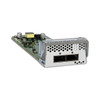
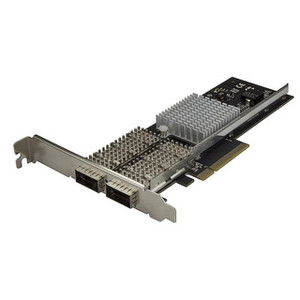
NETGEAR APM402XL-10000S 2-Port 40G QSFP+ Expansion Card
Overview
The NETGEAR APM402XL-10000S is a 2-port 40G QSFP+ expansion card engineered to scale bandwidth in NETGEAR M4300 managed switches. This modular port card delivers 40 Gigabit Ethernet performance for enterprise edge, data center, and high-density network backhaul scenarios where existing 10G connectivity cannot absorb traffic demand. Deployed as a field-installable module, the APM402XL-10000S (often searched as APM402XL 10000S) avoids costly chassis replacement and lets you grow bandwidth in place.
Key Features
- 2x 40G QSFP+ Ports: Delivers 80 Gbps aggregate throughput per card. Each port runs at 40 Gigabit line rate — meaningful when consolidating traffic from dozens of 10G branches or feeding a high-speed backbone. No oversubscription overhead at these port densities.
- Modular Expansion Architecture: Slides into compatible M4300 chassis without replacing core infrastructure. Stacks seamlessly with existing 1G and 10G modules in the same switch family, enabling mixed-speed spine-and-leaf topologies that cost less than forklift upgrades.
- Non-Blocking Switching Fabric: Works within the M4300's line-rate switching capacity, so all traffic forwarded at wire speed. No buffering delays or congestion on the fabric — packets move through at full 40G rate regardless of load.
- Multi-Gigabit Media Flexibility: Accepts both DAC (Direct Attach Copper) and fiber optic modules on each 40G port. DAC cables run up to 24 meters passive — practical for short-haul data center interconnects. Fiber extends to hundreds of meters, enabling campus backbone or remote site connectivity.
- IGMP Plus Multicast Optimization: Simplifies Layer 2 AV-over-IP distribution without PIM complexity. Scales multicast streams across professional broadcast, surveillance, and unified communications deployments using automated IGMP techniques — eliminates manual pruning and reduces bandwidth waste on non-subscribing ports.
- Advanced Routing and Policy: Full L3 stack including static, dynamic (RIP, OSPF), and policy-based routing as standard. VRRP, PTPv2, and tiered authentication (Dot1x, MAB, Captive Portal) support hybrid wired/wireless access convergence and precise traffic steering without license fees.
- High-Availability Stack Control: Integrates into M4300 virtual chassis architecture with Non-Stop Forwarding (NSF) and hitless failover. If a master switch fails, the standby assumes role while existing forwarding continues — zero-packet-loss convergence for critical network segments.
Integration and Compatibility
The APM402XL-10000S plugs into any M4300 series chassis (M4300-96X, M4300-48-PoE, M4300-24X) via standard modular port expansion slots. Works alongside 1Gig and 10Gig port cards in the same stack — no special configuration needed. Pairs with NETGEAR NMS300 single-pane-of-glass management platform for firmware updates, mass provisioning, and multi-switch monitoring across stacks. Supports industry-standard CLI, SNMP, sFlow, and RSPAN for integration into existing NOC workflows.
The card maintains M4300 feature parity: all VLAN, QoS, ACL, and multicast rules apply to 40G ports just as they do to lower-speed modules. Authentication Manager handles per-port tiered policies. BYOD scenarios benefit from successive-tier Dot1x fallback to MAB with Captive Portal — all on the same 40G uplink without adding complexity.
Deployment Context
Choose this expansion card when 10G aggregation links are saturating between switches, when consolidating 100+ 1Gig access ports into a single stack requires >100 Gbps of backplane capacity, or when building SDVoE-ready professional AV-over-IP networks that demand deterministic multicast at scale. The 40G QSFP+ ports also serve as spine interconnects in collapsed-core or three-tier topologies — far cheaper than dedicated 100G chassis. If your current 10G stack is healthy but growing, add 40G port cards incrementally rather than replacing everything at once.
What's in the Box
1x NETGEAR APM402XL-10000S 2-port 40G QSFP+ expansion card
Frequently Asked Questions
Q: What M4300 models support the APM402XL-10000S?
A: Any M4300 chassis with available modular port slots accepts this card — including the M4300-96X (which can grow from 2 to 24 ports of 40G by adding multiple cards), the M4300-48-PoE, and other stackable M4300 platforms. Verify your specific switch documentation for available expansion slots.
Q: Do I need fiber cables or can I use copper?
A: Both. Each 40G QSFP+ port accepts Direct Attach Copper (DAC) cables up to 24 meters passively, or active fiber modules (QSFP+ transceivers) for longer distances. Choose based on your cabinet layout and interconnect distance.
Q: What's the warranty coverage on the APM402XL-10000S?
A: The NETGEAR M4300 series is covered under NETGEAR Enterprise Lifetime Warranty with 3 years of Sprint support included (24/5 technical support via phone and online). Advance RMA replacement available; Overdrive support contracts offer 24/7 phone support and Next Business Day RMA if needed.
Q: Can I mix 1Gig, 10Gig, and 40Gig cards in the same stack?
A: Yes. The M4300 is designed for flexible stacking across multiple speed tiers. Start with 1Gig access, add 10Gig port cards for aggregation, and layer in 40Gig spine ports — all in the same stack without replacing the core infrastructure.
Q: Does the APM402XL-10000S support PoE?
A: No. The 40G QSFP+ ports are high-speed interconnect only and do not deliver power over the line. PoE is available on lower-speed M4300 port cards (1Gig and 10Gig modules with PoE+ option).
Q: What management protocols does this card support?
A: Full M4300 feature set applies to the 40G ports: CLI, web GUI, SNMP, sFlow, RSPAN, multicast VLANs, authentication manager, static/dynamic routing (RIP, OSPF, VRRP), policy-based routing (PBR), and PTPv2. Integrates with NMS300 for centralized management across multiple stacks.
The APM402XL-10000S solves a real problem I see in mid-enterprise deployments: you've got a solid M4300 stack handling hundreds of access ports, but the 10G uplinks are pinned at 80–90% utilization during peak hours. Rather than rip out the entire switch, this card lets you add 80 Gbps of 40G spine capacity in a single expansion slot. That's enough breathing room for another 3–5 years without a forklift upgrade.
Technical Highlights:
- 80 Gbps Aggregate 40G Throughput: Two 40G QSFP+ ports at wire rate means zero bottleneck between this card and the M4300 backplane. Line-rate switching fabric absorbs traffic without buffering — critical for low-latency spine interconnects or AV-over-IP backbone flows that can't tolerate jitter.
- 24-Meter Passive DAC Support: Direct Attach Copper cables work up to 24 meters without active transceivers — practical for most data center and office cabinet layouts. Eliminates the need (and cost) of fiber optics for typical same-floor interconnects unless you're building campus-scale topology.
- IGMP Plus Multicast at Scale: Professional AV and surveillance networks benefit from automated Layer 2 multicast pruning without PIM routing overhead. Scales broadcast and unicast-to-multicast streams across dozens of ports without manual rule management — tested in real SDVoE installations.
Deployment Considerations:
- Verify available modular slots in your specific M4300 chassis before ordering — not all M4300 models have expansion capacity. The M4300-96X is the most common candidate, but confirm with your hardware documentation.
- 40G QSFP+ optics cost more than 10G SFP+ modules. Budget for QSFP+ DAC cables or transceivers when planning the expansion — don't assume your existing inventory will fit.
This card is built for spine consolidation in growing stacks or for professional AV backbones that need deterministic multicast at 40Gig speeds. If your M4300 stack is still comfortable at 10G aggregation, defer the upgrade. But if you're managing branch consolidation or seeing 10G link saturation creep into peak-hour monitoring, the APM402XL-10000S pays for itself in deferred forklift costs and operational continuity.