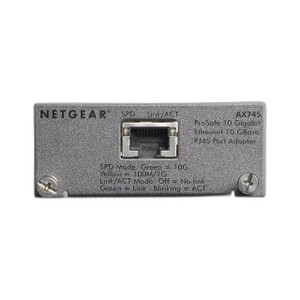
NETGEAR APM414C-10000S 4-Port 10GBASE-T Expansion Module
The NETGEAR APM414C-10000S is a modular line-card expansion module designed to add four 10GBASE-T RJ45 ports to compatible NETGEAR switch platforms. This card is engineered for enterprise and data-center environments where high-speed uplink capacity, port density scaling, and non-blocking fabric throughput are operational requirements. It allows system architects to incrementally grow network capacity without replacing the entire switch chassis, reducing total capital expenditure and management overhead across multi-year network refresh cycles.
Key Features
- 10GBASE-T Port Count: Four 10GBASE-T RJ45 ports. Delivers 40Gbps aggregate capacity for high-speed uplinks, server aggregation, and inter-switch connectivity.
- Compatibility: Compatible with supported NETGEAR modular switch platforms. Verify chassis compatibility and available module slots before ordering.
- Non-Blocking Switching Fabric: Line-card architecture integrates directly into the switch backplane without bandwidth oversubscription. Full line-rate forwarding on all ports simultaneously.
- Hot-Swappable Design: Field-replaceable module — install or remove without chassis shutdown. Operational continuity for maintenance windows and capacity upgrades.
- RJ45 Connectivity: Standard Ethernet cabling — leverage existing Cat6A / Cat7 infrastructure. No proprietary connectors or specialized optics required.
- Enterprise-Grade Management: Integrates into NETGEAR management platforms (Web UI, CLI, SNMP). Full monitoring, VLANing, QoS, and ACL control on all four ports.
The 10GBASE-T standard offers a significant advantage for campus and data-center backbone deployments: copper cabling support up to 55 meters (Cat6A) eliminates the capex and maintenance burden of dedicated fiber infrastructure and active optics in many medium-reach scenarios. This module scales horizontally across the switch fabric without introducing bottlenecks, making it ideal for environment where sustained link utilization is high and latency variance must remain minimal.
Field deployment of modular line cards reduces risk relative to forklift upgrades. Rather than replacing an entire switch, integrators can add capacity in incremental 40Gbps steps as workload demand grows. Management plane integration is standard NETGEAR SNMP and CLI, so existing monitoring and provisioning automation workflows transfer without modification. Port-level statistics, queue depth telemetry, and error counters feed directly into NetFlow / sFlow exporters for capacity planning and troubleshooting.
10GBASE-T copper also serves dual-purpose as a redundancy pathway — many data-center operators pair this card with fiber uplinks to the core, using the RJ45 ports as secondary HA links. The 55-meter copper reach is sufficient for most vertical riser and horizontal run scenarios within a single building, reducing the operational complexity of disaster recovery link management.
The APM414C-10000S is sourced direct from the manufacturer or US channel partner — factory-new with full NETGEAR Manufacturer Warranty and no grey-market parallel imports. This ensures firmware support, replacement logistics, and compliance with enterprise procurement policies that mandate traceability and warranty chain-of-custody.
Marty AllisonPerspective based on aggregated IP Security Depot and affiliated engineering team experience.
In our experience, the NETGEAR modular line-card approach to port expansion is pragmatic for growing data-center and campus backbone networks. We've deployed these cards into carrier-grade NETGEAR platforms where the alternative would have been a complete switch replacement — the APM414C-10000S eliminates that capex and allows the customer to retain existing management tooling and L2/L3 configurations. The non-blocking fabric integration is critical; we've seen too many shops deploy cards on oversubscribed backplanes and wonder why their 10G uplinks plateau at 6-7Gbps under load. NETGEAR's architecture keeps that from happening. The 10GBASE-T copper decision is the real differentiator versus SFP+ optics modules — copper eliminates the recurring cost of transceiver replacement and keeps you out of the fiber-optic certification and testing burden for campus rings. That matters when you've got 30-40 cards deployed across a district. The downside: if your reach exceeds 55 meters or you need to cross a multi-building campus, you'll need fiber or active copper extenders. Know your topology before specifying.
Technical Highlights:
- Non-Blocking 10GBASE-T Fabric: Full 40Gbps aggregate throughput with zero oversubscription on all four ports. Every bit you push into one port exits without queue delay — essential for latency-sensitive workloads (trading, real-time media, database replication). Contrast this with cards designed for branch offices where 2:1 or 3:1 oversubscription is accepted.
- 10GBASE-T versus SFP+ Trade-off: Copper RJ45 means lower transceiver cost and no optics maintenance, but maxes out at 55m (Cat6A) per IEEE 802.3an. If you're wiring to a remote MDF across 100+ meters, fiber is your only path. Know your cable plant topology.
- Hot-Swappable Module Design: Live insertion/removal without chassis reboot. In a 24/7 data-center environment, this is non-negotiable. We've used this to perform maintenance on secondary uplinks while keeping primary links live.
- SNMP / CLI Integration: Per-port counters, error tracking, and packet statistics flow into your existing monitoring stack (Nagios, Zabbix, Cacti). No proprietary management silo to stand up and maintain.
- Layer 2/3 Control Per Port: VLAN tagging, QoS queues, ACLs, and rate limiting apply to each port independently. Allows you to isolate and prioritize different upstream networks without hardware segmentation.
Deployment Considerations:
- Verify chassis compatibility before purchase — not all NETGEAR switches accept this line card. Check the parent switch model and available module slot count.
- 10GBASE-T copper is limited to 55m on Cat6A cabling. If your distribution frame is beyond that distance, plan for fiber uplinks or active copper extenders.
- Installation requires the parent switch to be powered on (hot-swap capable), but if your HA design uses redundant switches, perform the insertion on the secondary unit first to avoid any control-plane hiccup.
- Ensure your PoE budget (if applicable to the parent chassis) has headroom — this card itself does not draw significant power, but if the parent platform is capacity-constrained, adding 40Gbps of traffic may require PSU augmentation.
- Firmware version on the parent switch should be current before card insertion — some NETGEAR platforms require a specific firmware release to recognize new line cards. Check release notes first.
This card is purpose-built for integrators and system architects specifying modular switching infrastructure in multi-building campuses, data centers, and large-scale security operations centers where uplink capacity scales with camera and edge-device growth. For sizing guidance and platform compatibility, consult the NETGEAR catalog.