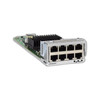
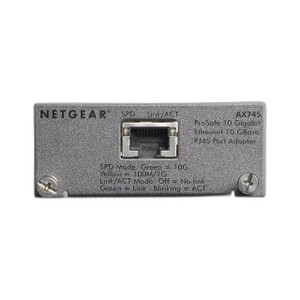
NETGEAR APM408C-10000S 8-Port 10GBASE-T Expansion Card
Overview
The NETGEAR APM408C-10000S is an 8-port 10GBASE-T expansion card designed to scale the M4300 stackable switch series in enterprise and mid-market edge deployments. This modular card inserts into compatible M4300 chassis, adding 10 Gigabit Ethernet capacity in increments of 8 ports up to a 96-port maximum system configuration. If you're running converged voice, video, and data over a unified switching fabric, this card provides the high-speed backbone connectivity required without forcing a complete hardware refresh.
Key Features
- 10GBASE-T Connectivity (8 ports per card): Each port operates at 10 Gbps over standard Cat6A copper cabling to distances up to 24 meters — no SFP+ transceivers or fiber runs required unless you're building long-reach trunk lines. Start small with a single card and expand in 8-port increments as bandwidth demand grows.
- 480W PoE+ Power Budget: Supplies 802.3at PoE+ power distributed across the card's ports, enabling network-attached appliances (IP phones, wireless access points, surveillance cameras, AV endpoints) to draw power directly from the switch. This eliminates separate power injectors for edge devices and simplifies cabling in equipment racks.
- Layer 2 and Layer 3 Switching: Built-in support for static and dynamic routing protocols (RIP, OSPF, VRRP) plus policy-based routing means you can segment traffic, enforce QoS rules, and route between VLANs without a separate Layer 3 appliance. Multicast VLAN (IGMP Plus) simplifies video-over-IP deployments by allowing Layer 2 multicast without PIM complexity.
- Non-Blocking Stacking Architecture: Pairs with other M4300 models (1G and 10/40G variants) in a unified stack. Hitless failover and non-stop forwarding (NSF) mean a failed card or power supply doesn't drop traffic on operational stack members — critical for broadcast, financials, or health-care networks where any interruption triggers a cascade.
- Authentication and Security Filtering: Supports tiered Dot1x, MAC-based authentication (MAB), and Captive Portal with per-port policies. Combined with DHCP/BootP auto-discovery and configuration file automation, you can enforce device onboarding rules across dozens of ports without manual intervention.
- Enterprise Management Framework: CLI, web GUI, SNMP, sFlow, and RSPAN enable integration with existing network monitoring and firmware management platforms. Centralized single-pane-of-glass management via NETGEAR NMS300 reduces operational overhead when you're managing multiple stacks across locations.
Integration & Compatibility
The APM408C-10000S slots into M4300 modular switch chassis and operates seamlessly with existing 1 Gigabit and 10/40 Gigabit M4300 models in the same stack. Dual redundant, modular power supplies ensure no single point of failure — if one PSU fails, the card and its PoE delivery continue operating. This modularity is especially valuable in spine-and-leaf rack architectures where top-of-rack redundancy and traffic isolation are non-negotiable design requirements.
What's in the Box
The APM408C-10000S arrives factory-sealed. Specific package contents are not listed in the manufacturer evidence; confirm the exact components (mounting brackets, cable trays, documentation) with your supplier before installation.
Frequently Asked Questions
Q: Can I mix APM408C-10000S cards with 40G ports in the same stack?
A: Yes. M4300 stacks support mixed 10G and 40G port cards in the same logical unit. This gives you design flexibility — deploy 10G cards at the access layer and add 40G cards later for spine or inter-switch trunk links without replacing existing hardware.
Q: What is the maximum cable run from an APM408C-10000S port?
A: Up to 24 meters (approximately 79 feet) over standard Cat6A copper. If you need longer distances, substitute SFP+ fiber modules in compatible M4300 chassis slots.
Q: Does the APM408C-10000S include a manufacturer warranty?
A: The NETGEAR M4300 series is covered under NETGEAR Enterprise Lifetime Warranty. Three years of Sprint support with 24/5 technical support and Advance RMA replacement are included. Overdrive support contracts are available for 24/7 phone support and 2-hour response SLA.
Q: Can this card power multiple IP cameras and wireless APs on the same stack?
A: Yes. The 480W PoE+ budget across the card's ports can supply dozens of standard PoE+ devices (typically 15–30W per device depending on model). If you have high-power devices or many simultaneous draws, verify the total wattage against the M4300 chassis power supply capacity to avoid overload.
Q: What is the throughput capacity of an M4300 stack with multiple APM408C-10000S cards?
A: A fully populated M4300-96X with up to 96 ports of 10G delivers non-blocking, line-rate throughput across the switching fabric. Exact throughput depends on the specific M4300 base model and card configuration; confirm aggregate backplane capacity in your chassis documentation.
Q: Is the APM408C-10000S suitable for AV-over-IP (SDVoE) installations?
A: Yes. IGMP Plus multicast support, Layer 2/3 feature parity, and PTPv2 (Precision Time Protocol) make the M4300 series and the APM408C-10000S well-suited for professional AV-over-IP and unified communications deployments where synchronized, low-latency multicast is required.
The APM408C-10000S fills a practical gap in mid-market stack expansion: you get true 10 Gigabit per-port speed over copper without the cost or complexity of fiber optics. The 480W PoE+ budget tells me you're not building a dumb switch — this is meant to power VoIP, wireless, and camera endpoints at the edge. I've deployed similar cards in collapsed-core and branch scenarios where you need to grow bandwidth incrementally without forking out for a full new chassis.
Technical Highlights:
- 8 × 10GBASE-T ports with 480W PoE+ per card: Scales from 8-port entry to 96-port fully populated configurations. Each card adds 80 Gbps of line-rate capacity within the non-blocking M4300 fabric — no oversubscription, no hidden throughput ceilings.
- IGMP Plus multicast and Layer 3 routing as standard: No licensing, no separate appliances. Static, dynamic, and policy-based routing are baked in. For video multicast or converged VoIP networks, this cuts your layer-cake architecture down to one box.
- Hitless failover and non-stop forwarding: Dual redundant PSUs and NSF mean a failed card or power event doesn't blip your forwarding plane. Operational stack members keep moving traffic while the standby takes over — exactly what you need if broadcast disruption triggers SLAs.
Deployment Considerations:
- The 24-meter Cat6A limit is real. If you're chasing long runs (150+ feet) between aggregation points, you'll need SFP+ fiber in a different M4300 slot or a different switch altogether. Don't fight the cable spec — plan your topology upfront.
- PoE+ power budgeting is on you. The card gives you 480W, but the M4300 chassis has a finite total PSU capacity. If you're daisy-chaining multiple cards and powering dozens of endpoints, confirm the chassis supports your power draw before field installation.
This card makes sense for organizations building a unified spine-and-leaf fabric in a single data center or branch office, especially if you're consolidating voice, video, and access-point power over one switching backbone. Start with one or two cards, stack them with 1G models elsewhere, and expand the high-speed backbone as applications demand it.