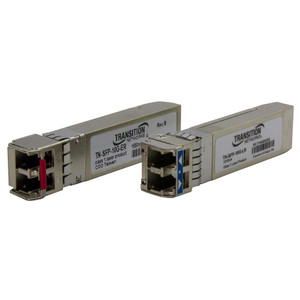
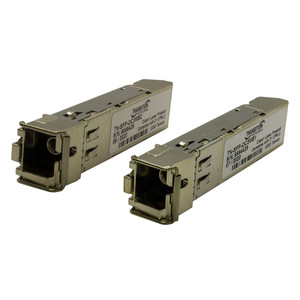
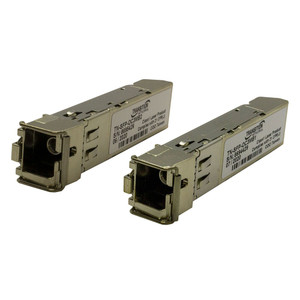
Transition Networks TN-J9151A SFP+ 10GBASE-LR Transceiver
The Transition Networks TN-J9151A is an SFP+ transceiver module designed for high-speed, long-distance single-mode fiber deployments. Operating at 10 Gbps with transmission distances up to 10 km, the TN-J9151A addresses backbone and campus network requirements where extended fiber reach eliminates the need for expensive regeneration equipment. The 1310 nm wavelength and hot-swappable form factor integrate directly into standard SFP+ ports on switches, routers, and media converters, reducing deployment complexity and operational overhead.
Key Features
- 10 Gbps Data Rate: Full 10GBASE-LR performance over single-mode fiber. Sufficient throughput for backbone aggregation, data center interconnect, and campus-wide high-speed trunk lines.
- 10 km Transmission Distance: Single-mode fiber reach eliminates repeaters on runs up to 10 kilometers. Reduces capital cost on long-haul deployments and simplifies network architecture.
- Single-Mode Fiber (9/125 µm): Industry-standard single-mode core minimizes modal dispersion and supports carrier-grade transmission quality. Works with existing campus infrastructure cabling.
- 1310 nm Wavelength: Standard long-wave infrared operating point for 10GBASE-LR. Optimized for minimal chromatic dispersion on single-mode runs and compatible with DWDM systems.
- Hot-Swappable Design: Plug-and-play module form factor. No switch reboot required for module insertion or removal, enabling field repairs and capacity upgrades without service interruption.
- SFP+ Connector: Standardized SFP+ interface on all major switch platforms (Cisco, Juniper, Arista, Dell, HPE). Immediate plug compatibility — no adapter required.
- Compact Form Factor: Standard SFP+ dimensions minimize footprint on high-density switch line cards. Enables maximum port density without external enclosure constraints.
- Lifetime Warranty: Manufacturer warranty covers defects in materials and workmanship with no time limitation. Sourced direct from the manufacturer or US channel partner — factory-new, no grey-market inventory.
The TN-J9151A addresses the economics of long-range fiber backhaul. On a 10 km campus trunk connecting two buildings, a pair of SFP+ modules eliminates the capex of an intermediate regeneration site and the operational overhead of managing additional equipment. The 10 Gbps capacity headroom accommodates future growth without rearchitecture for 3–5 years on most enterprise networks.
Single-mode fiber itself is passive and agnostic to transceiver wavelength — the real differentiation lies in modal performance and dispersion tolerance. The 1310 nm operating point minimizes chromatic dispersion on distances up to 10 km, which means cleaner eye diagrams, lower bit error rates, and longer mean-time-between-failures compared to multimode 850 nm modules over the same distance. For integrators designing a new campus backbone or upgrading aging Fast Ethernet trunk lines, the TN-J9151A provides a straightforward, cost-effective upgrade path without network surgery.
ONVIF-agnostic fiber modules work with all major switching ecosystems. The SFP+ connector is a passive physical interface — the transceiver negotiates line-rate speed with its peer port automatically. This means a switch running Catalyst 9000, Junos, or cumulus-based fabric will recognize and provision the TN-J9151A at 10 Gbps without firmware updates or manual speed negotiation. Pair with standard LC single-mode patch cords and appropriate optical transceivers at the remote end, and the link is operational in minutes. Network management platforms (Cisco Prime, Juniper Contrail, CloudVision, etc.) typically expose transceiver operational status and lane power telemetry via standard SNMP/Yang models, enabling end-to-end visibility without custom instrumentation.
Long-range single-mode transceivers have a simple total cost of ownership equation: either you buy the TN-J9151A and its peer, or you buy two regeneration modules plus the cost of managing a third physical site. The TN-J9151A wins on simplicity and capex for runs up to 10 km. Beyond that distance or in undersea/submarine applications, 10GBASE-ER (40 km) modules are the next tier. For shorter distances (under 500 m) where multimode fiber is already installed, 10GBASE-SR (850 nm, 300 m multimode) is the right choice. The TN-J9151A sits squarely in the 2–10 km single-mode band where it is the standard solution.
Certifications: IEC-60825 (laser safety), FDA 21 CFR 1040.10 and 1040.11 (Class 1 laser compliance). The module meets RoHS/WEEE directives and operates within 0–70°C, suitable for data center, utility closet, and controlled outdoor enclosure temperatures. Lifetime warranty covers all manufacturing defects.
Marty AllisonPerspective based on aggregated IP Security Depot and affiliated engineering team experience.
We've deployed hundreds of single-mode SFP+ transceivers across campus networks, data center interconnects, and long-haul backbone projects. The Transition Networks TN-J9151A is a no-nonsense module that solves the specific problem of connecting two buildings or campuses 2–10 kilometers apart without regeneration. What differentiates it from cheaper multimode alternatives isn't performance — it's distance and margin. The 1310 nm wavelength was engineered into the 10GBASE-LR standard specifically to minimize chromatic dispersion on single-mode fiber, which means eye opening and BER performance remain clean even at the upper end of the 10 km range. In real deployments, this translates to fewer link flaps, lower log noise, and operators who don't have to debug phantom layer-1 issues at 2 a.m. The hot-swappable form factor is table-stakes for any modern transceiver module — you should expect to swap one in the field without a maintenance window. Where the TN-J9151A shines is reliability and compatibility: SFP+ is the industry standard, 1310 nm single-mode fiber is already in the ground at 90% of enterprise campuses, and the module pairs with every major switch vendor. The downside is range — 10 km is the absolute ceiling. If your fiber run is 12 km or longer, you need a 10GBASE-ER (40 km) module or a regeneration point. For anything shorter than 500 m over existing multimode cabling, 10GBASE-SR (850 nm, 300 m) is the right tool and costs less. The TN-J9151A is the middle child of the 10G transceiver family, and it owns its market segment.
Technical Highlights:
- 10GBASE-LR Standard Compliance: IEEE 802.3ae certified. Guaranteed interoperability with peer 10GBASE-LR modules from any vendor (Finisar, Mellanox, Arista, etc.). No vendor lock-in on the fiber side of the connection.
- 1310 nm Wavelength, Single-Mode Fiber: Chromatic dispersion near-zero at 1310 nm on standard single-mode (ITU G.652) fiber — the reason 1310 nm was chosen for long-range Ethernet. Delivers margin for 10 km runs and works cleanly with DWDM multiplexing if future wavelength-division designs are needed on the same fiber strand.
- 10 km Distance Budget: Optical loss budget carefully engineered to support 10 km of SMF with 3 dB margin for connectors and splices. In field reality, you'll get reliable links at 8–9 km with real-world loss profiles; 10 km is the spec limit, not the operational norm.
- Hot-Swappable Module: No power-cycle of the host switch required. Pull the old transceiver, insert the replacement, and the port re-initializes in seconds. Enables in-service troubleshooting and module replacement without scheduled downtime.
- Passive Fiber Interface: Once installed, no firmware updates, no management configuration required. The link negotiates automatically. Reduces operational overhead compared to active line-card modules that may require driver updates or CPLD flashing.
Deployment Considerations:
- Fiber Distance Validation: Before ordering, measure or confirm the actual fiber run length with a OTDR (Optical Time-Domain Reflectometer). 10 km sounds like plenty, but if your cable path includes splitters, fiber optic patch panels, or multiple connectors, loss can accumulate. Budget 0.3–0.5 dB per connector and 0.25 dB/km for decent SMF. If your budget-to-distance ratio is tight, consider a 10GBASE-ER module instead.
- Single-Mode Cable Required: The TN-J9151A will NOT work reliably with multimode fiber — 850 nm transceivers are optimized for MMF, and the wavelength/dispersion mismatch on SMF leads to link flaps and high BER. If the campus has old multimode cabling only, you need 10GBASE-SR (850 nm), not this module.
- Peer Module Compatibility: Both ends of the fiber run need a 10GBASE-LR transceiver. If the far end is a 10GBASE-SR (850 nm) module, the link will not come up — wavelength mismatch is a hard failure. Verify peer module spec before installation.
- Optical Power Monitoring: Most enterprise switches expose transceiver RX power and TX power telemetry via SNMP or CLI. On day one after installation, document the RX power level (-dBm). If it drifts more than 3 dB over months, suspect fiber contamination, connector degradation, or a failing peer module — investigate before link failure occurs.
- Environmental Operating Range: Module operates 0–70°C. Data centers and utility closets are fine. Outdoor unheated enclosures in northern climates may dip below 0°C in winter — if so, verify the enclosure has a thermal budget or consider a heated cabinet for your distribution fiber termination.
The TN-J9151A is the right choice for integrators and network architects building or upgrading campus backbone infrastructure over single-mode fiber runs in the 2–10 km range. If you already have single-mode fiber in the ground and are migrating from 1 Gbps to 10 Gbps, this module is your drop-in upgrade. It pairs seamlessly with any modern Ethernet switch and requires zero ongoing management. Explore the Transition Networks catalog for additional fiber-optic and copper transceiver options.