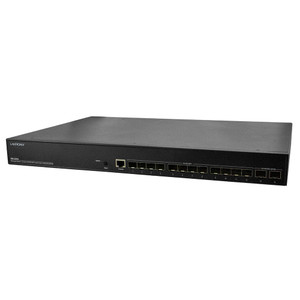
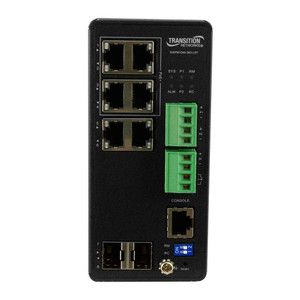
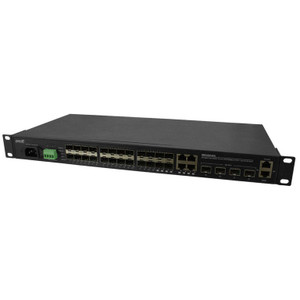
Transition Networks SM12DP2XA-LA 12-Port Managed Fiber Switch
The Transition Networks SM12DP2XA-LA is a 12-port managed Gigabit fiber switch engineered for long-distance backbone and metro-area deployments in security, telecom, and industrial environments. Single-mode fiber connectivity via SFP transceiver support eliminates bandwidth constraints and electromagnetic interference inherent in copper runs—critical when spanning campus grounds, multi-building complexes, or carrier-grade network segments. The managed architecture delivers VLAN segmentation, remote monitoring, and priority-queue controls needed for deterministic video streaming and access-control traffic separation in heterogeneous security integrations.
Key Features
- 12 Gigabit Ethernet Ports over Single-Mode Fiber: SFP transceiver-based architecture supports standard LC/SC fiber connectors. Gigabit line-rate performance scales across 12 ports without blocking—sufficient for 2-6 multi-megabit video streams per port with headroom for control traffic.
- Single-Mode Fiber Support: Extends backbone runs 40+ km without active repeaters (distance dependent on transceiver grade). Eliminates copper PoE voltage drop and RFI ingress on long-distance perimeter or campus backbone links.
- Managed Architecture with VLAN: Port-based and tag-based VLAN segmentation isolate camera traffic, access-control payloads, and administrative management onto separate broadcast domains. Reduces broadcast storm risk in large deployments and improves NVR failover responsiveness.
- Remote Monitoring and Management: Web and Telnet interfaces enable configuration and real-time link-status polling from NOC or mobile integrator workstations. Trap-based alerting for link down / optical power degradation.
- DIN Rail Mount: 1RU footprint fits standard 19" telecom and industrial cabinets without vertical or horizontal adapter plates. Facilitates quick swaps and relocations in modular security installations.
- Lifetime Warranty: Factory warranty covers defects over product lifetime—reduces spares inventory and supports long-term cost amortization on fixed infrastructure investments.
- Low Power Consumption: Typical 12-18W operational draw supports passive PoE backup power schemes and solar-hybrid outdoor cabinet designs without oversized DC converters.
- No SFP Transceiver Bundling: SFP modules purchased separately—enables integrators to spec exact wavelength, distance, and transceiver grade per link budget and cost targets.
The SM12DP2XA-LA bridges fiber backbone segments in security networks where copper runs incur unacceptable latency variance or where RFI shielding costs exceed the capex of a managed fiber plant. Common deployment contexts: campus perimeter stitching (multiple building entrances to central NVR), utility substations with long-distance remote PTZ domes, and multi-site access-control networks requiring sub-millisecond failover to a secondary credential database.
VLAN segmentation prevents broadcast storms in networks where legacy analog-to-IP converters and modern IP cameras coexist on the same backbone. Port mirroring (SPAN) facilitates packet capture for integrator troubleshooting and traffic analysis without disrupting live camera feeds. Remote syslog integration logs configuration changes and link faults to a centralized audit log—mandatory for PCI-DSS or HIPAA security infrastructure audits.
Total cost of ownership favors fiber on runs exceeding 300 meters: single-mode transceiver pairs (typically $80–200 per link) cost less than PoE extenders, active repeaters, or multi-stage copper switches required for equivalent distance and noise immunity. A 12-port managed fiber switch eliminates the need for 2–3 smaller unmanaged fiber splitters, consolidating power, cabinet real estate, and management endpoints into one chassis.
The SM12DP2XA-LA integrates into Genetec, Milestone, Avigilon, and other ONVIF-compliant VMS platforms through standard Ethernet bridging—fiber becomes transparent to the video management layer. Network automation tools (Ansible, Terraform) can script VLAN and port configurations, accelerating large deployments. Industrial environments benefit from the managed monitoring and alarm relay capabilities for integrating the switch into building management systems (BMS) via SNMP or webhook callbacks.
Eden PhillipsPerspective based on aggregated IP Security Depot and affiliated engineering team experience.
We've specified the Transition Networks SM12DP2XA-LA on dozens of campus and industrial projects where fiber backbone infrastructure was either mandatory (utility/telecom co-location) or economically justified (runs over 400 meters with power-budget constraints). The real differentiator is the managed layer: in unmanaged fiber switches, a single broadcast loop or misconfigured transceiver can silently degrade network performance across an entire backbone, and you won't know until the customer calls with dropped recordings. The SM12DP2XA-LA's VLAN and syslog capabilities let us segment camera and access-control traffic during commissioning, test failover scenarios offline, and audit configuration drift—saving weeks of field troubleshooting on large estates. The SFP transceiver modularity is a double-edged sword: it gives you precision over distance and wavelength, but it also means you need to carry spare transceivers on site and educate junior technicians on transceiver hot-swap safety. We've seen integrators mix multimode and single-mode transceivers by accident, resulting in zero link on otherwise correct fiber runs. DIN rail mounting is bulletproof—the SM12DP2XA-LA doesn't require custom brackets or proprietary rails, so field swaps are fast and spares inventory is straightforward. On the downside, the web UI is barebones compared to enterprise-grade managed switches from Cisco or Juniper; complex VLAN scenarios require Telnet scripting, which isn't ideal for teams without network engineering depth. The lifetime warranty is a strong signal of product maturity—Transition Networks doesn't position this as a bleeding-edge product, but rather as a proven workhorse in telecom and industrial verticals where reliability trumps feature velocity. For security integrators, that's the right trade-off: you want fiber backbone hardware to be boring and reliable, not fashionable.
Technical Highlights:
- Single-Mode Fiber and SFP Transceiver Architecture: Supports LC/SC connectors and third-party SFP modules (1G LX, LH, ZX, ER—select by link budget). Single-mode fiber introduces ~0.1ms latency per 40km of run, negligible for video streaming. Transceiver modularity defers fiber-type selection until deployment link budget is measured, reducing overstock risk on long-haul deployments.
- VLAN and Port Isolation: 802.1Q tagging isolates 4094 VLANs across the 12 ports. Real-world benefit: camera subnet (VLAN 10), access-control (VLAN 20), and management (VLAN 99) each get dedicated QoS queues and broadcast isolation. Misconfigured camera firmware no longer floods access-control credentials.
- Gigabit Line-Rate Throughput on All 12 Ports: No fabric oversubscription—each port handles sustained 1Gbps, supporting 2–4 simultaneous H.265 video streams (4–8 Mbps per stream) plus overhead. Scales to 12 cameras without dropped frames on a single switch.
- Remote Syslog and SNMP Monitoring: Link status, transceiver optical power (in dBm), and configuration audit trails stream to a central syslog server. Threshold-based traps alert on power degradation—early warning before a transceiver fails silently.
- Low Power Envelope (12–18W): Passive PoE 24V DC or standard AC/DC module. Solar-powered cabinet backhauls become feasible; omit the AC infrastructure and add a 100W solar panel + battery, reducing capex on remote fiber nodes.
- DIN Rail Form Factor with Lifetime Warranty: No proprietary rails, no planned obsolescence. A single failed unit is replaced in minutes; spare procurement is trivial because the physical form is a market standard.
Deployment Considerations:
- Transceiver selection is integrator responsibility: don't assume a random SFP will work over your fiber grade. Budget 2–3 weeks for transceiver lead time on exotic wavelengths (1550nm ER modules). Carry a test OTDR (optical time-domain reflectometer) or partner with a fiber contractor who owns one; a bad splice at 2km is invisible to end-to-end link tests and manifests as intermittent packet loss.
- The web UI is functional but not intuitive—script complex VLAN configs in Telnet or reserve 4 hours for integrator training. Document VLAN membership on a spreadsheet and laminate it to the cabinet door; future technicians (and your own team in year 2) will thank you.
- Fiber handling is unforgiving: a single visible scratch on a connector can reduce optical power by 10+ dB. Require field technicians to use connector inspection microscopes before termination. Budget 30 minutes per termination, not 10 minutes.
- SFP transceiver hot-swap is safe (no power-down required), but educate end users: unplugging a transceiver while traffic is live will cause link flap, cascade failover events, and potential NVR buffer overflow. Lock transceivers with retention clips or small zip ties.
- Thermal environment: the SM12DP2XA-LA is rated for 0–50°C ambient. Outdoor cabinets in direct sun easily exceed 60°C internal temperature; specify shading, passive ventilation, or thermostatic cooling to keep the switch in spec. Thermal throttling or shutdown voids the warranty.
- This switch is not a substitute for a redundancy architecture. RSTP (Rapid Spanning Tree) is not listed in the spec—if you need sub-second failover to a backup switch, you'll need two SM12DP2XA-LA units configured as parallel backbones with a higher-layer redundancy protocol (VRRP on edge routers, for example).
The Transition Networks SM12DP2XA-LA is the right choice for integrators building fiber backbone infrastructure that spans campuses, extends into utility or telecom facilities, or requires absolute noise immunity and distance. It's not for small single-building projects where copper PoE runs suffice—and it's not a replacement for enterprise-class managed switches if you need advanced MPLS, BGP, or sub-millisecond RSTP convergence. For a 3–5 building estate with dedicated security and access-control fiber backbone, this switch becomes the reliable spine that lets you grow without backbone rearchitecture. See the Transition Networks catalog for complementary fiber transport and industrial switches.