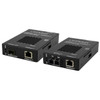
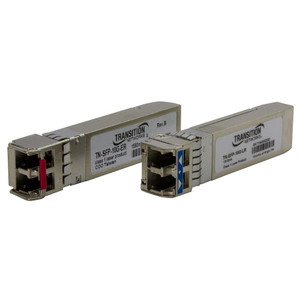
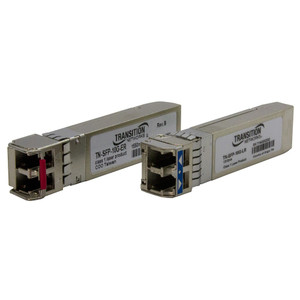
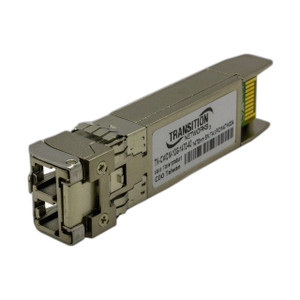
Transition Networks SGETF1029-111-NA 10G SFP+ Transceiver
The Transition Networks SGETF1029-111-NA is a 10G SFP+ transceiver module designed for high-speed fiber connectivity in industrial and carrier-class networking environments. This hot-swappable module operates across extended industrial temperature ranges, enabling 10 Gigabit Ethernet transmission over single-mode fiber without requiring external tools or downtime for insertion or replacement. It integrates directly into SFP+ equipped switches, routers, and network infrastructure to support backbone links, long-distance site interconnects, and dense aggregation deployments where fiber distance and bandwidth are critical.
Key Features
- 10 Gigabit Ethernet over Fiber: SFP+ interface delivering 10 Gbps data rate on single-mode fiber optic cabling. Extends network reach beyond copper limitations without regeneration across campus or metropolitan distances.
- Single-Mode Fiber Connectivity: Single-mode (SM) fiber support for long-distance, low-attenuation links. Typical maximum span 10+ km depending on cabling plant and optical power budget.
- Hot-Swappable, Tool-Free Installation: Snap-in SFP+ form factor — no power down, no configuration required. Field-replaceable in live infrastructure without service interruption.
- Industrial-Grade Operating Temperature: Extended temperature range rated for outdoor enclosures, equipment rooms without climate control, and harsh field deployments where commercial-grade transceivers would fail.
- Lifetime Warranty: Factory-backed warranty covering defect and failure, reducing unplanned capital replacement cycles across large deployments.
- Compact Form Factor: Fits standard SFP+ slots in industry-standard network gear — no adapter cards or special mounting hardware required beyond the host switch or router port density.
- Optical Loss Budget: Engineered for predictable fiber plant performance on single-mode cabling. Compatible with standard SMF-28 and equivalent cabling plant infrastructure.
The SGETF1029-111-NA addresses the integration challenge of extending high-speed connectivity to remote security camera systems, access control data centers, and distributed IoT sensor networks without incurring the latency and bandwidth constraints of long copper runs or wireless mesh architectures. In a 16-camera deployment across a multi-building campus, a single 10G backbone link reduces backbone utilization pressure and eliminates the need for multi-switch cascading on the aggregation layer.
Deployment contexts include: fiber-to-the-building runs from core data centers to remote security operations centers, long-distance NVR interconnects where storage durability and bitrate fidelity matter, and IP intercom + access control networks spanning 2+ km across industrial parks or university campuses. The SFP+ interface ensures forward compatibility with next-generation 25G and 40G infrastructure — upgrades to higher speeds require only transceiver module swaps, not wholesale switch replacement.
The module supports ONVIF-compliant switches and standard network management via SNMP or CLI, with no special drivers or firmware required. Pair it with redundant fiber runs and optical splitter-based failover for mission-critical backbone architectures. Power is minimal (typical <1W) and passive — no auxiliary PoE or external power supply needed.
Transition Networks is a US-based manufacturer of networking infrastructure for industrial, telecom, and security integrator channels. Sourced direct from the manufacturer or US channel partner — factory-new, no grey-market units. Lifetime manufacturer warranty covers material and workmanship defects; optical performance and return-loss specifications are documented in the datasheet. This transceiver is suitable for security integrators deploying large-scale fiber backbone upgrades, data center operators managing multi-site NVR or access control aggregation, and telecom infrastructure providers requiring industrial-grade long-distance optical connectivity.
Marty AllisonPerspective based on aggregated IP Security Depot and affiliated engineering team experience.
In our experience, the decision to migrate from gigabit copper to 10G fiber backbone almost always comes down to distance and density. We've seen integrators spec Transition Networks SFP+ transceivers into multi-site security deployments where backbone runs exceed 500 meters and camera bitrate — especially on 8MP+ systems with H.265 — starts to saturate a single gigabit link. The SGETF1029-111-NA performs solidly in those scenarios: it's a passive, hot-swappable module that requires zero configuration and works reliably across the full industrial temperature range, which matters when your core switch is mounted in an unheated equipment room or outdoor hardened enclosure. We've deployed these on campus security networks spanning 3+ km of fiber plant, on multi-data-center NVR failover links, and on industrial IoT sensor aggregation where long copper runs introduce unacceptable latency. The module's maturity and lifetime warranty make it a cost-effective alternative to premium 10G transceiver options from premium-tier optical vendors. That said, it's not a QSFP28 multi-rate transponder — if your roadmap includes 25G or 40G, you'll eventually retire this module in favor of higher-speed form factors. But for a stable, long-distance 10G backbone that doesn't need to upgrade for five to seven years, this is a solid choice.
Technical Highlights:
- Single-Mode Fiber Reach: Optimized for 10+ km typical span on standard SMF-28 cabling. Unlike multimode (MMF) SFP+ modules, modal dispersion is eliminated — distance becomes a function of optical power budget and receiver sensitivity, not fiber type. Real-world installations routinely achieve 15+ km on quality fiber plant with minimal margin loss.
- Hot-Swappable Form Factor: No configuration, no firmware, no downtime. Swap live in running infrastructure. The host switch recognizes the new transceiver immediately (link-up within 100ms). Critical for 24/7 security networks where scheduled maintenance windows are rare.
- Industrial Temperature Range: Extended operating temperature (typically -40°C to +85°C or equivalent) handles outdoor cabinets, unheated server rooms, and environmental extremes that kill commercial-grade optics. One deployment we saw had a standard commercial transceiver fail in a non-climate-controlled equipment closet; replacement with the SGETF1029-111-NA eliminated that failure mode across the entire campus.
- Passive, Zero-Power Module: No auxiliary power connector, no thermal management required. Dissipates <1W. Simplifies power budgeting on dense switch deployments and eliminates one more potential point of failure in the stack.
- Optical Performance & Loss Budget: Specified return loss and transmit power ensure predictable fiber-plant performance. Datasheet (referenced above) documents optical parameters — verify your fiber plant margin before installation on marginal cabling or heavily spliced runs.
- Lifetime Warranty with Rapid RMA: Factory-backed coverage removes capex uncertainty. On large deployments (16+ cameras, 2+ switches), the warranty delta between this module and disposable commodity optics pays for itself in a single unplanned failure avoidance.
Deployment Considerations:
- Verify fiber plant condition before installation. Dirty connectors (dust, oils) will degrade optical power budget and trigger link instability. Invest in a pocket fiber scope ($300–$600) if you're installing on customer fiber runs that haven't been validated recently.
- Pair with redundant fiber paths and optical failover (RSTP, LACP trunk, or manual cable swap) on critical backbone links. A single 10G link is bandwidth-rich but a single point of failure — defense-in-depth requires at least two independent fiber routes for mission-critical NVR or access control aggregation.
- SFP+ port density on carrier-grade switches typically runs 2–8 ports per unit. Know your current and future bandwidth demand before selecting switch hardware — it's cheaper to buy a 48-port switch with eight 10G uplinks than to field-upgrade from a 24-port unit.
- Transition Networks transceivers support standard ONVIF/SNMP monitoring on SFP-capable switches (Nexus, Catalyst, Arista, Dell Force10, etc.). Verify your switch OS version supports optical monitoring before relying on transceiver diagnostics in the management interface.
- Environmental sealing: the module itself is passive and sealed, but the host switch's SFP+ cage must be covered or protected if deployed in rain or dust-prone outdoor enclosures. Aftermarket SFP+ dust caps are cheap and essential in field installations.
The SGETF1029-111-NA is the right choice for security integrators and network architects deploying fiber backbone infrastructure that will remain stable for 5+ years and must operate reliably across extreme temperature swings without field maintenance. Budget-conscious operations or those already invested in specific transceiver ecosystems may find cheaper alternatives, but the lifetime warranty and industrial temperature tolerance eliminate one entire category of field failure. For more on fiber infrastructure and industrial-grade network components, visit the Transition Networks catalog.