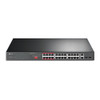
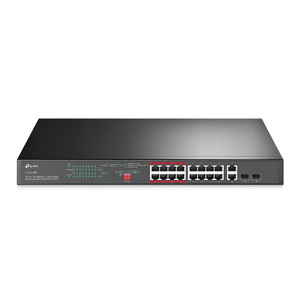
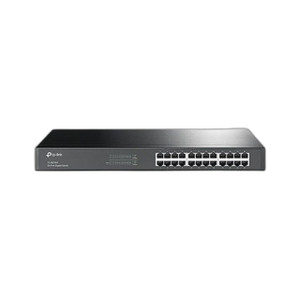
TP-Link TL-SL1226P 24-Port Unmanaged PoE Switch
The TP-Link TL-SL1226P is an unmanaged PoE switch designed for small-to-medium security and network infrastructure deployments requiring simultaneous power and data delivery across multiple endpoints. With 24 Fast Ethernet ports (10/100 Mbps) plus 2 Gigabit uplinks, it supplies IEEE 802.3at PoE (30W per port) or 802.3af (15.4W per port) to IP cameras, wireless access points, IP phones, and access control systems without requiring configuration, VLAN setup, or software licensing. The fanless, DIN-rail-mountable design operates in climate-controlled environments from 0–40°C, making it a low-touch backbone for distributed surveillance and automation networks.
Key Features
- 24 PoE-Enabled Fast Ethernet Ports: Each port delivers up to 30W (802.3at) or 15.4W (802.3af), eliminating separate power runs to standard IP cameras, wireless access points, and networked door controllers.
- 2 Gigabit Uplink Ports: Dedicated 1 Gbps connections to core switches, NVRs, or central management gateways reduce bottlenecks on the aggregation layer.
- Unmanaged Architecture: No IP configuration, no VLAN tagging, no QoS policies—plug in endpoints and they communicate immediately. Zero operational overhead.
- DIN Rail / Wall Mount: Compact form factor supports both cabinet rack mounting and DIN rail installation in electrical enclosures or outdoor cabinets.
- One-Click PoE Auto Recovery: Automatic power cycling on non-responsive endpoints restores connectivity without manual intervention or site visits.
- Extend Mode: Reaches up to 250m PoE transmission distance, stretching camera placement beyond standard 100m Ethernet runs in large industrial or warehouse footprints.
- 12VDC / 48VDC External Power: Field-selectable input voltage accommodates existing power infrastructure; no AC adapter required, reducing failure points.
- Fanless Operation: Silent design suitable for noise-sensitive environments; passive thermal design requires standard climate control but eliminates cooling-system maintenance.
Deployment Architecture & PoE Budget
The TL-SL1226P serves as a local PoE aggregation point in multi-building or large-campus surveillance networks. Each of the 24 ports independently supports 802.3at (30W maximum) or 802.3af (15.4W maximum) power negotiation—the switch detects endpoint power class and supplies accordingly. A typical deployment might allocate 12–16 ports to 5MP fixed IP cameras (12–15W each), 4 ports to wireless access points (15–20W with integrated PoE injector), and remaining ports to door readers, emergency call stations, or future growth. The 2 Gigabit uplinks connect to a core managed switch or directly to an NVR for local video traffic isolation. For sites exceeding 24 endpoints, cascade multiple TL-SL1226P units upstream from a managed core switch using the Gigabit ports to maintain backhaul capacity.
Because the switch is unmanaged, there is no per-port power limiting, priority queuing, or load balancing. If total PoE draw approaches the power supply rating, lower-priority endpoints (redundant access points, backup sensors) may not receive full power during simultaneous startup. Plan power allocation conservatively: if deploying 24 10W cameras, total draw is ~240W—well above a typical 30W external supply. Confirm actual PoE supply capacity with the datasheet before finalizing the port manifest. Extend Mode's 250m reach is achieved by boosting voltage at the expense of total available current; use it only when necessary, as it reduces per-port power headroom.
Integration is straightforward: the switch speaks standard Ethernet and PoE protocols. Any ONVIF-compliant camera, SIP phone, or 802.3af/at access point works without driver installation or firmware updates. No VMS integration or API required—the switch is transparent to NVR software and management platforms. For sites using Genetec, Milestone, Axis Camera Station, or other enterprise video management systems, the TL-SL1226P acts as a passive network backbone, leaving all intelligence at the edge devices and central recording tier.
Installation & Lifecycle Considerations
Mount the unit in a climate-controlled equipment cabinet, closet, or DIN rail enclosure. Connect the 12VDC or 48VDC external power supply to the terminal block (field-configurable for voltage selection—verify settings before installation). Run Category 5e or better cabling from the 24 Fast Ethernet ports to endpoints; run Category 6 or better from the 2 Gigabit uplinks to minimize jitter on the aggregation path. The fanless design produces no noise but has no active cooling; maintain ambient temperature between 0–40°C (typical office or conditioned outdoor cabinet). In dusty or high-temperature environments (data center hot aisles, uninsulated utility sheds), provide supplemental ventilation or relocate to a cooled enclosure. Operating power draw is approximately 30W continuous; size the external supply with 20% headroom to avoid thermal throttling during sustained PoE load. The unit has no internal battery or UPS integration—pair it with an upstream UPS or managed PoE+ injector for power-failure resilience if endpoints (access control, emergency phones) require five-minute hold-up time.
Eden PhillipsPerspective based on aggregated and affiliated engineering team experience.
We've deployed the TL-SL1226P in small-to-medium retail, warehouse, and industrial surveillance networks for years. It's a no-frills workhorse that excels in low-complexity environments where you need immediate PoE distribution without operational overhead. The unmanaged posture is the key differentiator—no VLAN misconfiguration, no QoS tuning, no firmware updates. Plug in 24 endpoints and they communicate. The two Gigabit uplinks are solid for small aggregation points, though they'll bottleneck if you're pushing sustained 20+ Mbps streams upriver (e.g., 24 simultaneous HD camera streams to a single NVR). The Extend Mode's 250m reach is genuinely useful for warehouse perimeter or multi-building campus layouts; we've seen it eliminate the need for powered PoE repeaters in stretches beyond 100m. Compared to managed alternatives like the Ubiquiti EdgeSwitch or MikroTik CRS, you lose visibility and granular control—no per-port statistics, no bandwidth monitoring, no storm-control settings. For a single-site deployment with under 20 cameras and stable network demand, that trade-off is painless. For a multi-site rollout or a site with legacy equipment noise or broadcast storms, a managed switch becomes necessary.
Technical Highlights:
- 802.3at PoE per Port (30W): Standard PoE+ power class covers 95% of fixed IP cameras (5–15W), enterprise APs (18–24W), and door readers (8–12W) without negotiation headaches. Eliminates the cost and labor of external injectors for small deployments.
- Two 1 Gbps Uplinks: Sufficient for 20–30 concurrent HD camera streams or 8–10 4K streams if traffic is local-only. Becomes a constraint if centralizing all video to a remote NVR or cloud gateway—monitor first 48 hours for sustained uplink utilization; if above 60%, upgrade to a managed switch with link aggregation (LAG).
- Extend Mode (250m): Boosts PoE voltage compensation for long cable runs; saves installation time and cost in campus or warehouse perimeter deployments. Trade-off: reduces per-port power output, so confirm no endpoints are at maximum wattage before activating.
- One-Click PoE Auto Recovery: Cycles power on hung endpoints (common with IP phones or older cameras) without manual reboot. Reduces helpdesk tickets and on-site visits for non-responsive device recovery.
- Fanless & Compact: Silent operation and small footprint suit noise-sensitive retail, hospitality, and office environments. Passive thermal design is simple—no fan bearings to fail, no ductwork to maintain—but requires stable ambient temperature and air circulation.
Deployment Considerations:
- Unmanaged Switch Means No Visibility: You cannot see per-port statistics, bandwidth utilization, or power consumption through a dashboard. Deploy network monitoring (SNMP-capable managed switch at the core, or passive packet sniffing tools) upstream if you need to troubleshoot congestion or validate PoE load. A managed core switch with SNMP traps will alert you if an uplink becomes saturated.
- PoE Power Budget Is Per-Port, Not Global: If you connect 24 cameras rated at 15W each (360W total), you must supply a power brick rated for at least 360W—the TL-SL1226P itself consumes ~30W, so your external supply must handle cumulative load. Verify the actual PoE supply specifications against total endpoint wattage; underestimating here causes brownout and port shutdown under sustained load.
- Extend Mode Reduces Power Per Port: When enabled, total available current per port drops to stretch voltage to 250m; don't activate Extend Mode on all 24 ports if any endpoints are near their rated wattage. Use it selectively on distant runs only, or split deployment across two switches.
- No VLAN, No QoS—Broadcast Storms Can Overwhelm: An unmanaged switch forwards all broadcast and multicast traffic to all ports. A misbehaving endpoint (rogue DHCP server, ARP flooder) can degrade the entire network. Implement broadcast filtering at the access point or core switch, not at the TL-SL1226P level.
- Cabinet Ventilation Essential: Fanless switches rely on ambient airflow. Mount in an open shelf or with clearance above and below, not in a sealed cabinet without forced air. High ambient temperature (above 35°C) will throttle performance; add ductwork or relocate to climate control.
- Gigabit Uplinks Are Not Redundant: The two 1 Gbps ports are independent, not bonded or failover-capable. If your core network has only one uplink port, both Gigabit connections will feed the same path, adding no resilience. For failover, configure a managed switch upstream with spanning tree or deploy two independent aggregation switches.
The TL-SL1226P is the right choice for integrators building small surveillance clusters (under 20 cameras), retail networks with stable device counts, and warehouse or industrial sites needing simple PoE distribution without management software. It's wrong for multi-site rollouts, complex VLANs, or environments where network observability is critical. See the TP-Link catalog for managed alternatives and complementary switch models.