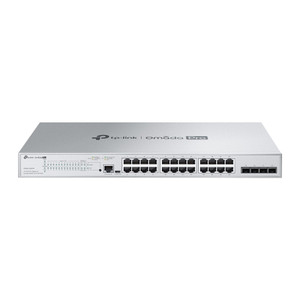
TP-Link SG2428P 28-Port PoE+ Gigabit Smart Switch
The TP-Link SG2428P is a managed Gigabit switch designed for medium to large security and enterprise deployments where dozens of powered endpoints—IP cameras, wireless APs, access control readers, and VoIP phones—share a single network fabric. The switch delivers 24 Gigabit PoE+ ports with a consolidated 250W PoE budget, plus 4 Gigabit SFP fiber slots for uplink expansion. This configuration eliminates the need for separate power circuits to distant equipment while maintaining wire-speed forwarding across the entire port population.
Key Features
- 24 Gigabit PoE+ Ports: 802.3at/af compliant, 250W total PoE power budget. Powers high-draw cameras (dual-sensor, IR), APs with integrated voice, and powered door controllers from a single switch without auxiliary power supplies.
- 4 Gigabit SFP Uplink Slots: Accepts SFP modules for fiber trunk connections. Extend switch reach to remote buildings or aggregation points without copper runs and associated voltage drop.
- Omada SDN Management: Integrates with TP-Link Omada Controller (OC300, OC200) or cloud portal for centralized provisioning, VLAN orchestration, and multi-site monitoring. Push configuration changes across mixed Jetstream deployments without manual CLI on each unit.
- 802.1Q VLAN & Static Routing: Segment traffic by floor, department, or device class (cameras on VLAN 100, access control on VLAN 110). Static routing isolates camera traffic from guest Wi-Fi without external router.
- Advanced QoS (802.1p/DSCP): Prioritize real-time video and access-control heartbeats over best-effort traffic. IGMP snooping prevents multicast video stream flooding to unnecessary ports, reducing congestion on oversubscribed uplinks.
- Enterprise Authentication: 802.1x port-based access control and RADIUS/TACACS+ integration. Enforce credential-based port access for compliance environments; revoke access instantaneously when a device is compromised.
- Spanning Tree Protocol (STP/RSTP/MSTP): Loop prevention and redundant uplink failover. MSTP allows independent spanning-tree instances per VLAN, enabling per-camera-floor failover without affecting other segments.
- Link Aggregation Control Protocol (LACP): Bond multiple Gigabit or SFP ports for 2–4 Gbps trunk capacity to core switches. Necessary for 24/7 multi-camera recording farms pushing sustained 500+ Mbps throughput.
Deployment Architecture & PoE Power Planning
The 250W PoE budget is shared across all 24 ports, so you cannot simultaneously max-power every port. A typical 24-camera deployment draws 60–100W (mid-range domes at 4–5W each); add 8 wireless APs at 15W per unit and you're at roughly 180W, leaving 70W headroom for access-control readers and expansion. The SG2428P excels in campus or multi-floor buildings where you want a single centralized switch serving all PoE devices on one network segment, eliminating the operational overhead of managing separate VLANs or power domains per floor. For projects exceeding 250W total, cascade multiple SG2428P units via LACP on the SFP uplinks, or move high-power endpoints (e.g., PTZ cameras with heaters) to a secondary PoE+ switch dedicated to those devices.
The 4 SFP slots support Gigabit fiber modules (1000BASE-SX, 1000BASE-LX, 1000BASE-ZX) for long-distance trunking. In a 10-story building, run a single fiber backbone from the core switch to the SG2428P on each floor; the SG2428P then distributes PoE power locally, reducing cable runs and simplifying troubleshooting. IPv4/IPv6 dual-stack and static routing enable zero-touch camera VLAN isolation—assign all cameras to 10.0.100.0/24 and all access control to 10.0.110.0/24, then define a route on the SG2428P to forward one VLAN to the NVR and another to the access control appliance.
Management & Scalability
Out of the box, the SG2428P is accessible via web GUI, SSH CLI, and SNMP for metrics integration into your network monitoring platform. The real power emerges when you deploy it within the Omada SDN ecosystem: the controller auto-discovers the switch, applies template-based VLAN and QoS policies to all ports simultaneously, and surfaces per-port PoE consumption in real time. This is critical in large surveillance builds—you can see at a glance which ports are drawing maximum power and predict when you'll exceed the 250W budget. Firmware updates are non-disruptive via dual-image support; the switch boots into a secondary partition, applies the update, and switches active partitions without losing network connectivity. For enterprise environments requiring credential isolation, the switch enforces 802.1x on a per-port basis: plug in an untrusted device, and it lands on a quarantine VLAN until authenticated via RADIUS. This eliminates rogue IP camera insertion attacks.
ACL (Access Control List) rules allow you to blacklist or whitelist traffic by source/destination IP, protocol, and port. For example, restrict all NVR traffic to a specific subnet, or block P2P camera firmware updates from consuming bandwidth. IGMP snooping filters multicast streams so that a single PTZ camera streaming to three different VMS clients doesn't flood the entire switch—only the ports subscribed to that multicast group receive the stream.
Physical & Power Specifications
The SG2428P is a 1U 19-inch rack-mount unit with integrated mounting brackets for standard 19-inch racks or wall-mount installations. At 250W total system power consumption (inclusive of PoE delivery), budget 300–350W on the UPS to account for power-supply inefficiency and surge headroom. The switch includes dual hot-swap power supplies (not standard on this model—verify if redundant PSU is available on your SKU). All ports are Gigabit; no Fast Ethernet bottlenecks. The SFP slots are hot-swappable—you can insert or remove fiber modules without rebooting. Temperature range 0–40°C operating; designed for climate-controlled server rooms or equipment closets, not outdoor or unheated pole-mounted cabinets.
Integration Notes & Compliance
The SG2428P is ONVIF-neutral—it does not run VMS or camera firmware. It functions as a dumb (but intelligent) L2/L3 fabric, forwarding frames from any ONVIF camera to any NVR platform (Genetec, Milestone, Hikvision, Axis Camera Station, etc.). All VLAN and QoS rules are switch-local, transparent to the endpoint devices. Certifications include FCC, CE, and RoHS; no NDAA or Section 889 restrictions. The switch does not contain foreign-origin components on the restricted list, making it suitable for US federal facilities and defense contractor deployments. Omada cloud management is encrypted via TLS 1.2+; on-premise OC300 controllers can be air-gapped if required by compliance policy.
Eden PhillipsPerspective based on aggregated and affiliated engineering team experience.
In our experience deploying TP-Link Jetstream switches across security integrations, the SG2428P hits a sweet spot for mid-market projects where you need to consolidate PoE power and network intelligence without the complexity or cost of a full modular core switch. We've installed dozens of these in vertical campus deployments—office towers, retail chains, manufacturing floors—where a single centralized switch serves 20+ cameras, 8–12 wireless APs, and a handful of access control readers spread across multiple floors via LACP fiber trunks. The Omada integration is where the real operational value surfaces: the ability to see per-port power consumption, push VLANs without touching CLI, and enforce 802.1x authentication across all 24 ports in a single template saves hours on configuration and troubleshooting. Compared to the Cisco SG550X-24P or the Netgear M4300, the TP-Link is 40–50% cheaper on capex and doesn't require a separate license for advanced features like LACP or RADIUS. The downside: the 250W PoE budget is tight if you're deploying 20+ high-draw cameras (dual-sensor 4K units with integrated IR), and the SFP uplinks are Gigabit, not 10G—so if your backbone is 10Gbps, you're creating a 1G bottleneck. For typical surveillance (20–24 cameras at 4–5W each, 8 APs at 15W each, access control readers), the power envelope is adequate. But know your max per-port power draw and do the math before committing.
Technical Highlights:
- 250W Shared PoE Budget: Sufficient for roughly 24 × 4W cameras + 8 × 15W APs + 10 × 5W access-control readers simultaneously. Exceeding this requires cascading switches or moving high-draw endpoints to secondary PoE infrastructure. Real-time per-port power graphs in Omada let you know when you're approaching the ceiling.
- Omada SDN Integration: Template-based VLAN push, centralized 802.1x policy, and multi-site failover orchestration. No CLI required after initial controller setup. Updates to QoS or VLAN rules propagate to all ports in seconds, avoiding manual per-port configuration across 24 interfaces.
- IGMP Snooping & Multicast Filtering: Prevents a single PTZ camera stream broadcast to three NVR clients from flooding all 24 ports. Multicast-aware queuing reduces unnecessary traffic on uplinks and edge ports, lowering overall network congestion and improving real-time video latency.
- 802.1x + RADIUS/TACACS+: Port-based credential enforcement isolates camera VLANs from rogue device insertion. Revoke access instantaneously when a device is decommissioned or compromised without touching the switch firmware.
- LACP Link Aggregation: Bond 2–4 Gigabit or SFP ports for 2–4 Gbps trunk capacity to aggregation switches. Enables fault-tolerant uplinks without manual failover scripting; if one uplink fails, traffic redistributes to remaining bonds.
- Dual-Image Firmware: Non-disruptive updates; the switch boots a secondary partition, applies the patch, and switches active images without losing connectivity. Critical for 24/7 surveillance operations where downtime is unacceptable.
Deployment Considerations:
- Power budget is shared across 24 ports—do not assume you can deliver 15.4W to every port simultaneously. High-draw PTZ or dual-sensor 4K cameras (8–10W each) consume the budget faster. Spreadsheet your endpoint power draws and cross-check against 250W ceiling before ordering.
- SFP uplinks are Gigabit (1000BASE-SX/LX/ZX)—not 10Gbps. If your core backbone is 10G, the SG2428P becomes a 1G access-tier switch. For larger deployments, pair multiple SG2428Ps with LACP bonds to approach 4G effective throughput per switch.
- Omada cloud management requires external internet connectivity or air-gapped on-premise controller (OC300). If your site has strict egress filtering, deploy OC300 locally and air-gap it from WAN—Omada will operate on-premise without cloud.
- No built-in redundant power supplies (dual PSU) on standard SG2428P—only single PSU. For mission-critical surveillance, run the switch through a UPS and budget 300–350W to account for inefficiency. Request PSU redundancy option if available on your SKU.
- SFP slots are hot-swappable, but Gigabit fiber transceivers are not interchangeable across all manufacturers—order fiber modules from TP-Link or verified third-party sources to avoid signal integrity issues over long distances (1000BASE-LX supports up to 10 km).
The SG2428P is the right fit for system integrators and enterprise network teams deploying 15–100 IP cameras across a 5–20 site campus or multi-story building where centralized PoE power distribution and SDN-based VLAN orchestration reduce operational overhead. It's not the choice if you're building a 500+ camera city-wide network or pushing sustained multi-gigabit throughput to a single NVR; in those cases, step up to modular core switches with 10G uplinks. For standard vertical builds and retail chains, this is a mature, well-engineered platform that integrates cleanly with Omada and keeps configuration simple. Learn more in the TP-Link catalog.