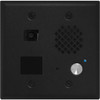
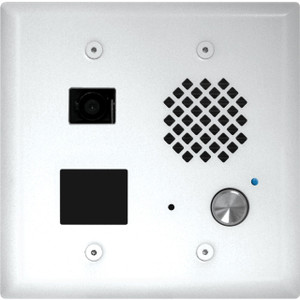
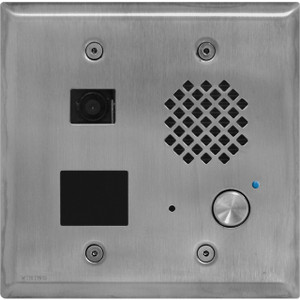
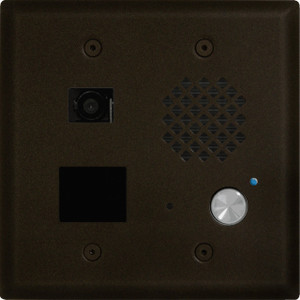
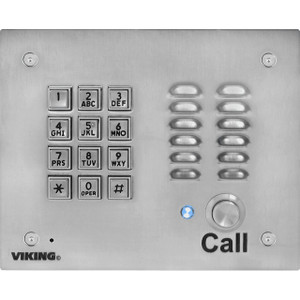
Viking Electronics E-75-BK-EWP Flush-Mount Entry Phone with Proximity Card Reader and Color Video Camera
The Viking Electronics E-75-BK-EWP is a compact, telephone-line-powered entry phone that combines a 420-line color video camera, a 125KHz proximity card reader, and two-way audio into a single flush-mount unit rated for operation from -30°F to 150°F. Whether you're securing a building entrance in a coastal environment, a parking structure exposed to exhaust fumes, or an industrial facility with temperature swings, the EWP (Enhanced Weather Protection) variant adds foam rubber gaskets, sealed connections, gel-filled butt connectors, and potted electronics to resist corrosion from salt air, chlorine, and similar chemical exposure — protection the standard housing doesn't provide. Explore the full Viking Electronics entry phone and intercom line for companion products.
Overview
Designed for flush installation in a standard double gang box or surface mounting with the optional VE-5x5 enclosure, the E-75-BK-EWP keeps the wall footprint tight: the faceplate measures 4.875" x 4.938" x 0.17", and the phone module itself is just 2.84" x 1.8" x 1.65". Power comes entirely from the telephone line (no separate power run required for the phone), though the camera requires a dedicated 6–22V DC supply at up to 150mA. If you're planning a video surveillance integration alongside this unit, account for that camera power drop at the terminal. This is one of the few access control entry phones that delivers simultaneous card read, color video, and speakerphone in a package that fits existing double gang rough-in.
Key Features
- 420-Line Color Video Camera (2.1mm Conical Pinhole Lens): The 420-line horizontal resolution with an 80° horizontal / 60° vertical / 100° diagonal field of view covers a standard doorway approach without wide-angle barrel distortion. The conical pinhole lens design is tamper-resistant and weather-tolerant — no protruding glass element to get scratched or fogged. Video output is 1Vp-p composite NTSC on 75 ohms, compatible with analog DVRs and most video door entry systems without additional hardware. If you need to integrate with digital VMS platforms, plan for a composite-to-IP converter in the signal path.
- Adjustable Camera Aim (±20° Vertical, ±30° Horizontal): Field adjustment of ±20° vertically and ±30° horizontally means you can compensate for imprecise rough-in without pulling the unit. On a recessed double gang box, minor misalignment during installation doesn't require a do-over — a small-driver tweak at commissioning corrects the frame.
- 125KHz Proximity Card Reader (26-Bit Wiegand, 1.25"–2.0" Range): The built-in reader handles standard 125KHz HID-format credentials over 26-bit Wiegand — the format supported by virtually every legacy access control panel in the field. Read range of 1.25" to 2.0" is typical for proximity (not long-range RFID), so users need to present the card close to the reader face. If your deployment requires hands-free or drive-up credential reads, this unit is not the right pick. For standard pedestrian door control, the Wiegand output wires directly to your panel's reader port with no additional interface board. See our access control panel and reader guide for compatible panel options.
- Telephone Line Powered (25V AC RMS Minimum Ring Voltage, 0.8A REN): Drawing power from the existing telephone pair eliminates a separate 12V or 24V power run to the door — one cable handles audio, signaling, and phone power simultaneously. REN of 0.8A means this unit consumes less than one full REN, so it won't overload a standard loop even with other devices on the line. CPC disconnect timing of 300ms minimum ensures reliable call-clearing on supported systems.
- Camera Power Separate (6–22V DC, 150mA Max): The wide 6–22V DC input range gives you flexibility — a 12V or 24V supply both work without a dedicated regulator. At 150mA max draw, the camera adds minimal burden to an existing door power supply, but you do need to run a second pair or use a combo cable. Budget for that wire run in new construction; in retrofit, check if an existing spare pair in the conduit can carry the camera supply.
- EWP Enhanced Weather Protection (IP66 Rated): The EWP designation means foam rubber gaskets seal the face, boots protect connector terminations, and gel-filled butt connectors prevent moisture ingress at wire joins. The IP66 rating (verified for the EWP variant) means the unit withstands sustained high-pressure water jets — relevant for pressure-washing of building exteriors or heavy storm exposure. It also means corrosive environments like pool enclosures, coastal buildings, and parking structures with exhaust accumulation won't degrade the terminations over time the way they would on standard-sealed units.
- Wide Operating Temperature Range (-30°F to 150°F): Both the phone and the camera share a -30°F to 150°F operating window — meaningful in unheated vestibules or exterior walls in northern climates where a unit rated only to 14°F or 0°F will fail in winter. The camera spec matches the phone spec exactly, so you're not constrained by the weaker of two components.
- Textured Black Faceplate: The textured finish reduces visible surface scratches and fingerprinting compared to smooth powder coat — relevant in high-traffic entries where the faceplate is handled frequently. The black finish blends with dark architectural hardware and modern commercial door hardware better than brushed aluminum on many installations.
Integration and Compatibility
The E-75-BK-EWP wires to any telephone-based entry system that supplies at least 25V AC RMS ring voltage and supports CPC (Calling Party Control) disconnect at 300ms or longer. The 26-bit Wiegand reader output is compatible with the majority of commercial access control panels — HID, Lenel, Software House, Honeywell Pro-Watch, Bosch, and similar platforms all support 26-bit Wiegand as a standard input format. Video feeds via composite NTSC to any analog monitor, DVR, or video door entry receiver accepting a standard 75-ohm composite signal. Flush installation requires a standard double gang box (not supplied); surface mounting requires the optional VE-5x5 enclosure. For deployments where the enclosure needs to match architectural hardware or survive higher mechanical abuse, review Viking's surface mount and protective housing options alongside this unit. The E-75-BK-EWP (often searched as E 75 BK EWP) ships ready for direct rough-in without additional mounting hardware beyond the gang box.
Frequently Asked Questions
Q: What access control panels is the E-75-BK-EWP compatible with?
A: The proximity card reader outputs standard 26-bit Wiegand, which is supported by virtually all major commercial access control panels including HID, Lenel, Software House, Honeywell, and Bosch platforms. No additional interface board is required — wire the Wiegand data lines directly to your panel's reader port.
Q: Does the E-75-BK-EWP require a separate power supply?
A: The phone itself is telephone line powered — no separate supply needed for audio and signaling. However, the built-in color camera requires a dedicated 6–22V DC supply at up to 150mA. Plan for a separate power wire run or a combo cable that carries both the phone pair and a camera power pair.
Q: What does the EWP rating actually protect against?
A: EWP (Enhanced Weather Protection) adds foam rubber gaskets, sealed connections, gel-filled butt connectors, and potted electronics to resist corrosion from salt air, exhaust, and chlorine. The EWP version carries an IP66 ingress protection rating, meaning it withstands sustained high-pressure water jets and is suitable for coastal, poolside, and industrial exterior environments where the standard variant would corrode at the terminations over time.
Q: What mounting options are available for the E-75-BK-EWP?
A: The unit flushes into a standard double gang electrical box (not included). For surface mounting, Viking's optional VE-5x5 enclosure is the recommended solution. The faceplate dimensions are 4.875" x 4.938" x 0.17".
Q: What is the camera's video output format, and will it work with my DVR?
A: The camera outputs 1Vp-p composite NTSC on 75 ohms — standard analog video compatible with most analog DVRs, multiplexers, and video door entry receivers. Integration with IP-based VMS platforms requires a composite-to-IP encoder or video server in the signal path, as there is no onboard network interface.
Q: What is the read range for the proximity card reader?
A: The 125KHz proximity reader has a read range of 1.25" to 2.0". Users must present their card in close proximity to the reader face — this is a standard pedestrian door credential presentation range, not a hands-free or drive-up range. If longer read range is required, a separate long-range reader panel would be needed.
The E-75-BK-EWP earns its place on commercial exterior doors where you need card access, visual verification, and two-way voice in a single rough-in that fits existing double gang boxes — and the EWP build is what separates a reliable multi-year installation from a corrosion call-back. The IP66 rating backed by gel-filled butt connectors and foam gaskets is not cosmetic; it's the spec that matters when the maintenance team pressure-washes the building exterior or when a coastal salt-air environment starts attacking unprotected wire terminations.
Technical Highlights:
- 26-Bit Wiegand Output: Wires directly to virtually any legacy or current access control panel reader port — no interface board, no converter. If your panel has a standard Wiegand reader input, the proximity reader on this unit connects without additional hardware.
- Camera Aim Adjustment (±20° Vertical, ±30° Horizontal): Post-installation aim correction prevents the most common door camera frustration — a face shot that misses the top of a tall visitor's head because the rough-in was half an inch off. That ±30° horizontal range is wide enough to cover typical gang box placement variation.
- Telephone Line Power + Separate 6–22V DC Camera Supply: The split power architecture is both the unit's strength and its installation wrinkle. Phone and audio run on the telco pair (no extra power wire for those functions), but the 150mA camera supply requires a dedicated run. On new construction this is straightforward; on retrofit, verify a spare pair exists in the conduit before committing to the design.
Deployment Considerations:
- The composite NTSC video output (1Vp-p, 75 ohms) integrates directly with analog DVRs and video door entry panels, but requires a composite encoder or analog-to-IP bridge for any IP VMS integration — budget for that component and the associated latency in your design review.
- The 125KHz read range tops out at 2.0" — spec this unit for pedestrian entry where card presentation is expected, not for vehicle gates or hands-free lobby entry where longer-range readers (EM4100 long-range or smart card formats) are required.
This unit is the right specification for commercial building entries in chemically aggressive environments — coastal properties, pool facilities, parking structures with vehicle exhaust accumulation — where a standard-sealed entry phone will need termination repairs within two to three seasons and this EWP variant will not.