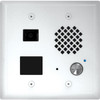
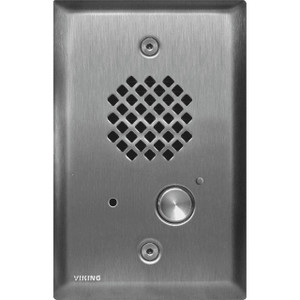
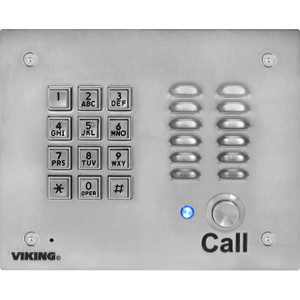
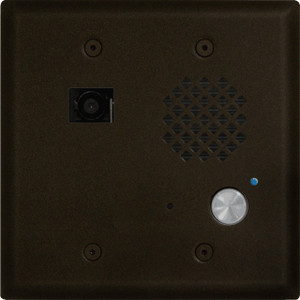
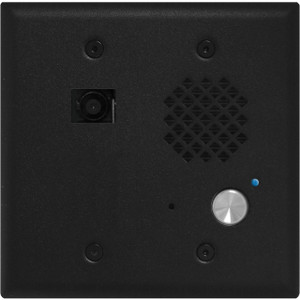
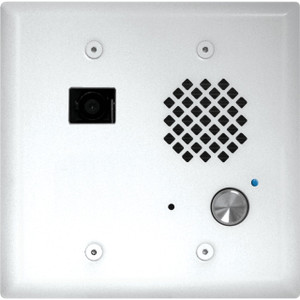
Viking Electronics E-75-WH-EWP Entry Phone with Proximity Card Reader and Color Video Camera
The Viking Electronics E-75-WH-EWP is a three-function entry station — two-way handsfree speakerphone, 125kHz proximity card reader, and 420-line color video camera — factory-sealed with Viking's Enhanced Weather Protection (EWP) coating for applications where standard weather resistance isn't enough. It flushes into a standard double-gang box or surface-mounts directly, which keeps rough-in labor minimal. If you're wiring an entry point that needs audio, access control, and video verification in a single compact faceplate, this is the device to evaluate.
Overview
Entry phones that bundle a proximity reader and camera into one vandal-resistant unit solve a common problem: separate devices mean separate conduit, separate power runs, and separate mounting templates per opening. The E-75-WH-EWP (often searched as E 75 WH EWP) consolidates all three functions behind a satin-white 4.875" × 4.938" faceplate that protrudes only 0.17" proud of the wall — unobtrusive enough for lobby and reception installations where aesthetics matter. The phone module itself measures 2.84" × 1.8" × 1.65", leaving room for the card reader and camera within the double-gang footprint. The EWP variant adds a thick protective coating over the standard E-75-WH's weatherproofing, rated IP66, making it viable in covered parking structures, pool areas, and vehicle exhaust-exposed drive-throughs where condensation and chemical fumes would degrade uncoated electronics over time.
Explore the full Viking Electronics intercom and entry phone line to compare panel configurations and analog expansion options.
Key Features
- Telephone-Line Powered: The phone draws power directly from the telephone line — no separate power supply, no additional conduit run to the entry point. That simplifies rough-in substantially on retrofit projects where pulling a new power circuit to each door is cost-prohibitive.
- 25V AC RMS Ring Voltage (minimum): Designed to receive standard ring signals from analog PBX and POTS lines. If your ring source drops below 25V AC RMS, the unit won't answer — confirm your system's ring output before commissioning.
- 300ms CPC Disconnect: The 300ms minimum CPC (Current Polarity Change) disconnect time is the handshake that tells the entry phone to hang up after an access grant. Most analog door controllers and PBX door modules meet this, but verify with your specific system — a controller with a shorter CPC pulse will leave the line active.
- 125kHz 26-Bit Wiegand Proximity Reader (6–22V DC, 150mA): The reader is standard HID-format compatible, which means it drops into existing 26-bit Wiegand access control panels without re-programming card formats. Read range of 1.25" to 2.0" keeps credential presentation deliberate — appropriate for controlled entry where tailgating is a concern. The reader's LED goes dark during card read (indicating active credential processing), and the transducer beeps to confirm the read — both behaviors are expected and by design, not a fault indication.
- 420-Line Color Camera at 0.025 Lux (F1.2): The 420-line NTSC composite output is a match for analog DVRs and video door phone monitors. The 0.025 lux sensitivity at F1.2 handles dimly-lit vestibules and covered entries without supplemental lighting in most cases — though this is a standard (non-IR) camera, so truly dark environments will require a separate light source.
- 80° × 60° FOV with ±20° Tilt / ±30° Pan Adjustment: The 80-degree horizontal and 60-degree vertical field covers a standard single-door entry width at close range. The physical tilt (±20°) and pan (±30°) adjustment lets you compensate for mounting height without shimming the backbox — useful when the double-gang box ends up higher or off-center from where the integrator planned.
- 2.1mm Conical Pinhole Lens: The recessed conical pinhole design resists tampering and obscuring — significantly harder to cover with a thumb or tape than a protruding lens. It also reduces glare from overhead lighting at interior entries.
- IP66 EWP Rating: IP66 means the unit withstands direct water jets from any direction — rain, pressure washing, and pool splash won't penetrate. The EWP coating goes further, providing chemical resistance to pool chlorine, vehicle exhaust, and high-humidity environments up to 100% RH. Standard IP66 without the coating would degrade faster in those chemical exposure scenarios.
- -30°F to 150°F Operating Range: The full assembly — phone, camera, and proximity reader — all share the same -30°F to 150°F operating range. That covers unheated parking structures in cold climates and sun-exposed entries in hot ones without needing a heated housing.
Integration and Compatibility
The E-75-WH-EWP is designed for analog entry phone systems and pairs with any access control panel that accepts 26-bit Wiegand input — the de facto standard across most commercial panel families. The camera outputs 1 Vp-p composite NTSC on a 75-ohm shielded connection, feeding directly into analog DVRs, video door stations, and dedicated video monitors. It does not output IP video and does not have an Ethernet port — if your project requires IP video at the door, this is not the right device.
Power the phone from the telephone line itself; power the proximity reader separately at 6–22V DC (150mA draw — well within most panel auxiliary outputs); power the camera at 5–14V DC drawing up to 60mA. Three separate power considerations, so plan your wiring diagram accordingly. Consider a dedicated door controller power supply to feed the reader and camera from a single source with backup.
For projects requiring video recording, pair this unit with a compatible analog DVR that accepts composite NTSC inputs. The camera is not compatible with IR illuminators — it's a standard color camera, not a day/night unit. If after-dark image quality is critical, add a low-level white light fixture at the entry rather than an IR illuminator.
For guidance on entry system design and reader selection, the access control buying guide covers Wiegand topology, panel selection, and power distribution in more detail.
Frequently Asked Questions
Q: Does the E-75-WH-EWP work with IP-based access control systems?
A: The proximity reader outputs 26-bit Wiegand, which is a wired protocol compatible with the vast majority of commercial access control panels regardless of whether the panel itself communicates over IP. The camera, however, outputs analog composite NTSC — not an IP stream — so it will not connect directly to an NVR or IP VMS. Plan for an analog DVR or dedicated video monitor for the camera output.
Q: What card formats does the proximity reader support?
A: The reader operates at 125kHz and outputs 26-bit Wiegand — the standard HID format used by the majority of proximity credentials in the field. If your existing badges are 125kHz HID-compatible (H10301 format or equivalent), they should read without re-enrollment.
Q: Is the E-75-WH-EWP suitable for outdoor use without an additional housing?
A: Yes — the EWP variant carries an IP66 rating and Viking's Enhanced Weather Protection coating, which adds resistance to moisture, pool chemicals, and vehicle exhaust beyond standard weatherproofing. It can be surface-mounted or flush-mounted in a double-gang backbox in covered outdoor locations. For fully exposed installations in driving rain or salt-air coastal environments, the optional VE-5x5 surface mount enclosure provides an added layer of protection.
Q: What is the camera's minimum light requirement?
A: The color camera is rated at 0.025 lux at F1.2 — sufficient for dimly lit but not completely dark entries. This is a standard color camera with no IR capability and no day/night switching. Completely dark environments require a supplemental white light source; do not attempt to add an IR illuminator, as the camera is explicitly not compatible with IR.
Q: Can the E-75-WH-EWP be surface-mounted without a backbox?
A: The unit is designed to flush-mount in a standard double-gang electrical box or surface-mount with the optional Viking VE-5x5 surface mount enclosure. Mounting directly to a flat wall surface without a box is not a supported installation method per the product design.
Q: What is the read range for the proximity card reader?
A: The read range is 1.25" to 2.0". This is intentionally short — it requires deliberate credential presentation and reduces the risk of accidental reads or relay attacks compared to longer-range readers.
The E-75-WH-EWP is one of the few entry station designs I'd recommend without hesitation for multi-tenant lobby retrofits: the telephone-line-powered phone circuit eliminates the most common retrofit headache — pulling a new power circuit to each door — while the 26-bit Wiegand reader drops straight onto whatever panel is already in the building. The EWP coating is not marketing language; it's the spec that makes the difference in covered parking garages where exhaust and condensation cycling kills standard-coated devices within two to three years.
Technical Highlights:
- 0.025 Lux Camera Sensitivity: At F1.2, this camera handles vestibule and lobby entries with low ambient light adequately — the pinhole design also survives attempts to obscure it better than protruding lens cameras. That said, sensitivity tops out at 0.025 lux; plan a dedicated light source if the entry is completely unlit after hours.
- 26-Bit Wiegand at 1.25"–2.0" Read Range: The intentionally short read range is correct for high-security entries where you want deliberate credential presentation. It's the wrong choice for drive-through or vehicle gates where distance reading matters — those need a long-range reader in a separate installation.
- -30°F to 150°F Unified Operating Range: All three subsystems — phone, reader, and camera — share identical thermal ratings. No weak link. In a northern climate parking structure that swings from -20°F in January to 120°F in a west-facing summer afternoon, the unit won't have a failing component at temperature extremes.
Deployment Considerations:
- Wire the three power domains separately: telephone line for the phone, 6–22V DC at up to 150mA for the reader, and 5–14V DC at up to 60mA for the camera. A single panel auxiliary output sized at 250mA or better handles both reader and camera, but verify voltage compatibility — the reader's 6V floor means a panel output that sags under load could cause intermittent card read failures.
- The 300ms CPC disconnect minimum is the specification most likely to cause a commissioning call. If your door controller's CPC pulse is shorter, the entry phone will stay off-hook after an access grant. Test the CPC duration at the controller output before final installation, not during customer walkthrough.
This unit is the right answer for commercial building lobbies, multi-tenant residential entry points, and pool or recreation facility access gates — anywhere you need a single device to handle audio intercom, access credential verification, and visual identity confirmation on analog infrastructure. It is explicitly not the right answer for IP video surveillance integration or long-range vehicle credential reading.