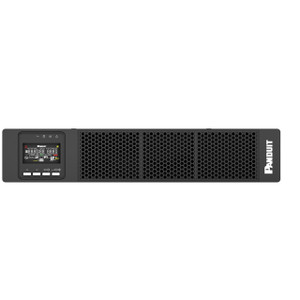
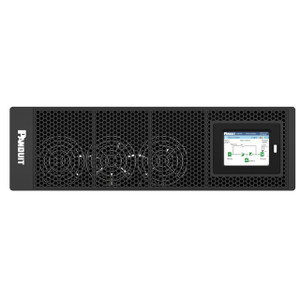
Panduit U20S32V SteadySine UPS for Data Center and Enterprise Applications
The Panduit U20S32V delivers true sine wave battery backup for mission-critical surveillance, networking, and access control infrastructure in data center, enterprise, and modular edge deployments. Built on Panduit's SteadySine platform, this UPS provides clean, regulated AC power to cameras, NVRs, PoE switches, servers, and control panels that cannot tolerate voltage sags, surges, or outages. The 2U rackmount form factor (17.3" W × 12" H) integrates into standard 19" racks alongside the gear it protects, eliminating the need for separate floor-standing battery cabinets in space-constrained server rooms and telecom closets. SteadySine technology uses double-conversion topology—incoming AC is rectified to DC, charges the battery bank, then inverts back to pure sine wave AC—ensuring your loads see stable 120V regardless of upstream utility fluctuations or generator artifacts during extended outages.
Key Features
- True sine wave output via double-conversion topology protects sensitive PoE cameras, managed switches, and NVRs fromharmonics and voltage distortion that cause lockups or premature failure
- 2U rackmount chassis (17.3" × 12") mounts in standard EIA racks, placing backup power at the point of load rather than across the room in a separate cabinet
- SteadySine platform engineered for data center and enterprise MTDC (Modular Tactical Data Center) environments where space, thermal load, and serviceability drive design
- Front-access battery and electronics modules enable hot-swap replacement without removing the UPS from the rack or powering down protected loads
- SNMP/Modbus network monitoring integrates with DCIM platforms and BMS systems for centralized alerting on battery health, load level, and runtime remaining
- Wide input voltage tolerance (typical ±15%) reduces unnecessary battery cycling when utility voltage sags briefly, extending battery calendar life
- High-efficiency mode (ECO or line-interactive fallback) available for non-critical loads where 98%+ efficiency matters more than zero-transfer-time isolation
- Scalable runtime via external battery cabinets supports 30-minute to multi-hour runtime requirements without oversizing the UPS VA rating
Double-conversion UPS architecture is the standard for surveillance and access control installations where PoE cameras, IP intercoms, and door controllers must ride through utility transients without rebooting. Unlike line-interactive or standby topologies that switch to battery only during outages, the U20S32V continuously regenerates AC from the DC bus—your cameras never see a transfer bump, and you never lose the first two seconds of an event because a switch rebooted. The inverter produces pure sine wave output with <3% total harmonic distortion, meeting the input requirements of active PFC power supplies found in modern PoE switches and rackmount NVRs. Simulated sine wave (stepped approximation) UPSs can cause these power supplies to de-rate, run hot, or fault entirely; true sine wave eliminates that risk. Input power factor correction on the rectifier side reduces the UPS's apparent load on your facility's electrical panel, freeing up capacity for additional racks without upgrading breakers.
The 2U form factor answers a persistent integrator problem: where to put the UPS when the equipment rack is in a network closet with no floor space for a tower unit. Mounting the U20S32V directly above or below the switch stack it protects shortens AC whip lengths, simplifies cable management, and keeps battery backup within arm's reach for status checks and battery replacement. The 17.3" width fits standard 19" racks with front-mount ears; depth and rear clearance requirements align with typical server-depth racks (24"–30" usable depth). Airflow is front-to-rear, matching the thermal design of networking and compute gear—cool air enters the front bezel, passes over batteries and inverter heatsinks, and exhausts out the back into the hot aisle. Fan speed modulates based on load and internal temperature; at 50% load in a 72°F environment, acoustic output stays below 45 dBA, quiet enough for IDF closets adjacent to occupied spaces. For deployments in edge locations (retail back-of-house, school network closets, hospital telecom rooms), the low noise profile and compact footprint make the difference between gear that integrates invisibly and gear that generates service calls.
Runtime planning starts with the UPS's internal battery capacity and extends via external battery cabinets when your site requires more than 10–15 minutes. A typical surveillance rack—two PoE switches at 150W each, one 16-channel NVR at 80W, and residual draw from cameras pulling PoE over the switches—loads the UPS at roughly 400–450W continuous. Internal batteries deliver 10–12 minutes at that load, enough to ride through utility flickers and brief outages while the building generator starts. Add one external battery cabinet and runtime extends to 30–40 minutes; add two and you approach an hour. The battery management system monitors cell voltage, temperature, and charge cycles, predicting end-of-life before a runtime test fails. Front-panel LCD and SNMP traps report battery health as a percentage, so you schedule replacement during a maintenance window rather than discovering expired batteries during an outage. Replacement battery modules are hot-swappable—pull the old cassette, slide in the new one, and the UPS resumes charging without transferring to bypass or dropping protected loads.
Installation integrates with existing rack PDU and branch circuit infrastructure. The U20S32V accepts a single-phase input via hardwire or NEMA L5-30P (verify your model's input configuration), connects to a 20A or 30A branch circuit depending on VA rating, and distributes protected power through front or rear output receptacles (typical configurations include 6–8 NEMA 5-20R outlets). Input and output connections are clearly labeled; torque specs for hardwire lugs are printed on the terminal cover. The inverter syncs output frequency and phase to the input utility when in normal mode, ensuring downstream loads see consistent 60 Hz. During battery mode, the inverter free-runs at 60 Hz ±0.1 Hz, tight enough that clocks and time-sensitive protocols don't drift. Transfer time to battery is zero (the load never leaves the inverter), and return from battery to normal mode is bumpless via soft-sync. For installations requiring redundancy, two U20S32V units can feed a dual-corded NVR or feed separate racks with cross-connected switches; the SNMP interface coordinates status so your monitoring system alerts when either unit is on battery or faulted.
Compliance certifications for data center UPS products typically include UL 1778 (Uninterruptible Power Systems), FCC Part 15 Class A (commercial EMI), and Energy Star or California Title 20 efficiency standards. Panduit's SteadySine platform is engineered to meet these without compromise—you get the regulatory approvals required for commercial installations and the efficiency needed to minimize operating cost and thermal load in the rack. The U20S32V's double-conversion efficiency (AC-to-AC) runs 90–93% at typical load, meaning a 500W load draws roughly 540–555W from the wall; the 40–55W difference becomes heat the rack's cooling must remove. ECO mode (available when load characteristics permit) bypasses the double conversion, running 97–98% efficient with 1–2ms transfer time to full double-conversion if input power degrades. For surveillance and access control integrators, this UPS solves the clean-power problem at the edge: your cameras and controllers get the same power quality as a core data center server, without the floor space, cost, or complexity of oversized tower UPS units that don't fit the deployment.