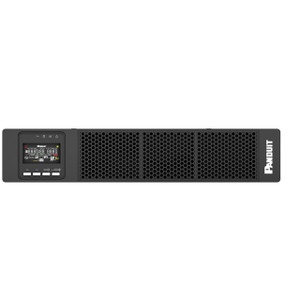
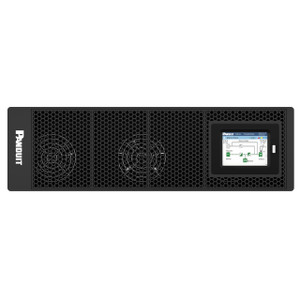
Panduit U10S11V SteadySine™ UPS
The Panduit U10S11V delivers enterprise-grade uninterruptible power in a compact 1U form factor designed for data center, edge computing, and modular tactical data center (MTDC) deployments. Part of Panduit's SteadySine™ family, this UPS provides pure sine wave output to protect sensitive IT infrastructure from power anomalies, sags, surges, and outages. The 10.3-inch depth and 17.3-inch width make this unit compatible with standard EIA racks while minimizing footprint in space-constrained edge locations. Unlike consumer-grade battery backups, the U10S11V integrates into enterprise power distribution architectures where clean power delivery and remote management are non-negotiable.
Key Features
- SteadySine™ pure sine wave output eliminates harmonics and voltage distortion for servers, switches, and storage arrays
- 1U rack-mount design (10.3" H × 17.3" W) fits standard 19-inch racks with minimal vertical space consumption
- Data center, edge, and MTDC application profiles support distributed IT infrastructure and remote site deployments
- Network card expansion capability enables SNMP monitoring, remote shutdown, and integration with datacenter infrastructure management (DCIM) platforms
- Compact footprint supports micro data center builds, telecom shelters, and retail edge computing nodes
Pure sine wave topology is the critical differentiator for IT-grade UPS systems. Modified sine wave and simulated sine wave outputs—common in residential and light-commercial battery backups—introduce harmonic distortion that degrades power supply efficiency, triggers nuisance shutdowns in active PFC power supplies, and shortens capacitor lifespan in enterprise servers. The U10S11V's SteadySine™ architecture delivers power indistinguishable from utility-grade AC, ensuring compatibility with server PSUs rated 0.9+ power factor, PoE switches with high-efficiency switching supplies, and NAS arrays sensitive to input waveform quality. This matters in edge deployments where a single UPS may support mixed loads—security NVRs, access control panels, network switches, and IP cameras—all with different power supply topologies. Clean sine wave output eliminates the troubleshooting variables introduced by marginal power quality.
The 1U form factor addresses a persistent challenge in edge and MTDC builds: vertical rack space is the constraint, not floor space. Traditional tower UPS units consume zero rack units but require separate floor placement, cable dress, and seismic bracing in datacenter environments. The U10S11V mounts directly in the IT rack alongside the gear it protects, reducing cable runs between UPS and protected equipment and simplifying branch circuit planning. The 10.3-inch height dimension suggests this is a shallow-depth unit compatible with wall-mount swing racks and shallow network cabinets common in retail, branch office, and telecom applications. Installers working in network closets, server rooms under 100 square feet, or outdoor telecom shelters gain a rackmount UPS solution that doesn't force a choice between battery runtime and physical installation constraints.
Network card expansion is called out explicitly in the manufacturer specifications, indicating this UPS requires or strongly recommends a network management card for production use. This positions the U10S11V as an enterprise-managed power protection node rather than a standalone battery backup. SNMP integration enables UPS status monitoring in SolarWinds, PRTG, Nagios, and other NMS platforms; graceful shutdown scripts triggered via network commands prevent filesystem corruption during extended outages; and email/SMS alerting notifies on-call staff of power events in unstaffed remote sites. For integrators building edge compute nodes in retail stores, cell towers, or industrial facilities, this network-first design means UPS health becomes a monitored metric alongside server CPU, switch uptime, and environmental sensors. The alternative—deploying a UPS with only local USB or serial management—creates a monitoring blind spot that defeats the reliability objective of installing backup power in the first place.
MTDC (modular tactical data center) and edge deployment scenarios involve physical environments hostile to IT infrastructure: temperature swings in non-climate-controlled spaces, dusty industrial settings, and locations where utility power quality is marginal. The U10S11V's application designation signals it's engineered for these conditions rather than optimized solely for climate-controlled raised-floor datacenters. Integrators deploying compute at oil & gas wellhead sites, agricultural processing facilities, or military forward operating bases encounter input power with voltage sag during motor starts, brief outages from storm activity, and harmonic distortion from variable-frequency drives on the same electrical panel. A UPS rated for edge/MTDC use includes input voltage tolerance wide enough to ride through sags without switching to battery, filtering to handle polluted input waveforms, and thermal design that accommodates ambient temperatures above the 68-77°F comfort zone of traditional datacenter spaces. This ruggedization—implicit in the MTDC application claim—extends UPS service life and reduces the truck-roll maintenance burden in remote sites where the nearest qualified service provider is 90+ minutes away.
The compact 17.3-inch width dimension is noteworthy for integrators building half-rack or wall-mount solutions. While this exceeds the 17.0-inch maximum for some compact rack standards, it fits standard EIA 19-inch racks with room for cable dress and airflow. Integrators provisioning micro data center builds—such as a retail store server closet with a 12U wall-mount rack supporting one server, one switch, one firewall—can deploy the U10S11V as the foundation layer, with protected equipment mounted above. The shallow depth means the UPS doesn't extend beyond the rear of shallow IT switches (typically 10-12 inches deep), eliminating the rear-protrusion problem that forces deeper equipment into full-depth floor racks. This seemingly minor installation detail determines whether a solution fits in the allocated space or requires a costly change order for a larger enclosure or floor-standing rack.
Runtime and capacity specifications are not provided in the available data, but the enterprise positioning suggests mid-range capacity suitable for protecting 1-3 rack units of IT gear rather than a whole-rack solution. Integrators should size this UPS based on actual load measurements (using a Kill-A-Watt or clamp meter to measure real server/switch draw under load) rather than nameplate ratings, since modern IT equipment often draws 40-60% of PSU nameplate during normal operation. Typical edge compute loads—such as a Dell PowerEdge R250 server (real draw ~180W), a 24-port PoE switch (real draw ~240W under 50% PoE load), and a security NVR (real draw ~65W)—total approximately 485W, well within the capacity range suggested by a UPS at this price point. For installations requiring 15+ minute runtime to allow graceful shutdown of virtual machines and database commits, integrators should verify runtime vs. load curves in Panduit's published specifications and consider external battery cabinet expansion if supported.
The SteadySine™ brand positioning indicates Panduit is targeting this UPS at the same integrator audience already specifying Panduit structured cabling, cabinet systems, and rack PDUs. For projects where the cabinet, copper/fiber infrastructure, wire management, and PDUs are already Panduit spec, adding the UPS from the same vendor simplifies procurement (single PO, single vendor relationship) and support (one TAC contact for the entire rack infrastructure). This matters less for product functionality than for project logistics: procurement departments prefer fewer vendors, and service contracts consolidate more easily when the rack, PDU, and UPS come from a single OEM. Integrators working on design-build projects with value-engineering pressure can position a single-vendor physical layer solution as a risk-reduction measure—no finger-pointing between cabinet, PDU, and UPS vendors when a power event occurs.
The U10S11V ships as a single unit per package with network card expansion as a required or recommended component for enterprise management functionality. Installers should confirm network card compatibility and availability at time of order to avoid deployment delays in projects with hard cutover dates. Battery replacement procedures, environmental operating limits, input voltage ranges, and detailed electrical specifications are available in Panduit's published datasheet—verify runtime requirements against actual protected load before specifying this UPS for mission-critical edge deployments where extended outages exceed typical 5-10 minute backup windows.