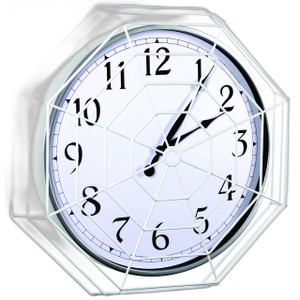
STI STI-9635-SS Clock/Bell Damage Stopper 14.25" Stainless Steel
Overview
The STI-9635-SS is a 14.25-inch diameter wire protective guard engineered to shield wall-mounted clock and bell assemblies from accidental or deliberate impact damage in schools, hospitals, government facilities, and industrial buildings. Built from stainless steel, this guard resists corrosion and degradation in both controlled indoor environments and harsh institutional settings where moisture, chemicals, or salt air can compromise unprotected fixtures. This addresses a concrete cost problem: unprotected clocks and emergency bells sustain repeated damage from collision, vandalism, or heavy-use wear — replacing damaged fixtures multiple times over an installation's lifecycle costs substantially more than installing protective guards upfront.
Authentication and credentials
The STI-9635-SS is not an access control credential reader or authentication device. It is a passive protective enclosure designed to work alongside institutional clock networks and emergency bell systems without interfering with their electrical operation or signal transmission. The guard's open wire construction maintains acoustic performance for emergency bells and preserves visibility of wall-mounted clock faces. Installation does not require credential management, user provisioning, or integration with card readers or door controllers — it is a purely mechanical protective barrier.
Door and zone capacity
This product does not control doors, manage access zones, or regulate entry pathways. The STI-9635-SS protects fixtures mounted on walls in open circulation areas — lobbies, hallways, cafeterias, stairwells, and emergency corridors where clocks and bells are visible and audible to all occupants. Its 14.25-inch diameter accommodates standard institutional clock and bell assemblies with internal component diameters up to 12 inches and mounting depths up to 3.65 inches. The guard's footprint is designed for wall mounting at standard institutional heights (typically 6–9 feet above floor level) and does not restrict physical passage or egress in corridors or emergency exit routes.
Integration and protocols
The STI-9635-SS integrates mechanically with existing wall-mounted clock and bell systems through four anchor points. It works with lag bolts or machine screws (both typically 3/16-inch) fastened through the guard's clamps into the wall substrate or existing mounting hardware. No electrical wiring, network communication, or data protocols are involved — the guard is a passive mechanical accessory. It accommodates fixture footprints with maximum outside width of 14.25 inches and is suitable for retrofitting onto installed clocks and bells without powering down or reconfiguring the underlying equipment. The stainless steel construction ensures compatibility with both indoor and outdoor institutional systems where corrosion resistance is mandatory.
Installation and wiring
Installation requires drilling four 3/16-inch anchor holes around the fixture perimeter to mount the guard's clamps and fasteners. Lag bolt installation demands flush anchor positioning with proper thread engagement into the mounting surface — bolt length must be selected to ensure full penetration and prevent pull-out under impact load. For tamper-resistant installations in high-vandalism environments (secure facilities, detention settings), STI offers KIT-82 stainless steel screws with security bit profiles to prevent unauthorized removal. The 75-degree installation angle and exact clamp positioning are detailed in the technical drawings supplied with the product. Standard hand tools (drill, socket wrench, screwdriver) are sufficient for wall mounting — no specialized installation labor or equipment is required. Custom wire guards are non-returnable, and prepaid design service fees apply if dimensional customization is needed; standard tolerance on custom guards is ±0.2 inches (5 mm).
What's in the Box
- 1x STI-9635-SS wire guard (14.25" diameter, stainless steel)
- 4x mounting clamps
- 4x mounting screws
Frequently Asked Questions
Q: What size clocks and bells does the STI-9635-SS fit?
A: The STI-9635-SS accommodates fixtures with internal component diameters up to 12 inches and mounting depths up to 3.65 inches, with maximum outside width of 14.25 inches. Standard institutional clocks and bells fit within these bounds. If your fixture falls outside these dimensions, contact the manufacturer about custom sizing options.
Q: Is the STI-9635-SS suitable for outdoor installations?
A: Yes. Stainless steel construction resists corrosion, salt air, and moisture, making the guard suitable for outdoor or semi-outdoor institutional environments such as exterior bell towers, covered walkways, and weathered facility entrances.
Q: Can I retrofit the STI-9635-SS onto an existing clock or bell system without removing it from service?
A: Yes, the guard is designed for retrofit installation. You drill four anchor holes around the fixture, mount the clamps and screws, and leave the underlying clock or bell powered and operational. No electrical work or system reconfiguration is necessary.
Q: What tools do I need to install the STI-9635-SS?
A: A hand drill capable of boring 3/16-inch holes, a socket wrench or adjustable wrench for the lag bolts (if used), and a screwdriver for machine screws are sufficient. The package includes mounting clamps and fasteners — no specialized equipment required.
Q: Does the wire guard affect the sound output of emergency bells?
A: The open wire construction preserves acoustic performance. Sound transmission is not measurably attenuated by the guard, so emergency alert functionality remains unaffected.
Q: What is the warranty on the STI-9635-SS?
A: The STI-9635-SS includes a 1-year manufacturer warranty covering defects in material and workmanship. Custom wire guards are non-returnable.
I have specified the STI-9635-SS for school districts and hospital systems where clocks and emergency bells are installed in high-traffic areas and face repeated impact risk. The 14.25-inch diameter stainless steel construction on this model strikes the right balance between protection and practicality — it shields fixtures from collision and vandalism without requiring power, network integration, or ongoing maintenance. If you have replaced a damaged institutional clock more than once in the same location, the STI-9635-SS is worth the upfront cost.
Technical Highlights:
- Stainless steel wire guard, 14.25" diameter: Corrosion resistance in both indoor and outdoor institutional settings eliminates repainting and extends fixture lifespan. Retrofit-compatible with standard lag bolt or machine screw anchoring — no rewiring or reconfiguration of the clock or bell system itself.
- Four anchor points with clamps and fasteners included: Simple mechanical installation (drill four 3/16-inch holes, bolt through clamps) means facility maintenance staff can handle deployment without specialized security labor. Prepaid design service and custom tolerance of ±0.2 inches available if non-standard fixture dimensions require customization.
- Open wire construction: Acoustic transparency and visual unobstructed clock face — emergency bell output is not attenuated, and time display remains fully visible from any viewing angle in corridors and common areas.
Deployment Considerations:
- For tamper-resistant applications (secure facilities, detention centers, youth corrections), order STI's optional KIT-82 security screws with bit profiles that prevent unauthorized removal — standard fasteners are sufficient for most institutional deployments, but high-vandalism environments benefit from the upgrade.
- The 75-degree clamp angle is fixed by design — verify that your wall substrate (concrete, block, gypsum, or wood) can accommodate 3/16-inch lag bolt penetration and thread engagement. Shallow mounting surfaces (thin drywall without backing) may require toggle bolts or molly anchors instead of lag bolts — test anchor pull-out resistance on at least one mounting point before final installation of all four.
Deploy the STI-9635-SS in any school hallway, hospital corridor, or government building where a clock or emergency bell has been damaged or vandalized before. It is the simplest way to shift the failure point from the fixture itself to a replaceable mechanical guard.