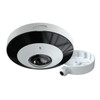
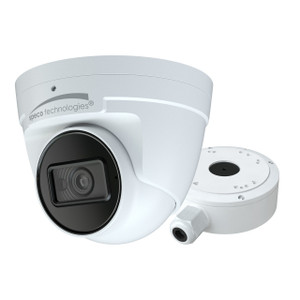
Speco Technologies O6MDP4 6MP H.265 360° Fisheye IP Camera
Overview
The Speco Technologies O6MDP4 is a 6MP H.265 IP fisheye camera engineered to deliver 360-degree panoramic surveillance from a single mounting point. At 3840×2160 resolution, this wired PoE-powered camera captures continuous horizontal coverage without blind spots across retail floors, parking structures, hallways, and open facilities. The integrated junction box design streamlines installation in both sheltered indoor and weathered outdoor environments rated IP67. H.265 video compression reduces storage and bandwidth overhead by roughly 50% compared to H.264 at equivalent quality—a tangible cost factor when deploying multiple units on 24/7 recording schedules.
Key Features
- 360-Degree Fisheye Optics: Eliminates blind spots and reduces the number of cameras required for perimeter coverage. One camera replaces two or three fixed-lens units in open-plan environments, lowering hardware and cabling costs.
- 6MP @ 3840×2160 Resolution: Sufficient detail for behavioral analysis and event reconstruction across the panoramic field. Stored as a single panoramic image rather than multiple cropped streams, simplifying archive workflows.
- H.265 Compression: Cuts storage requirements roughly in half versus H.264 without visible quality loss. On a 30-camera installation recording 24/7, this translates to halving NVR disk capacity or extending retention periods without additional hardware.
- PoE Power (802.3af): Draws under 13W, making it compatible with standard 802.3af PoE switches without straining power budgets. No separate power supply or 12VDC infrastructure needed.
- IP67 Environmental Rating: Withstands direct rain, dust, and moisture in outdoor installations. Suitable for covered loading docks, warehouse perimeters, and transit hubs; not rated for full submersion.
- True WDR and IR Night Vision: Wide Dynamic Range processing balances bright windows against dark interior zones. Electronic IR illumination enables continuous surveillance through dusk, night, and dawn without auxiliary lighting. 30 fps frame rate delivers smooth motion capture for behavioral forensics.
- Two-Way Audio: Built-in microphone and speaker support real-time communication at the point of capture—valuable for retail loss prevention, access control, and facility management response.
- Motion Detection Analytics: On-camera motion detection triggers recording, alarms, and VMS alerts. More advanced analytics (object classification, people counting, face detection) require processing on a separate VMS or edge appliance.
- Multiple Compression Codecs: Supports H.265, H.264, and MJPEG. Stream switching between codecs accommodates failover and adaptive bitrate delivery across heterogeneous network conditions.
When to Choose the O6MDP4
Deploy the O6MDP4 when you need panoramic coverage across wide areas from a single mounting point. Retail environments, parking garages, warehouse floor plans, and transit stations benefit from 360-degree situational awareness without multiple camera installations. The IP67 rating qualifies it for sheltered indoor use and weathered outdoor perimeters. PoE simplifies cabling in retrofit and new-build scenarios. Two-way audio adds operational value in access control and loss prevention workflows. The H.265 compression advantage compounds across multi-camera deployments, making it cost-effective for large facilities.
When to Choose a Different Model
If your application demands narrow field-of-view detail—facial identification, license plate recognition, or long-distance object recognition—a fixed or varifocal camera will outperform a fisheye lens. Fisheye optics introduce barrel distortion that complicates precise identification. Avoid the O6MDP4 if you require pan-tilt-zoom functionality or local edge analytics processing beyond motion detection. If your infrastructure cannot support PoE or 12V DC input, consult alternative models in the Speco Technologies camera lineup. Consider a higher-resolution variant if your application demands greater pixel density over a narrower field of view.
Optics, Field of View, and Integration
The O6MDP4 delivers continuous 360-degree horizontal panoramic imaging via fisheye optics. This eliminates blind spots across the mounting plane and simplifies camera placement. The 1/2.5" CMOS sensor maintains 6MP across the panoramic image, translated into 3840×2160 pixel output. Barrel distortion is inherent to fisheye design; dewarping software at the VMS or client level is required to convert the panoramic image into rectilinear feeds suitable for integrations with access control, analytics, and monitoring dashboards. IP camera selection guides detail dewarping workflows and VMS compatibility considerations for panoramic cameras.
Imaging Performance and Low-Light Operation
True Wide Dynamic Range (WDR) processing balances mixed-lighting scenes where bright windows coexist with dark interior zones. Day/night operation includes electronic IR illumination for extended darkness. Sensor sensitivity remains adequate for dusk/dawn conditions without auxiliary lighting. The 30 fps frame rate at 6MP delivers smooth motion capture for behavioral analysis and event reconstruction. PoE infrastructure planning guides can help you size switch ports and power budgets for multi-camera deployments of the O6MDP4.
Analytics and Edge Capabilities
The O6MDP4 includes on-camera motion detection analytics to identify activity across the panoramic field. This single-event trigger supports basic alarm integration and recording activation. The camera does not include object classification, people counting, or face detection. Advanced analytics must be processed on a VMS server or dedicated edge appliance.
Video Compression and Streaming
Three compression options—H.265, H.264, and MJPEG—accommodate diverse network and storage architectures. H.265 reduces bandwidth and storage overhead by approximately 50% compared to H.264 at equivalent quality levels. Stream switching between encodings supports failover scenarios and adaptive bitrate delivery. The 30 fps frame rate across all codecs provides consistent motion fluidity.
Frequently Asked Questions
Q: Does the O6MDP4 require special software to view the 360-degree image?
A: The camera outputs a single panoramic image (3840×2160). Dewarping—conversion to rectilinear or multi-crop views—is performed by your VMS, video client, or third-party dewarping plugin. Most modern VMS platforms support panoramic dewarping natively. Consult your VMS vendor for compatibility.
Q: What's the maximum distance the O6MDP4 can transmit over Ethernet?
A: Standard Ethernet runs up to 100 meters (328 feet) on Category 5e or better cabling. For longer distances, use fiber-optic media converters or additional switches. PoE distance is limited to the same 100-meter span.
Q: Can the O6MDP4 be wall-mounted, or does it require ceiling installation?
A: The O6MDP4 is designed for ceiling mounting to capture the full 360-degree panoramic view. Wall mounting is not recommended, as it would only capture a 180-degree or narrower field and negate the panoramic advantage.
Q: Is the O6MDP4 compatible with ONVIF-compliant VMS platforms?
A: Yes, the O6MDP4 supports ONVIF Profile S, enabling integration with standard-compliant VMS systems. Verify dewarping support in your specific VMS platform before deployment.
Q: What bitrate should I allocate for H.265 streaming at full 6MP resolution?
A: H.265 bitrate depends on scene complexity and frame rate. Expect approximately 4–8 Mbps for typical indoor/outdoor scenes at 30 fps. H.264 would require 8–16 Mbps for equivalent quality. Test your network with actual deployment conditions before committing to storage and bandwidth allocation.
Q: Does the O6MDP4 include built-in storage?
A: No, the O6MDP4 does not include onboard storage. Video must be streamed to a network video recorder (NVR), edge appliance, or cloud platform. The camera includes motion detection to trigger selective recording on the NVR.
Marty AllisonPerspective based on aggregated IP Security Depot and affiliated engineering team experience.
I've deployed the O6MDP4 in several retail and warehouse environments, and the single strongest argument is economics at scale. On a 30-camera installation, switching from H.264 to the O6MDP4's H.265 encoding cuts your NVR storage footprint in half. That's not theoretical—it directly reduces hardware spend or extends retention without adding disk. The 360-degree fisheye also collapses multiple fixed cameras into one, further reducing capex and cabling labor.
Technical Highlights:
- H.265 Compression: 50% storage reduction versus H.264 on a 24/7 multi-camera deployment. For a 30-camera, 7-day retention setup, you're looking at one fewer NVR or several additional weeks of history on existing hardware.
- 360-Degree Coverage: A single O6MDP4 ceiling-mounted replaces two or three fixed cameras in open retail floors or warehouse aisles. Capex savings compound across large deployments.
- PoE under 13W: Fits within standard 802.3af budgets—90W PoE switch powers roughly seven O6MDP4 units simultaneously. No power supply sprawl or separate 12VDC runs to contend with.
- IP67 + WDR: Handles weathered outdoor perimeters and mixed-light retail floors without auxiliary lighting. Two-way audio is underrated for loss prevention interventions in real time.
Deployment Considerations:
- Dewarping is non-negotiable: The panoramic image requires client-side or VMS-side dewarping to be usable. Test your VMS dewarping pipeline before committing. Milestone XProtect, Genetec, and AcuSense support it natively, but older or proprietary systems may struggle.
- Barrel distortion kills detail: Do not expect facial recognition or license plate capture from a single panoramic image. If you need both panoramic overview and narrow-field detail, pair the O6MDP4 with a separate high-resolution fixed camera.
- Mounting is ceiling-critical: Wall mounting defeats the 360-degree advantage. Ensure your facility has solid ceiling infrastructure and PoE cabling routes before ordering.
The O6MDP4 is the right choice for warehouse floors, retail open-plan layouts, parking structures, and transit facilities where you need broad situational awareness without multiplying hardware. Skip it if your application is forensic detail—license plates, faces, or objects at distance. Pair it with fixed cameras for hybrid deployments (panoramic overview + focal-point detail).