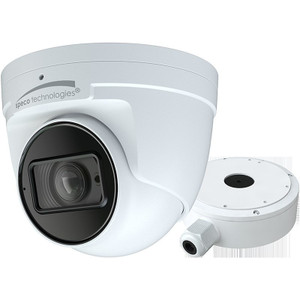
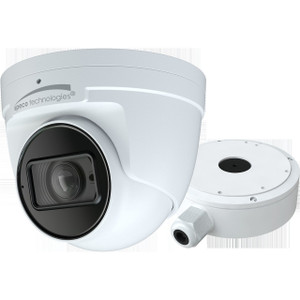
Speco Technologies O4VT2G 4MP H.265 Turret Camera
Overview
The Speco O4VT2G is a compact turret camera built for deployments where codec efficiency and reliable infrared imaging matter. At 4MP (2560 × 1920), it delivers sufficient resolution for identification and forensic review in retail, office, warehouse, and light industrial environments. The H.265 video compression cuts bitrate roughly in half compared to H.264 at equivalent quality—a real advantage when you're recording 24/7 across multiple cameras and storage is constrained. A fixed 2.8mm lens keeps installation straightforward and cost down; there's no autofocus drift to manage. The O4VT2G draws under 13W via standard PoE (802.3af), so it won't overload your switch's power budget. NDAA compliance qualifies this model for federal and government procurement channels.
Key Features
- 4MP resolution (2560 × 1920): Captures enough detail for individual identification and forensic playback in typical commercial spaces without overloading your storage or network.
- H.265 (HEVC) compression: Achieves roughly 50% bitrate reduction versus H.264 at the same image quality—extends recording retention on fixed storage and reduces WAN congestion on multi-site deployments.
- Wide Dynamic Range (WDR): Handles high-contrast scenes with both bright and dark areas—parking lot entries with backlighting, mixed indoor/outdoor zones, and sun-facing lobbies where conventional cameras wash out or crush detail.
- Infrared illumination (integrated IR LEDs): Delivers night-vision capability without external lighting; enables 24/7 operation across varying ambient light with no manual switching or scene-mode configuration.
- Fixed 2.8mm lens: Provides moderate field of view suitable for hallways, lobbies, entrances, and general mid-range surveillance; eliminates autofocus complexity and delivers predictable coverage without varifocal cost overhead.
- PoE power (802.3af, ~13W max): Single cable carries both data and power; simplifies installation and works on standard enterprise switches without requiring dedicated power supplies.
- Turret form factor: Compact mounting on walls or ceilings with minimal profile; easier to install than bulkier bullet housings and less conspicuous than dome domes in retail environments.
- ONVIF compatibility: Integrates with industry-standard VMS platforms (Milestone, Genetec, Hanwha, etc.); locks you into no single software stack.
- NDAA Section 889 compliance: Qualifies for federal, state, and municipal government procurement without waiver or exception-request overhead.
When this is the right choice
Select the O4VT2G if you need a cost-effective turret with modern codec efficiency and infrared capability for mixed indoor/outdoor deployments. The fixed lens is ideal when field of view is predictable and you want to avoid varifocal complexity. H.265 compression is particularly valuable in bandwidth-constrained or storage-limited installations—a 24/7 multi-camera warehouse or retail chain will see meaningful savings. NDAA compliance makes this model mandatory for government and defense-related projects.
When to choose a different model
If your application demands remote focus adjustment, pan-tilt-zoom capability, or wide-angle coverage beyond the fixed 2.8mm lens, evaluate varifocal or PTZ variants in the Speco Technologies IP camera line. For extreme low-light or zero-light performance beyond standard IR range, confirm the candidate camera supports thermal imaging or Lightfinder-class technology. If you need advanced edge analytics—people counting, line crossing detection, or deep learning object classification—verify that your VMS or edge device supports the O4VT2G's specific feature set; not all analytics are created equal across platforms.
Video encoding and network integration
The O4VT2G encodes primarily in H.265, offering approximately 40–50% bitrate savings versus H.264 depending on scene complexity. This efficiency is most visible in 24/7 recording scenarios where you're trying to extend retention on a fixed storage budget or reduce WAN traffic on multi-site NVR or cloud architectures. The camera supports ONVIF Profile S for broad VMS compatibility, ensuring you can integrate it into Milestone XProtect, Genetec Security Center, Hanwha SmartVMS, or other standards-based platforms without proprietary plugins. Simultaneous encoding and flexible bitrate control support both live monitoring and forensic playback without requiring separate camera streams.
Imaging performance across lighting conditions
The 4MP sensor captures 2560 × 1920 resolution, sufficient for detail retention and identification-grade evidence. Wide Dynamic Range (WDR) processing handles backlit entrances and mixed bright/dark zones—common in retail and warehouse environments with glazed entries or skylights. Integrated IR illumination provides passive night vision without external lights, enabling 24/7 operation across shifts without manual intervention. WDR + IR together make the O4VT2G effective for continuous deployment where lighting conditions change throughout the day.
Mounting and installation
The turret design supports wall and ceiling mounting with a compact footprint. The fixed 2.8mm lens eliminates the need for remote focus adjustment during commissioning—install once, no recalibration required. PoE power means a single cable from your switch to the camera; no separate power supply, no additional conduit planning.
Integration with network video recorders and VMS platforms
The O4VT2G adheres to ONVIF Profile S standards, compatible with industry network video recorders and software VMS platforms. Before final purchase, confirm your chosen NVR or VMS supports the camera's edge analytics profile and any required codec licensing. Many systems handle H.265 out-of-the-box; some older installations may require firmware updates.
Frequently Asked Questions
Q: Is the O4VT2G NDAA Section 889 compliant?
A: Yes. The O4VT2G is NDAA-compliant and eligible for federal, state, and municipal government procurement without exception requests.
Q: What's the infrared range on the O4VT2G?
A: The O4VT2G includes integrated IR illumination for night operation and low-light surveillance. Consult the manufacturer datasheet or your system integrator for specific illumination distance under your mounting and environmental conditions.
Q: Can I adjust the focus remotely on the O4VT2G?
A: No. The O4VT2G features a fixed 2.8mm lens with no remote focus adjustment. Focus is set at installation and remains fixed. This simplifies deployment and eliminates autofocus drift, but you cannot refocus via software.
Q: What's the power consumption of the O4VT2G?
A: The O4VT2G draws approximately 13W maximum via standard PoE (802.3af), so it will not strain typical enterprise switch power budgets. No separate power supply is required.
Q: Does the O4VT2G work with Milestone XProtect or other standard VMS platforms?
A: Yes. The O4VT2G supports ONVIF Profile S and integrates with industry-standard VMS platforms including Milestone XProtect, Genetec Security Center, Hanwha SmartVMS, and others. Confirm codec licensing and analytics support with your VMS vendor.
Q: What field of view does the 2.8mm fixed lens provide?
A: The fixed 2.8mm lens delivers a moderate field of view suitable for mid-range coverage in hallways, lobbies, parking areas, and general surveillance zones. It is not a wide-angle lens; if you need panoramic or extreme wide-angle coverage, consider a varifocal or higher-resolution variant.
James EverettPerspective based on aggregated IP Security Depot and affiliated engineering team experience.
The O4VT2G hits a practical sweet spot for mid-market warehouse and retail deployments where H.265 codec efficiency and NDAA compliance are non-negotiable. The fixed 2.8mm lens and 4MP resolution deliver predictable mid-range coverage without the complexity or cost of varifocal optics, and the integrated IR handles night operation without external lighting infrastructure. If your deployment is recording 24/7 across a dozen or more cameras, H.265's roughly 50% bitrate savings translates into real storage extension and reduced WAN load—worth the hardware cost on larger installations.
Technical Highlights:
- H.265 compression: Achieves ~40–50% bitrate reduction versus H.264 at equivalent quality—a meaningful factor in 24/7 multi-camera recording where storage or bandwidth is constrained. Single-stream H.265 will noticeably reduce NVR CPU load and extend recording retention.
- 4MP resolution with WDR: Sufficient detail for identification and forensic review in most commercial environments. WDR processing handles high-contrast scenes (backlit entries, mixed indoor/outdoor transitions) without separate exposure modes or manual reconfiguration.
- Integrated IR (850nm): Night-vision capability built-in; no external lighting infrastructure, no scene-switching logic. Simplifies commissioning and reduces ongoing operational overhead.
- PoE (802.3af) at ~13W max: Standard 90W switch supports 6+ cameras without additional power supplies. Eliminates conduit and power-distribution headaches in retrofit deployments.
Deployment Considerations:
- Fixed lens is a feature, not a limitation: The 2.8mm optic is designed for mid-range, general-purpose coverage. If your site demands tight close-ups of faces or license plates at distance, or panoramic wide-angle views, you need a varifocal or PTZ variant—commit to that before procurement.
- H.265 licensing: Confirm your NVR or VMS platform includes H.265 decode licensing. Some systems charge per-camera or per-channel codec fees; verify this won't blow your budget on a 20+ camera rollout.
- ONVIF Profile S coverage: The O4VT2G supports standard ONVIF; edge analytics (motion detection, object tracking) depend on your VMS or edge device—don't assume deep learning features are included.
Deploy the O4VT2G in warehouse aisles, retail back-of-house zones, office hallways, and parking entries where fixed-lens, mid-range coverage is sufficient and storage or bandwidth constraints make H.265 efficiency a priority. NDAA compliance makes this the default choice for any federal or state procurement channel. Skip it if you need varifocal zoom, PTZ, or zero-light thermal imaging.