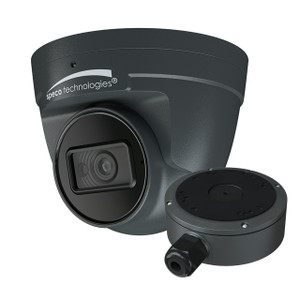
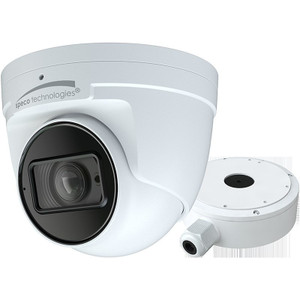
Speco Technologies O4T9 4MP H.265 AI IR Turret Camera
Overview
The Speco Technologies O4T9 is a fixed-position turret camera delivering 4MP resolution and native H.265 (HEVC) video compression in a compact form factor suited to small-to-medium facility deployments. This model integrates infrared illumination and edge-based AI analytics to enable 24/7 surveillance with minimal bandwidth overhead and rapid event detection at the camera itself. The O4T9 ships with a junction box to simplify wall and ceiling installation, and carries NDAA Section 889 compliance for federal and defense-adjacent procurement environments. The fixed 2.8mm lens prioritizes wide-angle coverage over zoom versatility, making this camera appropriate for entry points, hallways, and general perimeter monitoring where fixed positioning meets operational requirements.
Key Features
- 4MP (2688 × 1520) resolution: Captures legible facial detail and license plate information at typical operational distances (15–25 feet), sufficient for identity confirmation and incident review without resorting to higher-megapixel variants that demand greater bandwidth and storage.
- H.265 (HEVC) primary codec: Reduces file size by roughly 50% versus H.264 at equivalent visual quality. On a 24/7 multi-camera system, this translates to measurable storage and bandwidth savings—particularly relevant if your network link is constrained or your NVR has a fixed storage budget.
- Fixed 2.8mm lens, 110° horizontal field of view: Wide-angle design eliminates blind spots in compact spaces and reduces the number of cameras needed to cover a typical hallway or entry vestibule. No varifocal moving parts means lower maintenance and longer service life in continuous-operation environments.
- Infrared (IR) illumination: Extends visibility into darkness without auxiliary lighting, enabling round-the-clock operation in unlit areas or facilities without occupancy-dependent lighting controls. IR range and performance vary by scene reflectivity; consult the datasheet for specific low-light specifications.
- Edge-based AI analytics: On-camera object detection and classification run locally without external analytics servers, reducing latency in alarm response and minimizing false-alert overhead. Integrators benefit from simpler VMS architecture and faster incident correlation.
- PoE (IEEE 802.3af) power: Draws under 13W, so standard PoE-enabled network switches power the camera directly—no separate 12VDC supplies or UPS conditioning required. A single network cable handles both data and power, reducing cable runs and termination labor.
- NDAA Section 889 compliant: Required for federal, DoD, and defense contractor environments. Confirms the camera and supply chain meet federal procurement restrictions on certain foreign components.
- Day/night operation with automated mode switching: The camera detects ambient light levels and switches between color (daytime) and monochrome + IR (nighttime) automatically, preserving detail across a 24-hour cycle without manual intervention.
- Multi-codec support (H.265 and H.264): Simultaneous H.265 and H.264 streaming accommodates legacy VMS platforms and mixed-vendor integrations, preventing codec incompatibilities in heterogeneous security ecosystems.
Integration and Compatibility
The O4T9 conforms to ONVIF standards, enabling integration with third-party network video recorders (NVRs) and video management systems (VMS) that support ONVIF Profile S. Simultaneous multi-codec output allows the camera to stream H.265 to modern infrastructure while simultaneously supporting H.264 to older VMS instances or cloud-connected backup systems. When deploying across multiple cameras, assess your PoE switch capacity and power budgeting to avoid exceeding per-port or chassis-level power limits, particularly in high-density installations. The included junction box facilitates wall and ceiling mounting without additional hardware, though mounting bracket compatibility with your chosen surface type should be confirmed during the design phase.
When the O4T9 is the Right Choice
Deploy the O4T9 in indoor and covered outdoor environments where fixed-position wide-angle coverage satisfies operational requirements. Typical use cases include retail entry monitoring, office hallways, parking garage approaches, and facility perimeters where zoom capability is not a priority. NDAA compliance makes this model a default selection for federal and defense contractor facilities. Bandwidth-constrained networks and high-density multi-camera installations benefit directly from H.265's storage efficiency. Small-to-medium facilities and integrators seeking to minimize VMS infrastructure complexity will find the edge analytics and PoE simplicity particularly valuable.
When to Evaluate Alternatives
If your deployment requires long-distance identification or the ability to zoom into distant subjects, evaluate Speco Technologies varifocal or PTZ variants instead. Applications demanding extreme low-light performance beyond infrared capability—such as light-sensitive research environments or unlit outdoor spaces without ambient urban glow—may benefit from higher-sensitivity sensors or dedicated thermal imaging. If you need panoramic coverage or multi-directional monitoring from a single mounting point, explore multi-sensor or panoramic models in the Speco lineup. Confirm the IK (vandalism) rating for high-impact outdoor or public-access environments; the O4T9's specific IK rating should be verified against your facility's security spec.
Mounting and Physical Installation
The turret form factor mounts flush to flat surfaces (walls, ceilings, or bulkheads) with minimal standoff, reducing exposure to impact or intentional tampering. The included junction box simplifies termination and PoE injection on diverse mounting substrates. Field termination requires standard RJ-45 crimping and PoE injector provisioning (or PoE-enabled switch ports); no specialized tools or skills are required beyond basic network installation competency.
Frequently Asked Questions
Q: Is the O4T9 NDAA Section 889 compliant?
A: Yes. The O4T9 is NDAA-compliant and suitable for federal and defense-adjacent procurement environments.
Q: What is the infrared range on the O4T9?
A: IR range varies by scene reflectivity, lens focal length, and sensor sensitivity. Refer to the O4T9 datasheet for exact specifications under standard test conditions.
Q: Can the O4T9 work with my legacy H.264-only VMS?
A: Yes. The O4T9 supports simultaneous H.265 and H.264 streaming, so it can feed H.264 to older VMS platforms while H.265 streams elsewhere for modern systems.
Q: How much power does the O4T9 consume?
A: The O4T9 draws under 13W and operates on standard IEEE 802.3af PoE, so any PoE-enabled network switch port will supply sufficient power without additional conditioning.
Q: Does the O4T9 include mounting hardware?
A: Yes. The O4T9 ships with a junction box to simplify installation on walls and ceilings. Confirm mounting bracket compatibility with your chosen surface material during design.
Q: What analytics does the O4T9 provide?
A: The O4T9 incorporates edge-based AI analytics that run on the camera itself, enabling real-time object detection and classification without relying on external analytics servers.
James EverettPerspective based on aggregated IP Security Depot and affiliated engineering team experience.
The O4T9 addresses a common integration challenge: how to add 4MP turret coverage to a facility without overloading storage or adding complexity to the VMS stack. The H.265 codec is the real differentiator here—on a typical 24/7 deployment with dual-codec support, you're looking at real file-size reduction that compounds across 10, 20, or 50 cameras. Paired with edge-based analytics, the O4T9 shifts detection and classification work away from a centralized analytics appliance, which scales better than you'd think for small-to-medium installations.
Technical Highlights:
- H.265 (HEVC) primary compression: Delivers roughly 50% file size reduction versus H.264 at equivalent visual quality. On a 4MP 24/7 recorder storing 30 days of footage, expect single-digit terabyte savings—meaningful if your storage budget is capped or your WAN link is under 10 Mbps.
- 4MP (2688 × 1520) native resolution: Sufficient for facial recognition at 15–25 feet and license plate legibility at standard parking-lot distances. Beyond 30 feet, detail drops noticeably—if your deployment requires 50+ foot identification, evaluate 5MP or 8MP variants in the Speco family.
- Edge AI (on-camera analytics): Eliminates the need for a standalone analytics server or VMS plugins for basic object detection. Latency is milliseconds, not seconds, and false-alert filtering happens at the source rather than downstream in your VMS event queue.
- PoE (under 13W): Standard 802.3af power budget—no PoE+ injectors, no separate supplies. In a 48-port PoE switch powering 8–10 cameras, you'll stay well within chassis-level power capacity.
Deployment Considerations:
- The fixed 2.8mm lens is a commitment: 110° horizontal FOV is wide, but zoom is zero. If your facility layout requires both wide coverage and occasional zoomed detail from the same camera, you'll need multiple units or a hybrid approach (turret + varifocal PTZ in the same zone).
- IR range is scene-dependent. In a parking lot with reflective surfaces (painted lines, vehicles), IR penetration extends further than in a dark interior with matte finishes. Request a site-specific IR range estimate from Speco or your integrator before final placement.
- NDAA compliance is a selling point for federal work, but do not assume it covers every procurement requirement—some projects demand additional supply-chain certification (TAA, EAR compliance, etc.). Confirm with your contracting officer before design lock.
The O4T9 is a solid default for federal and state facilities, retail chains needing cost-effective multi-camera deployments, and integrators looking to reduce NVR footprint via edge analytics. Deploy it where fixed coverage and bandwidth efficiency matter more than zoom flexibility.