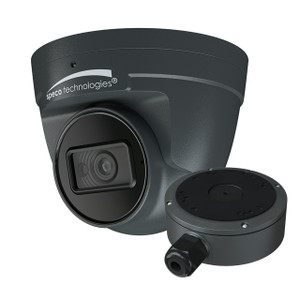
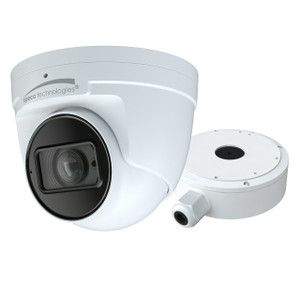
Speco Technologies O4VT2M 4MP H.265 Turret IP Camera
Overview
The O4VT2M is a 4MP turret-style IP camera engineered for outdoor surveillance where optical flexibility and low-light imaging matter. Built around a motorized 2.8-12mm varifocal lens and H.265 video compression, this IP camera delivers efficient network streaming and storage without sacrificing frame clarity. Operating on standard PoE (802.3af) or 12VDC, the O4VT2M adapts to both modern IP infrastructure and legacy DC-powered systems. The turret form factor and included junction box simplify mounting on poles, walls, or eaves in challenging outdoor deployments.
Key Features
- 4MP resolution (2560×1440): Captures fine detail for license plate recognition and facial recognition at moderate distances — sufficient for perimeter monitoring and facility access control without the bandwidth burden of 5MP or higher.
- Motorized 2.8-12mm varifocal lens: Delivers approximately 109° field of view at wide (2.8mm) and 28° at telephoto (12mm). Remote focus and zoom adjustment through the network means integrators tune framing on-site without climbing ladders or using separate tools — a time and cost saver on large deployments.
- H.265 (HEVC) + H.264 dual codec: H.265 cuts bandwidth and storage roughly 40–60% versus H.264 at equivalent quality. On a 24/7 multi-camera system, this translates directly to smaller NVR footprints and lower egress costs if cloud-assisted or remote backup is involved.
- True WDR (Wide Dynamic Range): Handles scenes with both bright sunlight and deep shadows — think parking lot entrances with reflected glare or loading docks with mixed indoor/outdoor lighting. WDR processing prevents blown highlights and crushed shadows that would obscure vehicle plates or faces.
- IR night vision with day/night operation: Built-in infrared illumination enables full surveillance through darkness without external lighting. Useful for 24/7 perimeter monitoring, parking structures, or sites where pole-mounted lighting is not feasible.
- IP67 rating and -40°F to 140°F operating range: IP67 protection means rain, dust, and garden-hose spray won't penetrate the housing. Temperature range covers cold-climate outdoor mounting and hot enclosed equipment rooms — deploy with confidence from arctic warehouses to southern U.S. facilities.
- Line-crossing analytics: Edge-based motion detection along user-defined virtual boundaries reduces backend processing load. Pair with a compatible VMS to trigger alarms when motion crosses a perimeter or egress route.
- PoE (802.3af) power draw under 13W: Draws minimal current, so a single 24-port PoE switch supports dozens of O4VT2M cameras without dedicated power injectors. Simplifies wiring runs and reduces cabinet power consumption.
- Two-way audio (mic in + speaker out): Enables remote announcements or communication at the camera location — useful for access gates, warehouse loading zones, or temporary event monitoring.
- ONVIF Profile I compliance: Interoperates with standard VMS and management platforms. Not locked into proprietary ecosystems — integrators mix vendors and swap recording systems without re-licensing cameras.
- NDAA Section 889 compliant: No banned Hikvision, Dahua, or ZTE components. Approved for U.S. government and critical infrastructure contracts that prohibit Chinese entity surveillance products.
When the O4VT2M is the correct choice
Specify the O4VT2M for perimeter monitoring, parking areas, facility entrances, and outdoor storage yards where varifocal optics let you adapt framing on-site. The motorized lens is a real advantage when mounting locations are difficult to access or when deployment scope changes post-install. H.265 compression is essential in bandwidth-constrained deployments or where storage efficiency drives NVR ROI. NDAA compliance makes this the natural choice for government agencies, military installations, and critical infrastructure projects subject to federal acquisition rules.
When to choose a different model
If your application demands 5MP, 8MP, or higher resolution for ultra-detailed recognition, evaluate higher-megapixel variants in the outdoor IP camera family. If you need pan-tilt-zoom capability, consider a PTZ turret or dome platform instead. For intrusion detection, people counting, or specialized AI analytics, consult analytics-enabled platforms or a camera with deeper edge computing support. If you require submersion or extreme washdown environments, step up to IP68 or nema 4x enclosures.
Integration and compatibility
The O4VT2M pairs with any ONVIF-aware VMS, including Milestone XProtect, Genetec SecurityCenter, and open-source platforms such as Frigate or BI. Integration does not require proprietary software licenses. Integrators can embed the O4VT2M in a broader NVR and storage strategy without vendor lock-in. When planning PoE delivery, a standard managed PoE switch supplies power and network in a single run — see PoE planning and power budgeting for multi-camera wiring design.
Environmental and operational context
Operating temperature span of -40°F to 140°F means the O4VT2M functions in cold climates where passive cameras freeze, and in hot equipment rooms or attics where internal heat builds. IP67 rating withstands steady rain and dust, but does not support full submersion or high-pressure spray. For harsh washdown environments (food processing, chemical storage), upgrade to an IP68 variant or stainless enclosure.
Frequently Asked Questions
Q: Is the O4VT2M NDAA Section 889 compliant?
A: Yes. The O4VT2M contains no banned Chinese entity components and is approved for U.S. federal government and critical infrastructure procurement.
Q: Can I adjust the focus and zoom remotely?
A: Yes. The motorized 2.8-12mm lens allows remote focus and zoom adjustment through the network interface, eliminating the need for physical access after installation.
Q: What codec should I use — H.265 or H.264?
A: Use H.265 (HEVC) for bandwidth and storage efficiency, especially in multi-camera 24/7 deployments. Fall back to H.264 only if your VMS does not support H.265 decoding.
Q: What is the maximum IR range at night?
A: The datasheet does not specify a maximum IR range; consult Speco's technical support or request a demo in your target lighting environment.
Q: Does the O4VT2M work with Milestone XProtect or Genetec?
A: Yes. ONVIF Profile I compliance ensures interoperability with Milestone, Genetec, and other ONVIF-aware VMS platforms.
Q: How much power does the O4VT2M draw?
A: Under 13W via standard 802.3af PoE. Multiple cameras can run on a single PoE switch without a dedicated power injector.
James EverettPerspective based on aggregated IPSD and affiliated engineering team experience.
The O4VT2M hits a practical sweet spot for outdoor fixed surveillance. The motorized 2.8-12mm lens eliminates the painful trade-off between wide-angle coverage and zoomed detail — you tune it on-site through the network, which saves hours of on-ladder adjustments. H.265 encoding cuts storage overhead meaningfully: on a 16-camera parking lot rig running 24/7 at full frame rate, you'll consume roughly half the NVR disk space versus H.264. That compounds across multi-site deployments.
Technical Highlights:
- Motorized varifocal 2.8-12mm lens: 109° wide angle to 28° telephoto without hardware swaps. Remote focus and zoom adjustment through the VMS eliminates field visits to re-frame after installation changes.
- H.265 compression: Reduces bandwidth and storage by 40–60% versus H.264 at equivalent perceived quality — meaningful on 24/7 deployments where storage tier (SSD vs. HDD) and retention window (30, 60, 90 days) drive capex.
- IP67 + -40°F to 140°F range: Handles outdoor rain, dust, and cold-climate sites without heater modules or enclosure upgrades. Not rated for submersion, but stands up to garden hose spray and seasonal extremes.
- PoE 802.3af under 13W: Minimal power footprint means a single managed PoE switch in a small cabinet can feed dozens of O4VT2M cameras. No splitters, no remote power injectors — cleaner wiring and less to troubleshoot.
- NDAA compliant, ONVIF Profile I: Zero proprietary lock-in. Works with Milestone, Genetec, Frigate, or any ONVIF platform. Government/critical infrastructure procurement is cleared.
Deployment Considerations:
- The 4MP sensor is adequate for vehicle plate and facial recognition at 30–40 feet. Beyond that distance, a 5MP or 8MP variant will deliver better detail per pixel.
- IR illumination range is not specified in the datasheet — request a manufacturer demo in your lighting environment if night-time detail is mission-critical. Do not assume 50-meter IR just because the camera is rated IP67.
- True WDR processing handles mixed lighting (sun + shadow), but backlit subjects can still blow out if the dynamic range exceeds the sensor's capability. Test in your worst-case scene geometry before large rollouts.
- Two-way audio is supported, but a built-in microphone is not mentioned. Budget for a separate audio input if two-way announcements are required.
Deploy the O4VT2M for perimeter and parking surveillance where motorized zoom avoids the cost and complexity of fixed multi-lens systems or PTZ turrets. The H.265 codec justifies the choice on bandwidth-constrained networks or high-volume storage environments. NDAA compliance makes this a no-brainer for government and critical infrastructure projects. Skip it if you need 5MP+, real-time AI analytics, or submersion-rated enclosures.