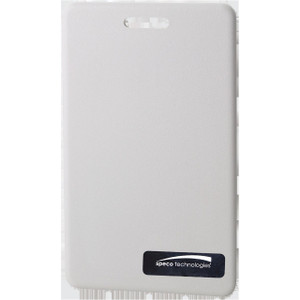
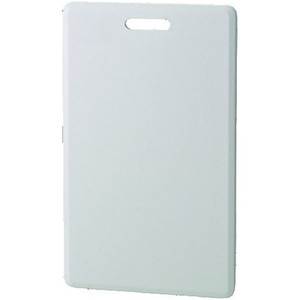
Speco Technologies ACSM2P Passive ISO Smart Card Credential
The Speco Technologies ACSM2P is a passive ISO 14443-A smart card credential engineered for access control systems that require government compliance and long-term reliability. Operating at 13.56 MHz without an onboard battery, this card integrates with Speco's ACSR35L Bluetooth reader and delivers consistent read performance across facility access, critical infrastructure, and federal security deployments. NDAA Section 889 Part B compliance makes it suitable for organizations under federal procurement mandates.
Key Features
- Passive ISO 14443-A at 13.56 MHz: No battery means no maintenance burden and infinite shelf life — you won't face credential expiration or power depletion issues common with active RFID cards.
- 2.25-inch read range: Balances security (short enough to prevent accidental multi-card reads in crowded areas) with practical usability — users don't need to position the badge at an exact distance.
- 2K memory standard: Sufficient for credential data, encryption keys, and facility-specific access rules in typical multi-building deployments without requiring external storage.
- MIFARE DESFire EV2 support: Enables mutual authentication and advanced encryption, protecting against cloning — critical for high-security and government facilities where credential tampering is a threat.
- Wiegand 26-bit format compatibility: Allows integration with legacy card readers already deployed in your facility, reducing costs when migrating from older credential systems.
- Durable PET/PVC composite construction: Withstands repeated badge swipes, access card stacks in wallets, and warehouse environments ranging from -35°C to 50°C (-31°F to 122°F) without delamination.
- Vertical and horizontal slot punch indicators: Visual markers prevent badge orientation errors at readers, eliminating read failures caused by user misplacement.
- NDAA Section 889 Part B certified: Meets federal procurement requirements for government agencies, military installations, and critical infrastructure operators — a hard requirement for many public-sector RFPs.
Integration & Compatibility
The ACSM2P pairs with Speco's ACSR35L Bluetooth reader. When evaluating this credential against competing access control systems, confirm that your reader hardware supports 13.56 MHz ISO 14443-A and MIFARE DESFire EV2 authentication. Facilities already running Wiegand 26-bit infrastructure can issue these cards in parallel with legacy credentials during a phased migration — no forklift upgrade required.
Physical & Environmental Specifications
Card dimensions measure 2.1 inches wide by 3.4 inches tall (54mm × 86mm) with a thickness of 0.03 inches (0.76mm), matching standard ISO/IEC 7810 ID-1 pocket card form factor. Operating range spans -35°C to 50°C with 0–95% non-condensing humidity, supporting both indoor office deployments and outdoor perimeter access installations without environmental degradation. Weight is negligible (6.4g), making bulk issuance practical for large campuses.
Frequently Asked Questions
Q: Does the ACSM2P require a battery or external power to function?
A: No. The ACSM2P is entirely passive — it draws power inductively from the reader's 13.56 MHz field, eliminating battery replacement cycles and credential expiration dates.
Q: Is the ACSM2P NDAA Section 889 Part B compliant?
A: Yes. The ACSM2P holds NDAA Section 889 Part B certification, meeting federal procurement requirements for government agencies and critical infrastructure deployments.
Q: What reader does the ACSM2P work with?
A: The ACSM2P is designed for use with the Speco ACSR35L Bluetooth reader. Verify reader compatibility before deployment if you are integrating with other 13.56 MHz platforms.
Q: Can I use the ACSM2P to replace older Wiegand 26-bit cards?
A: The ACSM2P supports Wiegand 26-bit format output, enabling gradual credential migration from legacy systems. Both card types can operate on the same reader network during transition.
Q: What is the warranty on the ACSM2P?
A: The ACSM2P includes a 1-year manufacturer warranty covering defects in materials and workmanship.
Marty AllisonPerspective based on aggregated IP Security Depot and affiliated engineering team experience.
If your facility operates under federal procurement mandates or handles critical infrastructure security, the ACSM2P is a pragmatic choice — not because it's fancy, but because it solves a real compliance headache. The passive design and NDAA certification eliminate two common deployment friction points: battery management and procurement delays. I've watched too many access control rollouts stall because credentials couldn't clear federal review. The ACSM2P clears that bar before day one.
Technical Highlights:
- Passive inductive power at 13.56 MHz: Zero battery maintenance and unlimited card lifespan — meaningful for large badge populations where credential replacement logistics become a real line item in your annual budget.
- MIFARE DESFire EV2 encryption: Mutual authentication and encrypted data exchange eliminate simple cloning attacks — standard for government facilities but often overlooked in commercial deployments.
- 2.25-inch read range: Tight enough to prevent accidental multi-card detection (a gotcha in crowded lobbies), but loose enough that users don't fumble with exact positioning.
Deployment Considerations:
- This card pairs specifically with the Speco ACSR35L reader — don't assume it will work with generic 13.56 MHz readers without explicit vendor confirmation. Middleware compatibility varies.
- Passive cards don't broadcast; they only respond to reader interrogation. If your facility runs asset-tracking use cases (geofencing, movement logging outside designated readers), you'll need active RFID infrastructure, not passive credentials.
Reserve the ACSM2P for government facilities, DoD contractors, and critical infrastructure operators who have NDAA compliance as a hard requirement. For corporate campuses without federal procurement pressure, evaluate whether MIFARE DESFire EV2 encryption is a genuine threat model or scope creep. The card itself is well-engineered, but compliance and reader pairing are your real decision drivers.