Panduit SP-SFCS1GR-CEG SPE Shielded Copper Cable
Single Pair Ethernet (SPE) infrastructure is rewriting the connectivity playbook for building automation, industrial control, and edge-IoT deployments—and the Panduit SP-SFCS1GR-CEG delivers the shielded, ruggedized construction these environments demand. This 1,000-foot bulk cable combines 18/7 AWG stranded tinned copper conductors with dual-layer shielding (aluminum/polyester foil + tinned copper braid) in an S/FTP configuration engineered to handle simultaneous data and power transmission in electrically noisy, mechanically harsh industrial spaces. The oil-, UV-, and abrasion-resistant green PVC jacket meets plenum (CMP) and riser (CM/CMR) flame requirements, while exceeding draft ANSI/TIA-568.5 and IEC 61156-13/-14 standards—making this cable the backbone choice for integrators tasked with converging OT networks, PoE-fed sensors, and long-reach field devices onto a unified two-wire architecture.
Key Features
- Single Pair Ethernet (SPE) architecture: one twisted pair supports 10BASE-T1L (10 Mbps up to 1 km) or 100BASE-T1 (100 Mbps up to 40 m) plus optional power delivery over the same pair—eliminates the four-pair overhead of traditional Cat5e/6 for point-to-point sensor and actuator runs
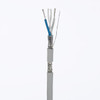
- S/FTP dual-shield construction: aluminum/polyester foil tape plus tinned copper braid shield with dedicated 24/7 AWG tinned copper ground wire—provides 360° EMI/RFI protection in VFD-heavy industrial bays, alongside high-power motor controls, or near RF broadcast equipment
- 18/7 AWG stranded tinned copper conductors with foamed polyethylene insulation—balances flexibility for conduit pulls with low-loss signal integrity and sufficient cross-section for PoDL (Power over Data Line) Class 4–9 applications (up to 50 W at the PSE)
- Plenum-rated (CMP) green PVC jacket with oil/UV/abrasion resistance—approved for air-handling plenums per NFPA 90A, resists hydraulic fluid and coolant exposure in factory floors, and survives outdoor UV exposure in building-to-building aerial runs or rooftop conduit
- Exceeds ANSI/TIA-568.5 (draft) and IEC 61156-13/-14 (draft) performance requirements—forward-compatible with emerging SPE standards for building automation (IEEE 802.3cg-2019), industrial Ethernet (IEEE 802.3bu), and automotive Ethernet (IEEE 802.3bw) physical layers
- 1,000-foot bulk spool in carton-of-6 packaging—supports large-scale industrial retrofits, multi-floor BAS installations, or zone-based sensor networks with minimal splice points and consistent lot-to-lot electrical performance
Why Single Pair Ethernet matters in commercial and industrial integration: Traditional four-pair Ethernet (Cat5e, Cat6, Cat6A) was engineered for office LAN speeds—1 Gbps, 10 Gbps, multi-gigabit—but the vast majority of building automation endpoints (thermostats, VAV controllers, door strikes, PIR sensors, gas detectors) operate at 10–100 Mbps and draw under 15 W. Deploying eight-conductor cable, keystone jacks, and 48-port PoE switches for these sparse endpoints wastes copper, conduit fill, and switch port density. SPE collapses data + power onto one twisted pair, enabling M12 or IP20 connectors smaller than RJ45, reducing cable diameter by 40–60%, and allowing integrators to home-run 200+ sensors per switch using compact SPE-to-Ethernet media converters or native SPE switch ports. For brownfield retrofits where conduit is already maxed out, SPE cable fits alongside existing Cat6 runs without requiring new pathways. For greenfield projects—warehouses, cold storage, clean rooms—SPE dramatically lowers per-drop material and labor cost while future-proofing the physical layer for MQTT-over-IP, BACnet/IP, and OPC-UA edge devices that will dominate the next decade of smart building architecture.
S/FTP shielding and grounding in electrically hostile environments: The SP-SFCS1GR-CEG's dual-layer shield (foil tape bonded to the pair, plus 85% tinned copper braid over the core) creates a Faraday cage around the signal conductors, attenuating external EMI ingress and preventing the cable itself from radiating crosstalk or harmonics back into adjacent circuits. This matters acutely in industrial settings where SPE links run parallel to 480 VAC three-phase feeders, share cable tray with VFD motor leads, or pass within inches of 400 Hz inverter modules in data center UPS rooms. Unshielded SPE cable in these scenarios suffers bit errors, packet loss, or complete link failure when EMI couples onto the differential pair; the aluminum/polyester foil blocks high-frequency hash (>1 MHz), while the braid handles low-frequency magnetic fields and provides a low-impedance path to earth ground via the 24/7 AWG drain wire. Crucially, the drain wire must terminate to earth ground at one end only (typically the switch/PSE end) to avoid ground loops; integrators should bond the braid to the panel's chassis ground stud using a Panduit grounding pigtail or compression lug, ensuring shield continuity without creating a secondary current path. In plenum installations above drop ceilings, the shield also prevents the cable from acting as an antenna for cellular or Wi-Fi interference—critical when SPE links serve IP cameras, access points, or wireless IoT gateways that operate in the 2.4/5 GHz bands.
Conductor construction and PoDL power budget: The 18/7 AWG stranded conductors (18 AWG cross-section, seven-strand lay) offer three advantages over solid-conductor SPE cable. First, stranded construction tolerates repeated flexing during installation—conduit snaking, cable tray bends, strain relief loops—without work-hardening and fracturing the copper, which solid cable is prone to after 5–10 flex cycles. Second, the seven-strand lay reduces skin effect at 10 MHz (the upper frequency bound for 100BASE-T1), lowering insertion loss by 0.3–0.5 dB per 100 meters compared to solid equivalents. Third, 18 AWG provides 6.4 Ω/km DC loop resistance, enabling PoDL Class 6 (30 W) or Class 9 (50 W) delivery at distances up to 200 meters with acceptable voltage drop—compare to 24 AWG SPE cable (26 Ω/km), which can only sustain 15 W beyond 100 meters without undershooting the 40 VDC minimum at the PD. For integrators powering PTZ controllers, electromagnetic locks, or LED strobes over SPE, 18 AWG eliminates the need for mid-span injectors or local 24 VDC supplies. The foamed polyethylene insulation (rather than solid PE) reduces dielectric constant to ~1.6, cutting capacitance to 45 pF/m and keeping return loss above 20 dB across the SPE operating band—essential for 100BASE-T1's ±2 V differential signaling and tight 100 Ω ±10% impedance tolerance.
Jacket performance and NEC/CEC compliance: The green PVC jacket is compounded with plasticizers and stabilizers for three harsh-environment resistances. Oil resistance (per ASTM D471) ensures the jacket won't swell, crack, or delaminate when exposed to hydraulic fluid, cutting oil, or diesel spills common in manufacturing and vehicle maintenance bays—critical because jacket failure exposes the braid to corrosion and the foil to tearing. UV resistance (per ASTM G154) allows outdoor aerial runs between buildings or rooftop HVAC equipment without jacketing degradation; unprotected PVC typically chalks and cracks after 18–24 months of solar exposure, but stabilized formulations extend service life to 10+ years. Abrasion resistance (per ASTM D1242) protects against scraping on cable tray edges, conduit burrs, and vibration wear where SPE cable ties off to motors or actuators—integrators can expect 50,000+ flex cycles at a 25 mm bend radius without jacket breach. The CMP (plenum) flame rating meets NFPA 262 (UL 910) requirements for low smoke, low flame spread in air-handling spaces; CM (communications) and CMR (riser) ratings per NEC Article 800 cover general-purpose horizontal runs and vertical shafts. Note that CMP cable may substitute down for CM/CMR applications but not vice-versa—so this single SKU covers plenum, riser, and general wiring specifications, simplifying BOM management for multi-zone projects where some cable runs through return-air plenums and others through sealed conduit.
Installation best practices and termination hardware: Bulk SPE cable requires field termination to M12 A-coded (2-contact), M8 (2-contact), or proprietary SPE connectors like the Panduit Mini-Com SPE jack. Unlike RJ45 termination, SPE connectors use insulation-displacement or crimp contacts rated for 18 AWG stranded wire—integrators should stock Panduit's SP-series crimp tool and pin kits, which ensure gas-tight crimps without cold-welding the strands. Shield termination is non-negotiable: strip back 50 mm of jacket, fold the braid over a ferrite bead or grounding sleeve, and compress with a cable gland that bonds braid to the panel's grounded backplane. Do not twist the braid into a pigtail and land it under a terminal screw—this creates a high-inductance ground path that defeats shielding above 1 MHz. For long horizontal runs (200+ meters), integrators should pull SPE cable with the same technique as Cat6: use cable lube, limit pull tension to 25 lbf (110 N), maintain minimum bend radius of 4× cable diameter (~25 mm), and avoid stapling or zip-tying over the jacket (use Velcro or cushioned J-hooks). The 1,000-foot spool ships in a carton-of-6, so large projects ordering 6+ cartons receive factory-consistent twist lay and capacitance—important when commissioning SPE links near the 1 km distance limit for 10BASE-T1L, where 5 pF/m variance can mean the difference between clean link-up and intermittent packet loss.
Application scenarios and deployment context: The SP-SFCS1GR-CEG is purpose-built for three classes of installation. Building Automation Systems (BAS): Home-run wiring from VAV controllers, fan coil units, chiller controllers, and lighting panels back to BACnet/IP or Modbus-TCP gateways—SPE replaces MS/TP trunks, reducing protocol translation hops and enabling native IP addressing for every endpoint. A single 48-port SPE switch in the MDF can serve 200+ zones with PoE-powered sensors, cutting switch closet HVAC load by 40% compared to conventional PoE switches (SPE switches dissipate 15–25 W per port vs. 60 W for 802.3bt). Industrial Control Networks: Fieldbus replacement in PLC-to-sensor/actuator runs—SPE supports EtherNet/IP, PROFINET, or EtherCAT at 100 Mbps full-duplex with deterministic latency under 1 ms, meeting IEC 61784 real-time class requirements. The S/FTP shield handles proximity to VFDs, welders, and induction heaters without bit errors, while plenum rating satisfies fire marshal inspections in food processing and pharmaceutical clean rooms. Edge IoT and Smart Infrastructure: Long-reach sensor networks for tank-level monitoring, gas detection, perimeter lighting, and parking guidance—10BASE-T1L PHYs (like the TI DP83TD510E) push 10 Mbps + 15 W PoDL to 1,000 meters, letting integrators deploy IP-native sensors in remote areas (rooftop RTUs, parking structure endpoints, site-perimeter gates) without fiber or mid-span repeaters. The green jacket color-codes SPE infrastructure vs. yellow Cat6 or blue Cat6A, reducing mis-patching risk during MAC work.
This cable ships on 1,000-foot spools with UPC 61305680071, carton quantity 6. Panduit backs the SP-SFCS1GR-CEG with their standard manufacturer warranty; integrators should verify compatibility with their SPE switch or media converter (check for 10BASE-T1L, 100BASE-T1, or MultiGig-SPE PHY support) and confirm that PoDL power class matches the cable's 18 AWG current-carrying capacity. For projects requiring pre-terminated SPE patch cords, custom lengths, or IP67-rated M12 assemblies, consult Panduit's SPE solutions catalog—but for new construction and large retrofits where per-drop cost and future scalability drive the decision, bulk SP-SFCS1GR-CEG cable delivers the shielded, standards-compliant physical layer that purpose-built IP infrastructure depends on.