
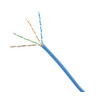
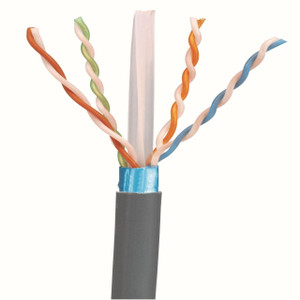
Panduit PFP6C04WH-UG Cat6 F/UTP Plenum Cable 1000ft
Usually Ships in 2-3 Weeks
Free shipping over $499


Manufacturer-verified compatible cameras, recorders, mounts, accessories, and licenses for this product. Adjust quantities and add the entire bundle to your cart in one click.
Questions about this product? Free pre-sales support from a senior specialist — product questions, compatibility checks, BOM quotes, price confirmation — typically answered within one business day. Need camera placement or system design work? Engineering time is $175 per hour (qty 1 = 1 hour). Hardware buyers get up to one hour ($175) credited back on their order.
The Panduit PUP5C04BU-F delivers TIA-568-C.2 compliant Category 5e performance in a CMP-rated plenum construction for air handling spaces. This 1000-foot pull box contains four-pair 24 AWG solid bare copper conductors in an unshielded twisted-pair (U/UTP) configuration, supporting Gigabit Ethernet and Power over Ethernet deployments up to 100 meters. The blue jacket provides visual identification in multi-cable pathways while meeting NFPA 262 low smoke and flame spread requirements for installation above drop ceilings, in HVAC plenums, and other environmental air spaces without additional conduit.
The PUP5C04BU-F is engineered for horizontal cabling applications in commercial buildings, healthcare facilities, education campuses, and datacenter environments where structured cabling must traverse plenum spaces. The CMP jacket compound is formulated to meet strict smoke density and flame propagation limits defined in UL 910 and NFPA 262, ensuring code compliance in jurisdictions requiring plenum-rated cable for above-ceiling distribution. Unlike riser-rated (CMR) or general-purpose (CM) constructions, CMP cable can be installed in environmental air spaces—areas where building HVAC systems use the space above drop ceilings or below raised floors for return air circulation. This eliminates the need for metallic conduit or enclosed raceways, reducing material and labor costs on commercial retrofits where fishing conduit through occupied spaces is impractical.
Each of the four pairs uses 24 AWG solid conductors—the industry standard gauge for permanent links terminated to 110-style punchdown blocks, keystone jacks, and patch panels. Solid conductors offer superior tensile strength during pulls and maintain stable contact pressure at insulation displacement connector (IDC) termination points compared to stranded alternatives, which are reserved for patch cords and jumper applications where flexibility is required. The solid construction also ensures consistent characteristic impedance across the link; stranded conductors introduce impedance variations at the strand-to-strand contact points that can degrade return loss performance at higher frequencies. At 24 AWG, DC loop resistance stays below 28.6 ohms per 100 meters, ensuring IEEE 802.3bt (PoE++) devices drawing up to 71.3W receive adequate power at maximum channel distance when voltage drop across the copper is factored into the power budget.
The unshielded twisted-pair construction balances cost and performance for installations where external electromagnetic interference is minimal or where grounding infrastructure for shielded cable (F/UTP or S/FTP) is unavailable. U/UTP cable relies on differential signaling and balanced pair geometry to reject common-mode noise, making it suitable for typical office environments, retail spaces, and building areas away from high-power electrical equipment or industrial machinery. This cable supports channel lengths up to 100 meters (90-meter permanent link plus 10 meters of patch cords) when installed to TIA-568 standards, with sufficient performance margin to accommodate PoE applications. The 1000-foot pull box format reduces mid-run splices, which introduce insertion loss and potential failure points; sequential footage markings printed on the jacket allow installers to verify remaining cable length and plan pulls across multiple drops without over-ordering or creating excessive scrap.
Panduit's Pan-Net manufacturing process maintains tight tolerances on electrical parameters critical to Category 5e performance. Pair-to-pair capacitance unbalance is controlled within 330 pF per 100 meters, and twist lay variation is minimized to reduce near-end crosstalk (NEXT) and far-end crosstalk (FEXT) in high-density cable bundles. When multiple cables are bundled together in overhead cable trays or plenum pathways, alien crosstalk—interference between pairs in adjacent cables—can degrade link performance below the single-cable test results. Category 5e does not specify alien crosstalk limits (that requirement was introduced with Category 6 and above), but maintaining consistent twist ratios and tight pair geometry ensures this cable performs reliably even in heavily congested pathways typical of multi-tenant office buildings and datacenter horizontal distribution.
For security and surveillance integrators, this cable provides a cost-effective backbone for IP camera networks, access control panels, and intercom systems that rely on Gigabit Ethernet connectivity. Modern IP cameras with 4MP to 8MP sensors and H.265 compression typically require 8-12 Mbps of sustained bandwidth, well within Category 5e's 1000 Mbps capacity even when supporting multiple cameras on a single switch port via aggregation. The real constraint on camera runs is often PoE power delivery rather than bandwidth; at 24 AWG and with proper attention to total cable resistance, this cable supports IEEE 802.3at (PoE+, 25.5W) cameras at the full 100-meter distance, and IEEE 802.3bt Type 3 (PoE++, 51W) cameras when voltage drop is calculated based on actual camera power draw and ambient temperature. Integrators should use the formula: Voltage Drop = (2 × Cable Length × Current × Resistance per unit length) and verify that the voltage at the camera end remains above the device's minimum operating voltage—typically 42.5V for 802.3at and 50V for 802.3bt.
The blue jacket color is a practical differentiator in structured cabling installations where multiple logical networks share the same physical infrastructure. Many integrators adopt color-coding standards to visually separate data networks (blue), voice circuits (gray or white), building automation (orange), and dedicated surveillance VLANs (yellow or red). This practice simplifies troubleshooting, reduces the risk of accidental disconnection during moves/adds/changes, and accelerates MAC work when a technician needs to trace a specific circuit from the patch panel to the drop location. The jacket material is also rated for direct burial in concrete or contact with wet locations, though plenum cable is typically not specified for outdoor use due to UV exposure considerations; for outdoor or direct-burial applications, a CMX or UV-rated OSP (outside plant) construction is more appropriate.
Installation best practices for this cable include maintaining the minimum bend radius of four times the cable diameter (approximately 1 inch for this construction) to avoid kinking the pairs and degrading electrical performance. Maximum pulling tension should not exceed 110 Newtons (25 lbf) to prevent conductor elongation or jacket damage. When terminating to keystone jacks or patch panels, preserve the pair twists as close to the termination point as possible—untwisting more than 0.5 inches can introduce crosstalk and degrade NEXT performance. The cable should be supported at intervals no greater than 5 feet in horizontal pathways and 4 feet in vertical risers, using J-hooks, cable trays, or basket tray that do not compress the cable bundle; over-compression flattens the cable geometry and can shift impedance out of the 100-ohm ± 15-ohm tolerance.
This cable is designed for integrators running structured cabling in retrofit commercial projects, multi-tenant office builds, and institutional facilities where ceiling plenums serve as the primary horizontal pathway. The CMP rating ensures compliance with NFPA 90A (Standard for Installation of Air-Conditioning and Ventilating Systems) and NEC Article 800.113, which mandate plenum-rated communications cable in spaces used for environmental air. Inspectors and authority-having-jurisdiction (AHJ) reviews typically focus on jacket markings; the PUP5C04BU-F is clearly marked with "CMP" and "ETL Verified to TIA-568-C.2 Cat 5e" to facilitate code inspections and final acceptance testing. For projects requiring third-party certification of the installed channel, this cable pairs with any TIA-568 compliant connectivity hardware and can be field-tested using a Category 5e certification test suite per TIA-568-C.2 Annex A.
When evaluating Category 5e versus Category 6 or 6A for new installations, consider the application requirements and future bandwidth needs. Category 5e remains the most cost-effective solution for Gigabit Ethernet and PoE deployments where 100 MHz bandwidth is sufficient and where 10GBASE-T is not anticipated within the cable plant's service life. Category 6 offers 250 MHz bandwidth and supports 10GBASE-T up to 55 meters, while Category 6A extends 10GbE to the full 100-meter channel distance but at significantly higher material and installation costs. For security integrators deploying IP camera networks with current-generation 4K cameras (which rarely exceed 25 Mbps per stream), Category 5e provides a 40:1 bandwidth margin and will remain viable through multiple camera refresh cycles. The decision point typically centers on PoE power requirements—if the installation includes PTZ cameras, high-lumen LED illuminators, or multi-sensor cameras drawing more than 60W, then evaluating Category 6A with its lower DC loop resistance (18.5 ohms per 100m for 23 AWG) may be justified to reduce voltage drop and improve power delivery efficiency.
Pan-Net copper systems from Panduit are backed by a comprehensive applications assurance program when installed as a complete end-to-end system using Panduit cable, connectivity, and patch cords. The program provides up to 25 years of product and application warranty coverage, including support for current and future applications operating within the Category 5e performance envelope. This cable meets or exceeds all TIA-568-C.2 Category 5e requirements for insertion loss (24.0 dB at 100 MHz for 100m), return loss (10.0 dB at 100 MHz), NEXT (30.1 dB at 100 MHz), and propagation delay (5.45 μs per 100m), with manufacturing process controls that ensure batch-to-batch consistency across production runs. Third-party ETL verification provides independent confirmation of compliance, ensuring interoperability with keystone jacks, patch panels, and connectivity hardware from any standards-compliant manufacturer—a critical factor for integrators who may need to match existing infrastructure or client-specified brands during retrofit and expansion projects.

Manufacturer-verified compatible cameras, recorders, mounts, accessories, and licenses for this product. Adjust quantities and add the entire bundle to your cart in one click.

Cat 6 performance in a CMP-rated plenum jacket, engineered for commercial backbone installations where fire-code compliance and Gigabit Ethernet

Category 5e performance in industrial Profinet installations where standard commercial cables fail
1000-foot spool of Category 6A unshielded twisted pair (UTP) bulk copper cable
Looking for more Panduit products? Shop the full Panduit catalog →
Support services and planning resources for commercial surveillance, access control, and infrastructure deployments.
Fixed scope • Fixed price