

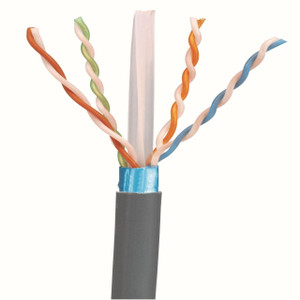
Panduit PFP6C04WH-UG Cat6 F/UTP Plenum Cable 1000ft
Usually Ships in 2-3 Weeks
Free shipping over $499


Manufacturer-verified compatible cameras, recorders, mounts, accessories, and licenses for this product. Adjust quantities and add the entire bundle to your cart in one click.
Questions about this product? Free pre-sales support from a senior specialist — product questions, compatibility checks, BOM quotes, price confirmation — typically answered within one business day. Need camera placement or system design work? Engineering time is $175 per hour (qty 1 = 1 hour). Hardware buyers get up to one hour ($175) credited back on their order.
The Panduit PFP6C04RD-UG is a 1,000 ft reel of TX6™ Category 6 F/UTP plenum-rated copper cable engineered for installations where EMI/RFI immunity and fire-code compliance intersect. Built around 23 AWG solid copper conductors with FEP/polyolefin insulation, a full-length foil shield, and a CMP-rated red jacket, this cable delivers TIA-568.2-D performance in environments where unshielded alternatives fail—think IP camera runs near fluorescent ballasts, PoE access-control readers alongside VFD-driven HVAC, or surveillance infrastructure in industrial facilities where electrical noise is constant. The red jacket simplifies circuit identification during pull and troubleshooting, a practical advantage when security and fire-alarm cabling share the same pathways. Packaged on a reel for long horizontal or backbone runs, the PFP6C04RD-UG pairs with Panduit's F/UTP RJ-45 connectors to maintain end-to-end shielding—critical when you're pushing 60W PoE++ to PTZ cameras or multi-sensor arrays and can't afford frame loss from crosstalk or external interference.
Foil-shielded twisted pair (F/UTP) is the architecture of choice when security integrators face environments that unshielded UTP cannot tolerate. The PFP6C04RD-UG wraps four twisted pairs—each individually insulated with FEP/polyolefin—around a rigid cross-divider (the "X" in TX6), then encases the bundle in a continuous aluminum-polyester foil shield bonded to a drain wire. That shield intercepts electromagnetic interference before it couples into the signal conductors, a non-negotiable advantage in facilities with variable-frequency drives, arc welders, or dense fluorescent/LED lighting. Unshielded Cat 6 in these spaces often shows intermittent link errors, especially under high PoE load when conductor heating increases susceptibility to crosstalk. The foil also provides a low-impedance ground path that stabilizes common-mode noise, which matters when you're daisy-chaining PoE switches and need consistent power delivery to endpoints 80+ meters away. The drain wire terminates at both ends through Panduit's shielded RJ-45 plugs (MP588 series or similar), creating a continuous shield bond to the switch chassis—break that bond with a mix of shielded cable and unshielded connectors, and you've just built an antenna. The 23 AWG conductor gauge keeps DC loop resistance below 28.6 ohms per 100 meters, which translates to roughly 6.2 ohms over a 90-meter permanent link. For a 60W PoE++ load (802.3bt Type 3) at 50V, that's 1.2A per pair, or ~7.4W dissipated in the cable—well within the thermal budget, but only if you start with 23 AWG. Drop to 24 AWG and resistance climbs 25%, pushing dissipation into the range where bundled cables derate and voltage drop threatens camera reboot loops. The FEP insulation (fluorinated ethylene propylene) maintains dielectric stability across temperature extremes, so return loss and insertion loss stay consistent whether the plenum space is 50°F in winter or 130°F in summer. The cross-divider physically separates pairs, increasing NEXT margin by ~3 dB compared to non-divided Cat 6—that margin is the difference between a link that passes fluke certification at 250 MHz and one that fails on NEXT at tap 4-5. When you're pulling 400 ft of cable through a congested plenum with three 90° bends, that divider also prevents pair deformation, which would otherwise create impedance discontinuities (return loss failures) at stress points.
The red CMP jacket serves two roles: regulatory compliance and operational visibility. CMP (Communications Plenum) is the NEC Article 770 designation for cables installed in environmental air spaces without conduit—these are spaces where building codes assume a fire could spread rapidly via airflow, so the jacket must meet UL 910's 5-foot flame-spread limit and generate minimal smoke. The PFP6C04RD-UG's low-smoke PVC formulation passes that test, making it legal for above-ceiling runs in commercial buildings, schools, hospitals, and government facilities. That alone opens installation options: you can route horizontally from IDF to camera drop without EMT, saving 40–60% on labor compared to conduit pulls, and without the derate penalties of riser-rated (CMR) cable in plenums. The red color is the operational win. Security and fire-alarm circuits are often required to be visually distinct from IT data drops—some AHJs mandate red or orange for anything that might be on emergency power or tied to life-safety systems. Even when it's not code, it's practical: a ceiling full of blue and gray cables looks identical during troubleshooting, but a red run stands out immediately, cutting diagnostic time when a camera goes dark or an access panel drops offline. That visibility also helps during design validation—when the fire-alarm contractor is tracing their initiating circuits and you're verifying surveillance home-runs, color-coding prevents the "Is this ours?" confusion that burns hours on large sites. The 1,000 ft reel is sized for typical horizontal runs in commercial construction. TIA-568 allows 90 meters (~295 ft) of permanent link plus 10 meters of patch cords, so a single reel covers three full-length runs with minimal waste, or five to seven shorter drops in dense IDF layouts. Reel packaging also protects the cable during storage and pull—no risk of kinks or jacket damage from boxed coils, and the reel flange lets you mount it on a cable caddy for smooth payout under tension, which matters when you're snaking through J-hooks in a plenum where you can't see the cable path.
Compliance starts with TIA-568.2-D Category 6, which defines transmission performance to 250 MHz (insertion loss, NEXT, return loss, PSANEXT, PSAACRF), but the TX6 cable is tested to 500 MHz to ensure margin. That margin is why the PFP6C04RD-UG supports 10GBASE-T to 55 meters—officially Cat 6A's job, but achievable on high-quality Cat 6 over shorter distances, useful for inter-switch links in an IDF or between an NVR and a PoE switch when you need to backhaul 8+ cameras without a fiber uplink. The cable is also ETL Listed (Intertek), meaning a third-party lab verified both performance and flame rating—critical for AHJ inspections where the inspector will check for ETL or UL marks on the jacket. RoHS compliance is increasingly non-optional for government projects (GSA schedules, state and local procurement) and required by law in California and several other states. The F/UTP architecture, combined with Panduit's shielded connector ecosystem, makes this the go-to choice when the project spec calls out "shielded end-to-end"—a requirement that's now common on DoD, airport authority, and critical-infrastructure projects where EMI immunity is a security control, not just a performance optimization. For security integrators managing multi-building campuses with long pull distances, high PoE loads, and mixed electrical environments, the PFP6C04RD-UG delivers the combination of shield performance, plenum compliance, conductor gauge, and jacket visibility that turns a spec-sheet checkbox into a reliable, inspector-approved, long-term installation.

Manufacturer-verified compatible cameras, recorders, mounts, accessories, and licenses for this product. Adjust quantities and add the entire bundle to your cart in one click.
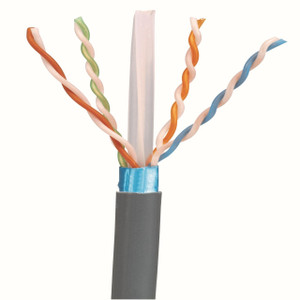

1000-foot spool of TX6™ Cat 6 F/UTP (Foiled/Unshielded Twisted Pair) plenum-rated bulk copper cable
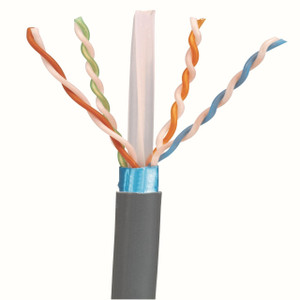
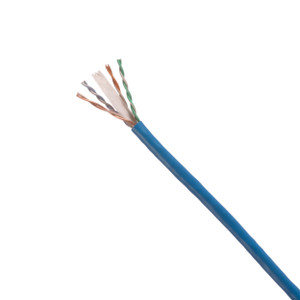
1000-foot Cat 6 UTP plenum-rated cable in orange, designed for commercial structured cabling installations where fire-safety compliance and circuit
Looking for more Panduit products? Shop the full Panduit catalog →
Support services and planning resources for commercial surveillance, access control, and infrastructure deployments.
Fixed scope • Fixed price